Feb 022015
 

WittgensteinandMusilRobert Musil (1880-1942) was an Austrian novelist, philosopher, student of mathematics, physics, behavioral psychology and engineering with mystical tendencies, and the author of the great unfinished experimental novel, The Man without Qualities. Ludwig Wittgenstein (1889-1951) was an Austrian philosopher whose thoughts on logic, mathematics, language and ethics have been extremely influential in both philosophical and artistic circles. He is the author of the Tractatus Logico-Philosophicus (1921) and many unfinished works, including Philosophical Investigations.

Disclaimers: 1. I do not pretend to be an expert on Wittgenstein. These, my observations, come from a mere few years of study of a philosopher who deemed that even his closest peers did not understand him. By comparing my interpretation of his ideas to those of Robert Musil, I am merely suggesting connecting strands, and possible shared concerns, and generally avoiding here (in the interest of space and time) the very real and complex differences between their world views. 2. Since I have spent decades studying and writing about Musil, I have concentrated mostly on Wittgenstein in this essay, assuming a general knowledge of Musil which is probably quixotic at this point in his ill-fated English-language reception. Hopefully the hints and references to his ideas and works will lead the reader back to the primary sources and also to my more thorough treatment of things Musil in my book, The World as Metaphor in Robert Musil’s &c.,&c. . 3. This essay could only be “completed” if I allowed it to be just that—an essay, or “essai,” a trial, and not at all a finished work of writing. It is an attempt to pull together many, many related but still insufficiently synthesized ideas. It will take a lifetime to get all of this into some truly presentable shape.

— Genese Grill

.


“Necessity is nothing but Existence, which is given through the Possibility itself.” — Immanuel Kant,
The Critique of Pure Reason

“It is reality that awakens possibilities, and nothing would be more perverse than to deny it. Even so, it will always be the same possibilities, in sum or on the average, that go on repeating themselves until a man comes along who does not value the actuality above the idea. It is he who first gives the new possibilities their meaning, their direction, and he awakens them.” — Robert Musil, The Man Without Qualities

“It is clear that however different from the real one an imagined world may be, it must have something—a form—in common with the real world.” — Ludwig Wittgenstein, Tractatus Logico-Philosophicus

“Thought is surrounded by a halo—Its essence, logic, represents an order, in fact the a priori order of the world: that is, the order of possibilities, which must be common to both world and thought…prior to all experience [this order] must run through all experience; no empirical cloudiness or uncertainty can be allowed to effect it—it must rather be of the purest crystal…” — Ludwig Wittgenstein, Philosophical Investigations

One of the most troubling challenges of living in what is nowadays assumed to be a relativized subjective universe is never knowing for sure whether what one sees, understands, or experiences is the same as what someone else sees, understands or experiences. What once was conceived to be solid shared reality, describable with definable words and measurable by standardized tools, has, since Kant (and, over the next century, in the wake of Einstein, Darwin, Nietzsche, and Freud), been deemed increasingly fragmented, uncertain, and relative. After philosophers spent centuries wrestling with the question of what could be known about the world and the related question of what, in fact, reality is, with or without the intervention of the subjective experiencer, the so-called “linguistic turn” in twentieth century philosophy took this question a step further by concentrating on the role played by language in describing, creating, delimiting, or expanding our experience and knowledge of the real. Modernist art and literature wrestled with these problems of knowing and communicating and earnestly strove to find ways to build bridges between the individual alienated person and the shared world of nature and culture. To put it simply, Kant was looking at the limits of thought; Wittgenstein at the limits of language. But both were concerned with the way philosophy had hitherto claimed to know or say certain things (of a metaphysical sort) that in their opinion could not be known or spoken of with certainty. Despite these reservations about the possibility of knowing or speaking certain things, neither Kant nor Wittgenstein rejected the realms of ethics or metaphysics as valuable aspects of experience.[1] And Musil made it even more clear than Kant and Wittgenstein (through his experimental fiction; through showing, not theorizing or merely saying) that aesthetics was the realm wherein one could begin to know, experience, and articulate those things which could not be grasped otherwise. He called this realm the realm of essay, of the ethical, of the aesthetic, of the other condition, and, despite his training as a mathematician and scientist, despite his tendency toward philosophical precision, he valued this realm above all others, choosing to write a novel rather than a scientific treatise for reasons with which Wittgenstein would probably have concurred. But the philosophical question of what could or could not be known of the shared world of phenomenon, and, thus, expressed in language (what kind of language became a heated question in Modernist poetics) haunted writers in the early twentieth century.[2]

Another philosophical conundrum discussed by Kant and then revisited by Modernist thinkers was the related question of ethics and the nature of the willing, determining self. For Kantians, as Anthony J. Volpa notes in his biography of Fichte, “At issue was whether selfhood as autonomous agency was an illusion and indeed whether the very notion of an integral self dissolved if the individual was merely one more object in a web of causes” (46). A hundred years later neo-empiricists like Ernst Mach (whom Musil critiqued and praised in his doctoral dissertation) were definitively denying the nature of the integral self and casting doubt on the individual’s ability to determine his or her shared reality—for quite other reasons and with quite other consequences than earlier thinkers. While in Kant’s time the debate was one between a divine determinism and the free will of the ethical individual, in contemporary philosophy the debate is between a random chaos or a mechanistic universe and a treacherous social construction wherein the individual plays no meaningful role. What exercised Musil and Wittgenstein was the quest for some direction for individual ethical behavior; and the search for some conduit to meaning amid the increasing fragmentation and uncertainty. In contrast to the abstract philosophizing of many logicians, Musil and Wittgenstein were, like the transcendentalists before them and the existentialists to follow, engaged in exploring philosophical questions that could help human beings figure out how to live.
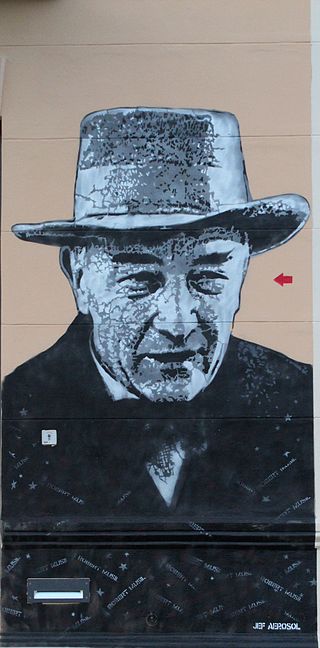
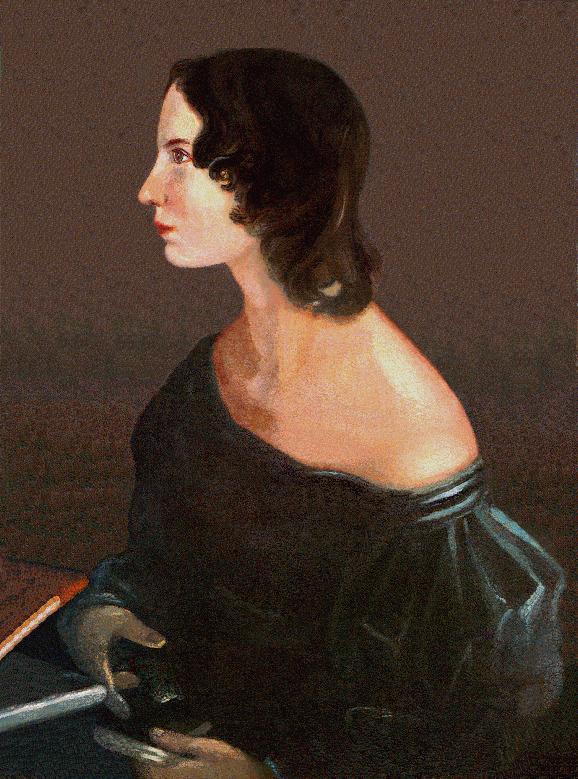
320px-Klagenfurt_-_Musilhaus_-_Robert_MusilDepiction of Musil at the Musilhaus in Klagenfurt

According to Allen Tiher, in his Understanding Robert Musil, “Musil saw no place for human concerns in Mach’s limited positivism…in critiquing Mach he was already thinking of science’s uses for humanity…[Musil was] troubled by Mach’s idea of truths as mere fictions…” (34). Tiher goes on to say that Musil’s critique of Mach in many ways works as a critique of Wittgenstein’s belief that language could only depict the substance (not the core) of reality (“propositions mirror the exact part of facts, though nobody could ever point to exactly what they might be…all that can be meaningfully said is what can be mirrored in propositions in language”) (Tiher 42). Musil wanted to at least consider the possibility of knowing the thing in itself, whereas Wittgenstein may have been more skeptical about such certainty. Yet Tiher also points to commonalities between Musil and Wittgenstein, noting that both “yearned for a reality beyond the limits of positivist propositions and functional relations” (42). Both Wittgenstein and Musil “reacted to Mach’s limitation of knowledge to the realm of functional relations” (42). Wittgenstein wrote in the Tractatus, 6.52 “We feel that even if all possible scientific questions have been answered, the problems of life have still not been touched at all”. Tiher concluded that “Both conceive of aesthetics as a ‘showing’ of ethics, and of ethics as the realm where values are as real as any other aspect of reality” (43).

Early twentieth century Machian positivism inspired a new set of concerns for contemporary artists, writers, and philosophers, who were struggling with what they called a crisis of language (like the Kantkrise of an earlier generation of artists) amid a greater crisis of values. Did the breakdown of some certainties mean that anything was possible? Or rather nothing? Or were there natural parameters or boundaries, some sort of a priori order to things?[3] In the wake begun so long ago, today many heirs of two generations of skeptical inquiry err on the side of a radical openness and relativity of values to which Kant, Wittgenstein, and Musil would not have subscribed.

Many 20th century thinkers and artists, following the spirit if not the law of Kant’s ethical aesthetic imperative, believed earnestly in the possibility of redemption through art and an ethical conduct of life born of the friction between experimental empirical assessment and some sense of essential but shifting truths, between personal and shared reality, between repeating patterns and new arrangements, and between established archetypes or forms and new metaphors and synthesis—in short, in a kind of proto-aesthetic existentialism, whereby the artist and thinker expands the possibilities of the real (through seeing for the first time what was always there)without denying reality’s concrete parameters. These thinkers and artists were dealing with a struggle between necessity and arbitrariness, a priori truth and creative agency, asking such question as: What do we have agency over, what not? And how do language and art function in this interchange between what is necessary and what is possible or even merely constructed? How does the word or image “make” the world (as Musil and Wittgenstein suggest repeatedly), how does language respond to the world, answer the world? Is it like a call and response? A mirror, a warp, a description or re-creation? A betrayal, a social construction, a deception? Are certain facets of reality best described by showing, not naming, as Wittgenstein suggested and Musil modelled? Or is it impossible to know, and then impossible to describe or communicate at all?

While it has been the fashion for the last half century at least among sophisticated theorists and artists to maintain that nothing whatsoever can be determined, communicated, named, or delimited, past masters of precision and soul were capable of carefully examining what in fact still remained in the shared universe that could be established to be repeatable, certain enough, objectively measurable, and to what extent language could in fact be used to communicate not only what was solid, but even those more tenuous shifting internal subjective states that made up so much of the content of the art and literature of the psychologizing 20th century. The distinction between a world where nothing at all can be determined and one in which only certain things can be has been too often slurred over. The difference between a world wherein language means nothing and one in which language can approximate and approach meaning is considerable; and it takes patience and daring to dwell in this uneasy borderland, exemplified by Robert Musil and Ludwig Wittgenstein.
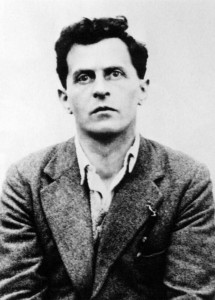
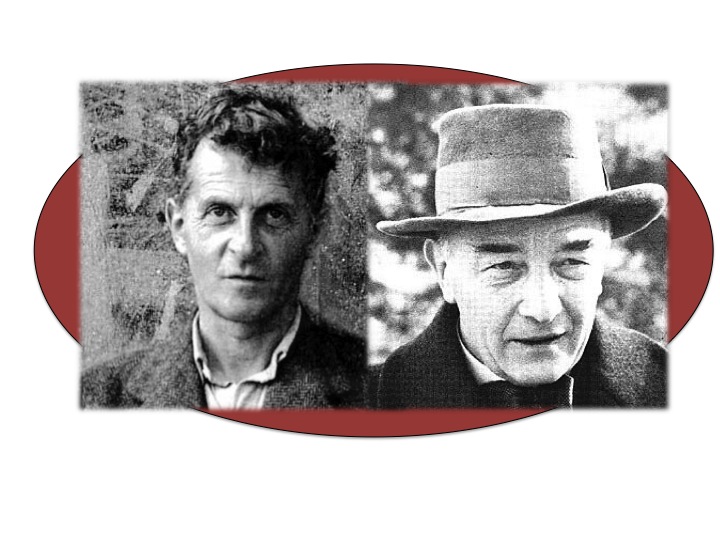
ludwig-wittgenstein-nacido-en-viena-austria-1889-fallecido-en-cambridge-reino-unido-1951-125700_w1000Ludwig Wittgenstein

These two thinkers lived almost side-by-side on Rasmofskygasse in Vienna for about a year sometime between 1920 and 1921, possibly without ever making each other’s acquaintance. They were both snobs who craved discourse; both were scientists who had more faith in art than in philosophical logic; both were individualists who were suspicious of collectivism and resisted joining groups or being categorized into positions or ideologies[4]. They both rejected externally-imposed morals and social judgments in favor of a personal rigorous ethics and conduct of life. They both had ambivalent relationships with the scientific positivists of the Vienna Circle. In contrast to the members of this circle, both wanted to connect philosophy and science with aesthetics and ethics and make it meaningful for human life[5]. Both resisted theory in favor of experimental empiricism. Both had mystical experiences as soldiers in World War One, leading to puzzling relationships with something they both sometimes called “God”; both were mathematicians suspicious of mathematics; both were engineers and inventors; empiricists and idealists; pragmatists and utopians. Both looked to anthropology to present alternative possible ways to live; both loved Dostoevsky; both worked and wrote in a non-linear,[6] inter-disciplinary fashion; both liked to go to the movies. Both of them were obsessed with using language precisely; but both rejected language skepticism, while acknowledging the limits of language and knowledge; and both saw metaphor as the best possible mode of expressing certain experiences and truths. Both were so committed to the experimental method and a resistance to closure or final solutions that they were almost pathologically unable to finish their works. They are exemplars of a special breed of idealist-realists—a group of people who throughout history have simultaneously hugged the surface of the real “what is” while reaching for the ideal “what could be”; thinkers who have labored to establish what can and cannot be known or spoken, thinkers who have eschewed what Musil called “Schleudermystik” (wishy-washy mysticism) and Wittgenstein called “transcendental twaddle,” and, at the same time, kept at bay a nihilistic relativism or void of all values. (Other thinkers in this cadre include Thoreau, Blake, Novalis, and Nietzsche).
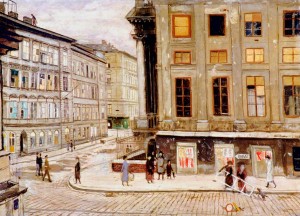
(c) Bridgeman; Supplied by The Public Catalogue FoundationThe Rasumovsky Palace, Vienna, Corner of Rasumofskygasse and Geusaugasse, by Carel Victor Morlais Weight

To harbor some belief in a repeatable recognizable shared reality and a language that serves well enough to communicate what we think, want, and care about is to fundamentally take responsibility for our place and agency in the world. The opposite tends toward an adolescent “whateverism” wherein everything cancels itself out and wallows in bankrupt cynicism. In contrast to this hollow sophistication, Wittgenstein and Musil are related to the transcendentalist age of self-improvement and both earnestly struggled with determining what was the right way to live. Their “sense of possibility” (Musil’s phrase) and skepticism about social conventions and abstract propositions about right and wrong was not the same as absolute license, total openness, or self-indulgence. Looking back to Wittgenstein and Musil, we find an alternative to the total relativity of values and vacuum of meaning—a veritable model of existential responsibility and an ethics grounded in a complex analysis of what can and cannot be known, expressed, or experienced—an ethics, in short, grounded in aesthetics. Ironically, the refusal to accept any shared reality today in some philosophical circles has led to a situation similar to the age of faith. While in the latter the realm of truth was found in scripture or metaphysics, in both cases truth is not recognized in the real exigencies or material experience of life. In both cases truth is an abstraction, although in one this abstraction is to be mistrusted while in the other it is to be uncritically believed. High Modernism marked out a middle zone between skepticism and non-critical acceptance of abstract generalities and ideals. This middle zone is difficult to navigate, but it is imperative that we abide here in uncertainty to catch the shirt tails of agency as reality flies past our subjective indifferent gaze.

We have come so far from that comfortable pre-Kantian world of shared beliefs, and we have heard so much skepticism about shared reality that we have almost become blind to the palpable real that is right in front of us, to the facts of our shared existence—birth, death, seasons, dusk, bodies, beauty, the night sky. Many contemporary theorists would have us scoff at the possibility of experiencing anything real at all, or at the possibility of using words to describe what we feel or see. But they must be blind themselves, and lacking fundamental sense organs, to arrive at such a bankrupt state of existence wherein nothing at all is real and no combination of words can resonate with an external or internal event. I have a young friend, so steeped in the allurements of this “philosophy” (it should be called love of no-truth, not love of truth, since, according to its basic tenets there is no truth to love) that he feels the need to create a new mythology, a trumped-up mythological meaning, since there is, he fears, no real one anymore. But wait! There is still meaning, there is still a real world, and words can still be used to celebrate and lament it! And this meaning will come from our sensual, aesthetic, experiential contact with the real, mediated through the mind, the senses, language, and images, the only tools that we have. Herein we may have some glimpse of the meaning behind the pronouncement (which we find in both Musil and Wittgenstein) that “ethics and aesthetics are one”. For aesthetics does not merely connote fantasy and fiction but sense experience, a living palpable conduit between the abstracted mind or pen and the real breathing, smelling, scintillating, churning world. How we see and experience and the way in which we formulate what we see and experience depends on sensations, formal arrangements, and the process and poetics of space, time, and shifting perspectives. And these perceptions determine our actions and judgments about how to live.

Wittgenstein is thought to have changed his ideas on the relationship between language and reality in between his writing of the Tractatus and the Philosophical Investigations, maintaining later that language is not necessarily a picture of the world, but, rather, that language determines what we see and, in effect, makes our world. But neither position is based on a radical separation between the mind as language-maker and the reality that it attempts to describe. Instead, it is a matter of interpreting, and expanding or limiting (waxing and waning, to use Wittgenstein’s terminology), our perspectives. According to David Pears, Wittgenstein, “abandoned the idea that the structure of reality determines the structure of language, and suggested that it is really the other way around: our language determines our view of reality, because we see things through it” (13). As my friend Dharman Rice put it, Kant’s theories suggest that the mind is not a camera simply recording what is out there, but rather has something to do with choosing, selecting, and arranging the phenomena it encounters. According to Kant, phenomena are transmitted or filtered through transcendental schema or structures of the mind (space, time, etc.); according to Wittgenstein, this arranging occurs through the process of language use. I scoured Kant in vain to find an answer to the question of whether this means that what the mind sees is an illusion, I could find no definitive answer (probably because it is the wrong question. Kant is not concerned with what is or is not there, but rather to what extent we can determine it). It seems to me that he does not assume that the filtered view is false. It is merely filtered. The same seems to be true for Wittgenstein. What changes in between the Tractatus and The Philosophical Investigations then is not Wittgenstein’s conclusion about a priori reality, but his process of arriving at a conclusion at all. In fact, one could say that there are really no conclusions, only a process. While in the Tractatus he relied heavily on what he came to see as a priori givens or logical abstractions, in the Investigations he is modelling a process of experimental empiricism, a method quite close to Musil’s aesthetic of experimental essayism, one which resists theory and final conclusions in favor of what Musil would call “partial solutions” or the “utopia of the next step”.

According to Ashok Vohra in his Wittgenstein’s Philosophy of Mind, this process is not a refutation of realist philosophy, although a realist might consider it to be. Wittgenstein,

[M]aintains that acceptance of any proof is an act of ratification which is independent of any previous acts of ratification. Nothing that we have done in the past forces us to ratify, or to withhold ratification from the proof which we are now being offered. This sounds absurd, because we naturally assume that the meanings of the terms used in the proof of the would-be theorem or equation must have been fixed in advance. But what Wittgenstein is suggesting is that their meanings were not completely fixed in advance, and that their full meanings accrue to them bit by bit when the later ratifications are made or withheld. (136)

In other words, the human mind continually participates in making and acknowledging a shifting changing world. This is an alternative to the chicken and egg question of whether the mind makes the world or the world the mind. The answer to the riddle is that the mind and the world constantly work together to fashion a meaningful approximation of reality. Further, of course, the mind is a part of the world, a part of nature, and thus should not be so very different from what it sees and records as to prohibit correspondence!
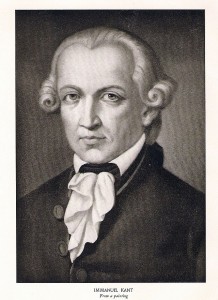
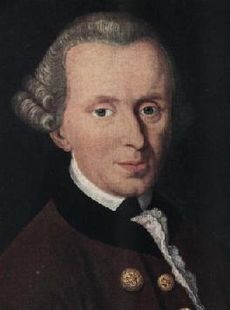
Immanuel_Kant_3Immanuel Kant

C. N. Wilson explains in his book, God’s Funeral, that Kant “was trying to marry the twin truths: namely, that by the very process of perceiving and knowing, we invent our world; and also that this world has a reality of its own.” In a note, Musil summarizes the paradox: “Kant: Concepts without observation are empty. Observation without concepts is blind” (Mann ohne Eigenschaften, 1820). In another formulation he explores the question of how the phenomenological world interacts with the human mind: “In truth, the relationship between the outer and the inner world is not that of a stamp that presses into a receptive material, but that of an embosser that deforms itself in the process so that its design can be changed into remarkably different pictures without destroying its general coherence” (Mann ohne Eigenschaften, 1435). In a conversation about ideality and reality with some high school students from The Walden Project here in Vermont, two of them came up with a marvelously helpful image: the ideal is like a light shining on the real, but it has to be plugged in to the real to shed light in the first place. The real, without imagination, ideas, dreams, or light, is nothing but a mechanical mass; the ideal, without the real, would have nothing to shine on.

In answering the related questions of what is determined and what determinable, or what is essence and what existence, what transcendental and what existential, or how much do our perceptions contribute to shared reality (beyond doubts about knowing the thing in itself), both Musil and Wittgenstein were pragmatists of sorts, who believed that we know the world well enough to avoid burns, bumping into tables, walking into walls, and well enough to understand basically the words others use. They also, as scientists, must have seen that the mind was not separate from Nature in some Cartesian sense and that such a natural structure or lens would probably see in a fashion more or less consistent with the reality of nature. As David Pears writes, describing Wittgenstein’s general perspective, “When the field [of observation] is extended to the limit, there does not seem to be any possibility of discovering that thought and reality might fail to fit one another[…]. [T]he fact is that in certain general ways thought and reality must fit one another”.[7]

Prop 5.6—5.641 of Wittgenstein’s Tractatus states: “The world is my world’, ‘I am my world. (The microcosm)” and “The subject does not belong to the world; rather it is the limit of the world’. But this need not contradict his emphasis on what Thoreau would call “fronting the real”. This is, in effect, the same paradox of Emersonian Self-reliance and the Kantian categorical Imperative and its subsequent iteration in existentialism: what is true for me is true for all men; what I do determines what others do; existence precedes essence. Our actions change the world; our perceptions expand and contract it; reality waxes and wanes depending upon the words we use to describe it; but that doesn’t mean that we change the basic coordinates of nature. Proposition 3.032 states: “One can depict something that contradicts logic in language just as little as one can present a figure in geometry whose coordinates contradict the laws of space; or give the coordinates of a point that does not exist.” And, again, in proposition 3.033, we read: “One used to say that God could create anything except something that contradicted logical laws— in other words, we couldn’t say what an illogical world would look like.” And yet, certain strictures, like grammar and some mathematical rules, are arbitrarily limiting. And there are socially-constructed morals and prejudgments that inhibit a fresh experience of the real. These must be resisted and continually tested. Musil wrote: “The period and the semicolon are symptoms of stasis. We don’t make them because we learned to, but because that is how we think. And that is the danger in them. As long as one thinks in sentences with end stops, certain things cannot be said; at most they can be vaguely felt. Infinite perspectives (moving inward) would have to be expressed like infinite rows” (Notebooks II, 822). As such, the way we use language to talk about our world can limit or open up what possibilities we see in it.

Perhaps the answer to the alleged problem (Wittgenstein would probably say that there is not even a problem to begin with!) is that knowledge of reality does not comes solely from empirical experience (as opposed to a priori essence), but that it comes from a process of synthesis and the constant creation of fresh, repeating—not rigid and unexamined—metaphor. A metaphor which, chez Wittgenstein, always points outside itself by virtue of its very nature as metaphor. Both Wittgenstein and Musil repeatedly make the distinction between living language and dead cliché, and this distinction is linked to their common cause of experimental empirical ontology and the processes called, respectively, the utopia of the next step (Musil) and re-ratification (Wittgenstein), whereby nothing is certain until one takes into consideration what comes next, or, until one re-tests it within new circumstances. Musil writes: “Living word full of meaning and correspondence in the moment, bathed in will and feeling. An hour later it says nothing although it says everything that a concept contains.” And Wittgenstein writes in his Philosophical Investigation, “Every sign by itself seems dead. What gives it life?–In use it is alive. Is life breathed into there?—Or is the use its life?” (432e).

Instead of adhering to one polarization of the empiricist/Platonist spectrum, Wittgenstein (like Musil and Nietzsche too) posits another kind of process of world-making (one that acknowledges a reality outside of abstraction, language, and theory), one which involves a conscious awareness of our use of language and image to create a good deal of what we consider reality and truth. The trick, as Nietzsche explains in his “On Truth and Lying in a Supra-Moral Sense,” is to never forget that the metaphors which we invent to describe and see the world are not rigid absolutes in themselves, but rather living, self-generating, shifting approximations or, to use Wittgenstein’s term, “family resemblances” rather than exact representations— likenesses, overlapping commonalities.

Although there are multifold possibilities of how language may be used to describe reality, there are not infinite possibilities. There are limits; and these limits are the limits of logic, reality, nature, experience and shared human and social life. And these limits have very important consequences in Musil’s and Wittgenstein’s world views for determining a conduct of life. In fact, both of these individualistic—one might even say anti-social—thinkers, were deeply concerned with questions of society and the problem of solipsism. Wittgenstein’s rejection of the idea of a private language is one answer to the Modernist question of artistic solipsism, and touches on a central problem never solved by Musil: how might the mystical experience of “the other condition” depicted in his unfinished novel expand from the private specialized realm of two people to become a social utopia for the many? And how do his insane characters (Clarisse and Moosbrugger) serve to both destroy and invigorate common language with their private idiolects (Clarisse, in one very Wittgensteinian scene in the Nachlass chapters of the novel, tries to remove the meanings from words by taking them out of their natural order, by repeating them, by underlining them). One of Wittgenstein’s answers to the problem of solipsism is his conclusion that, as Vohra writes, “the real relationship between words and physical phenomena is not contingent but essential, and that language is not the product of one person, but has evolved with human life” (6). Although we do have private (i.e., nontransferable) sensations, they are stimulated by public, shared phenomena (the objects of observation) (Vohra 16-17). The necessity of communicating with others is served by a union of aesthetics and ethics, requiring an awareness of reality taking the special case into consideration rather than an abstract impersonal morality. Individual responsibility is born in each new moment— in concert with others. As opposed to an alienated despair or nihilism about the ability to ever share values, ideas, goals with others, Kantian, Wittgensteinian, Musilian individualism breeds ethical consciousness when it includes other-directed awareness. Anti-individualistic collectivism, on the other hand, can be the seedbed of a lack of self-responsibility. In the Philosophical Investigations, Wittgenstein suggests that the problem with the idea of private language is its lack of practical social consequences. A private language is like one’s right hand giving one’s left hand money (80) or the absurdity of a person giving “himself a private definition of a word” (80). What would understanding be, what consistency? It would be, Wittgenstein writes, like “… a wheel that can be turned though nothing else moves with it, is not part of the mechanism” (81). “Imagine,” he continues,” someone saying: ‘But I know how tall I am!’ and laying his hand on top of his head to prove it” (82).

There is a real world outside of or in correspondence with the mind, and its parameters do limit and guide what can and cannot be correctly said. Wittgenstein “holds the view that one who attempts to use a private language not only fails to communicate his meaning to others, but also does not have a meaning to communicate even to himself; in other words, he does not succeed in saying anything at all” (Vohra 38). Sensations, while they can be kept private, are communicable (Vohra 52). A private language is category mistake, according to Wittgenstein, that ignores the social nature of language. Language is a set of activities, and practices, defined by certain rules, and uses, “a form of life” (Vohra 66). As such, the individual has a social and ethical responsibility to use language in a way that corresponds to a shared social reality. While today some theorists might see this as a treacherous crime, or a sort of social coercion applied to the idiosyncratic non-contingent mind, Wittgenstein and Musil probably saw it as a pragmatic and workable means to attempt to communicate ideas and feelings. People who imagine Wittgenstein as the patron saint of silence and the impossibility of communication may be surprised to read this rather characteristic statement from the Philosophical Investigations: “The sign post is in order—if, under normal circumstances, it fulfils its purpose” (35 e). Inexact, he suggests, does not mean unusable.

And while Musil too (following Nietzsche’s metaphor theory in On Truth and Lying) is clear about the fact that metaphors are inexact, that, in fact, every time we make a metaphor we are perpetrating a sort of crime against the true differentiation of each entity or idea, he is equally clear that this process of inexactitude and imprecision is just what humans must do in order to bring “beauty and excitement” into the world. Making metaphors is a form of human-generated, reality-generated meaning-making which continually resists ossification, cliché, and fixed ideas. It is an ethical and aesthetic process of existential engagement in expanding (without denying) the boundaries of the real, of nature, of truths in their varied, shifting relativity. And this expansion of boundaries—what Wittgenstein called waxing—works in tension with the constriction of the already known and accepted, the already established conventions (a waning), as well as with the eternally reverberating archetypal and naturally recurring realities of shared human life (trembling aliveness of ancient energies). In the Tractatus, Wittgenstein writes: “6.43 If good or bad willing changes the world, it can only change the limits of the world, not the facts; not the things that can be expressed in language…. In brief, the world must thereby become quite another. It must so to speak wax or wane as a whole.”

All philosophical theories are rooted in pictures (metaphors); and every already-known picture must be continually uprooted by the introduction of a new picture, a new metaphor: once a simile or metaphor has been accepted, it is too often taken for granted, no longer seen as a picture but taken as a reality or an exact representation. The creation of new metaphors is necessary not only for the successful creation of new meaningful art objects, but, moreover, for the enlivening and generation of ethical life through living language and living forms. Wittgenstein writes: “The means whereby to identify dead forms is Mathematical Law. The means whereby to understand living forms is analogy” (qtd. in Monk, 302). Monk glosses: “In understanding ethics, aesthetics, religion, mathematics and philosophy, theories were of no use” (304). In lieu of theories then: art, the realm of the individual case.

Each poetic pronouncement or artistic expression is at once a free act, individual voice, new note, an addition to and a conversation with, response to, answer to what has already been. And it can only be understood within such a linked context of history, cultural discourse, and shared experience of the world and its cultural products. Rampant skepticism, anti-intellectualism, and obfuscation lead only to careless, speechless, inarticulate grunts and irresponsible confused beings. Art, again, is often the best medium for communicating what cannot be shared otherwise and it models a process of generative re-visioning and a creative tension between what is and what can be, between the abstracted whole and the individual unique non-repeatable experience. Wittgenstein writes: “We speak of understanding a sentence in the sense in which it can be replaced by another which says the same; but also in the sense in which it cannot be replaced by another. (Any more than one musical theme can be replaced by another.) In one case the thought in the sentence is something that is expressed only by the words in these positions. (Understanding a poem.)” The use of poetic language, the ongoing conversation of form and image is a fruitful correspondence between particular individualized once-in-a-world empirical experience and a store of family resemblances, likenesses, and shared cultural and natural reverberations.

While sometimes the most valuable aspects of these human experiences (shared or alienating as the case may be) cannot be easily imparted, what can be shown but not said (in art rather than logic) is nevertheless sometimes stammered (one tries to say it, denotes it, suggests it, points to it) before it disappears. As Kafka wrote, “Truth is the light on the shrinking grimacing face”. We try to bring the wordless phantoms up from the depths or catch the rush of a flying experience of nature with words that are all too clunky, all too general. But they serve. They have to serve. And sometimes they serve brilliantly.

Wittgenstein apparently saw himself as “a disciple of Freud because of Freud’s use of similes: ‘It’s all excellent similes’, he said in a lecture on Freud’s work; and of his own contribution to philosophy: ‘What I invent are new similes’” (Monk 357). And Wittgenstein’s late philosophical technique even seems a bit like the technique of modernist fiction. The playing of “language games,” according to Monk, was a “method of inventing imaginary situations in which language is used for some tightly defined practical purpose. It may be a few words or phrases from our own language or an entirely fictitious language, but what is essential is that, in picturing the situation, the language cannot be described without mentioning the use to which it is put. The technique is a kind of therapy, the purpose of which is to free ourselves from the philosophical confusions that result from considering language in isolation from its place in the ‘stream of life’”(330). Wittgenstein’s anthropological approach has a good deal in common with the process by which fiction helps us to think about ourselves and our social assumptions by presenting alternative or slightly oblique visions of reality. This is, of course, a technique which Musil utilized expertly. Monk’s description of Wittgenstein could be a description of Musil the possibilitarian whose protagonist Ulrich was always imagining how things could be different; who was working on a utopian novel imagining all sorts of different ways to live; and whose short prose piece “Cannibals” describes a society of flesh eaters in a way that mirrors our own moral justifications for things that might be seen as aberrations: “By imagining tribes with conventions or ways of reasoning different to our own, and by constructing metaphors different to ones commonly employed, [Wittgenstein] tries to weaken the hold of certain analogies, certain ‘similes that have been absorbed into the forms of our language.’ He attacks, for example, the Platonism that regards logical propositions as analogous to factual propositions. ‘Isn’t there a truth corresponding to logical inference?’ he makes his interlocutor ask. ‘Isn’t it true that this follows from that?’ Well, replies Wittgenstein, what would happen if we made a different inference? How would we get into conflict with the truth? […]The point here is that the criteria for correct or incorrect reasoning are not provided by some external realm of Platonic truths, but, rather, by ourselves, by ‘a convention, or a use, and perhaps our practical requirements’” (Monk 381).

Wittgenstein’s new method in Philosophical Investigations rejected the earlier essentialist method of the Tractatus as metaphysical. His theories, he deemed, did not match real language or real experience (Pears 105-7). The generalizations arrived at intuitively were not results of empirical investigations…and, “he had wrongly assumed that the multifarious uses of language must have a high common factor [a generalized abstraction]. The truth was more complex: each resembled each other in many ways [family resemblances]” [and thus, he] “turned his investigation onto the multifarious differences” (107). Wittgenstein’s new method mirrors Musil’s:  “[I]t is empirical…it shows great respect for the particular case and …it is more like art than science, because the nuances of particular cases are not caught in any theory, but are presented in careful descriptions of actual linguistic practices…”(105).

Such an experimental method is actually a conduct of life—one requiring an open-endedness resistant to closure or absolute solutions. Demanding, in fact, a constant new re-visioning of fresh circumstances and combinations and a radical skepticism about received ideas and established categories. Wittgenstein’s work method was quite a lot like Musil’s, whose Nachlass is thousands of pages of versions, alterations, notes, sketches, and cross-references. Wittgenstein, according to Monk, would begin by writing remarks in a notebook; then he would select the best of these, write them out, “perhaps in a different order, into large manuscript volumes. From these he made a further selection, which he dictated to a typist. The resultant typescript was then used as the basis for a further selection, sometimes by cutting it up and rearranging it—and then the whole process was started again. Though this process continued for more than twenty years, it never culminated in an arrangement with which Wittgenstein was fully satisfied, and so his literary executors have had to publish either what they consider to be the most satisfactory of the various manuscripts and typescripts…” (Monk 319).

The work of philosophy, the work of the artist, in Musil’s and Wittgenstein’s sense, is a job with no end. One can never arrive at a conclusion. Monk explains: “This conception of philosophy, which sees itself as a task of clarification that has no end, and only an arbitrary beginning, makes it almost impossible to imagine how a satisfactory book on philosophy can be written. It is no wonder that Wittgenstein used to quote with approval Schopenhauer’s dictum that a book on philosophy, with a beginning and an end, is a sort of contradiction” (326). Musil, who never finished his magnum opus, would have concurred. In fact, as long as one lives, the work of being a human being is likewise an open experiment. We can never rest, but must always strive for the utopia of the next step, ever re-ratifying what we thought we once knew. “Ethics and aesthetics are one.”

— Genese Grill

Genese Grill

Genese Grill is an artist, writer, German scholar, and translator living in Burlington, Vermont. Her first book, The World as Metaphor in Robert Musil’s ‘The Man without Qualities’: Possibility as Reality (Camden House, 2012), explores the aesthetic-ethical imperative of word and world-making in Musil’s metaphoric theory and practice and celebrates the extra-temporal moment of Musil’s “Other Condition” as a transformative aesthetic and mystical experience informing a utopian conduct of life.

.
.

Footnotes    (↵ returns to text)

  1. Wittgenstein speaks of a certain kind of experience, similar to Musil’s mystical “other condition,” in which “I wonder at the existence of the world. And I am then inclined to use such phrases as ‘how extraordinary that anything should exist’…another experience…the experience of feeling absolutely safe. I mean the state of mind in which one is inclined to say, ‘I am safe, nothing can injure me whatever happens’”. Monk writes that Wittgenstein “went on to show that the things one is inclined to say after such experiences are a misuse of language—they mean nothing. And yet the experiences themselves ‘seem to those who have had them, for instance to me, to have in some sense an intrinsic, absolute value’. They cannot be captured by factual language precisely because their value lies beyond the world of facts” (qtd. 277).
  2. In my book, The World as Metaphor in Robert Musil’s “The Man without Qualities,” I wrote:

    Hofmannsthal’s “Lord Chandos Brief” gave voice to the modernist skepticism about the ability of logical or literal language to express subjective experience; but Wittgenstein provided a theoretical framework for articulating individual emotional and ethical experiences through the poetic image (that is, metaphor) rather than through dialectical rational language. What philosophy and science could not describe or explain might be approximated through the realm of art. The work of art, alongside its associated realm of ethical thinking, is marked out as a realm especially conducive to the expression of particulars, and thus escapes the inherent inaccuracy and generalization of rational and scientific conceptualization or logical abstraction. On the other hand, the selection process necessary for art makes it a form of abstraction as well, and as such it is capable of presenting illusions of completion and harmony. Marjorie Perloff, in her book Wittgenstein’s Ladder, wrote: “Wittgenstein would have had no answers to these and related questions. On the contrary, his writing of ‘philosophy’ as if it were ‘poetry’ dramatizes the process of working through particular questions so as to test what can and cannot be said about literary forms (e.g., poetry), concepts (e.g., barbarism), and facts of life (e.g., death)” (i)

  3. In The World as Metaphor, I wrote: “Wittgenstein wrote that the central question that exercised his entire life’s work was: “Is there, a priori, an order in the world, and if so, of what does it consist?” What, in other words, is the nature of the order of the world and what is the role of the human subject in maintaining, producing, destroying, or rebuilding our shared reality? And while the easy answer is that Wittgenstein negated the possibility of an a priori reality, declaring instead that humans construct their shared reality out of language and perception, the fact remains that in many pronouncements he suggests that there might actually be such an “essence of the world,” one that we simply cannot access or express. “What belongs to the essence of the world,” he writes, for example, “cannot be expressed by language” (31). Making meaning of the world, whether through discovery of, or invention of, patterns and recurring forms, seems to be a requirement for survival, an aesthetic operation conducted upon possible random chaos to make life bearable. Gunter Gebauer explains, quoting Wittgenstein: “Only if we see the world in the proper perspective are we filled with ‘enthusiasm . . . (But without art, the object is a piece of nature like any other’); this occurs through a particular method of description. With the help of the art of description, the wonderful side of the world can be grasped” (35). Conversely, Gebauer continues, “Wittgenstein also knows the moments in which he loses this vision of the world,” when he has, “‘done with the world,’ he has created an amorphous (transparent) mass, and the world in all its variety is abandoned like an uninteresting junk closet” (34–35). This description is eerily reminiscent of many of Musil’s descriptions of a world miraculously flooded with, and just as suddenly drained of, meaning. In keeping with Musil’s constant allegorical comparison of world and word, this process of meaning and meaninglessness is most often described by him as the difference between living and dead words. The living word, like the living world, does not mean anything definite or fixed, but is imbued with meaning by the creative subject. The dead word, or “concept,” like the petrified world of received ideas and unexamined “facts,” is always the same word/world, no matter what one brings to it”.
  4. “The search for essences is, Wittgenstein states, an example of ‘the craving for generality’ that springs from our preoccupation with the method of science…’The tendency is the real source of metaphysics, and leads the philosopher into complete darkness”…”Wittgenstein’s avoidance of this tendency—his complete refusal to announce any general conclusions—is perhaps the main feature that makes his work difficult to understand, for without having the moral pointed out, so to speak, it is often difficult to see the point of his remarks”. Ray Monk. Ludwig Wittgenstein, The Duty of Genius, 338.
  5. Wittgenstein gave this explanation of the anti-positivist intentions of his Tractatus in a popular lecture to the “Heretics” club: “My whole tendency and I believe the tendency of all men who ever tried to write or talk on Ethics or Religion was to run against the boundaries of language. This running against the walls of our cage is perfectly, absolutely hopeless. Ethics, so far as it springs from the desire to say something about the meaning of life, the absolute good, the absolute valuable, can be no science. But it is a document of a tendency in the human mind which I personally cannot help respecting deeply and I would not for my life ridicule it…” (qtd. in Monk, 277).
  6. Philosophical Investigations. Foreword: “My thoughts were soon crippled if I tried to force them on in any single direction against their natural inclination—and this was, of course, connected with the very nature of the investigation. For this compels us to travel over a wide field of thought crisscross in every direction…The same or almost the same points were always being approached afresh from different directions, and new sketches made…” (ix).
  7. David Pears, Ludwig Wittgenstein, Viking Press, 1970, 31.
Nov 042013
 

daffodil

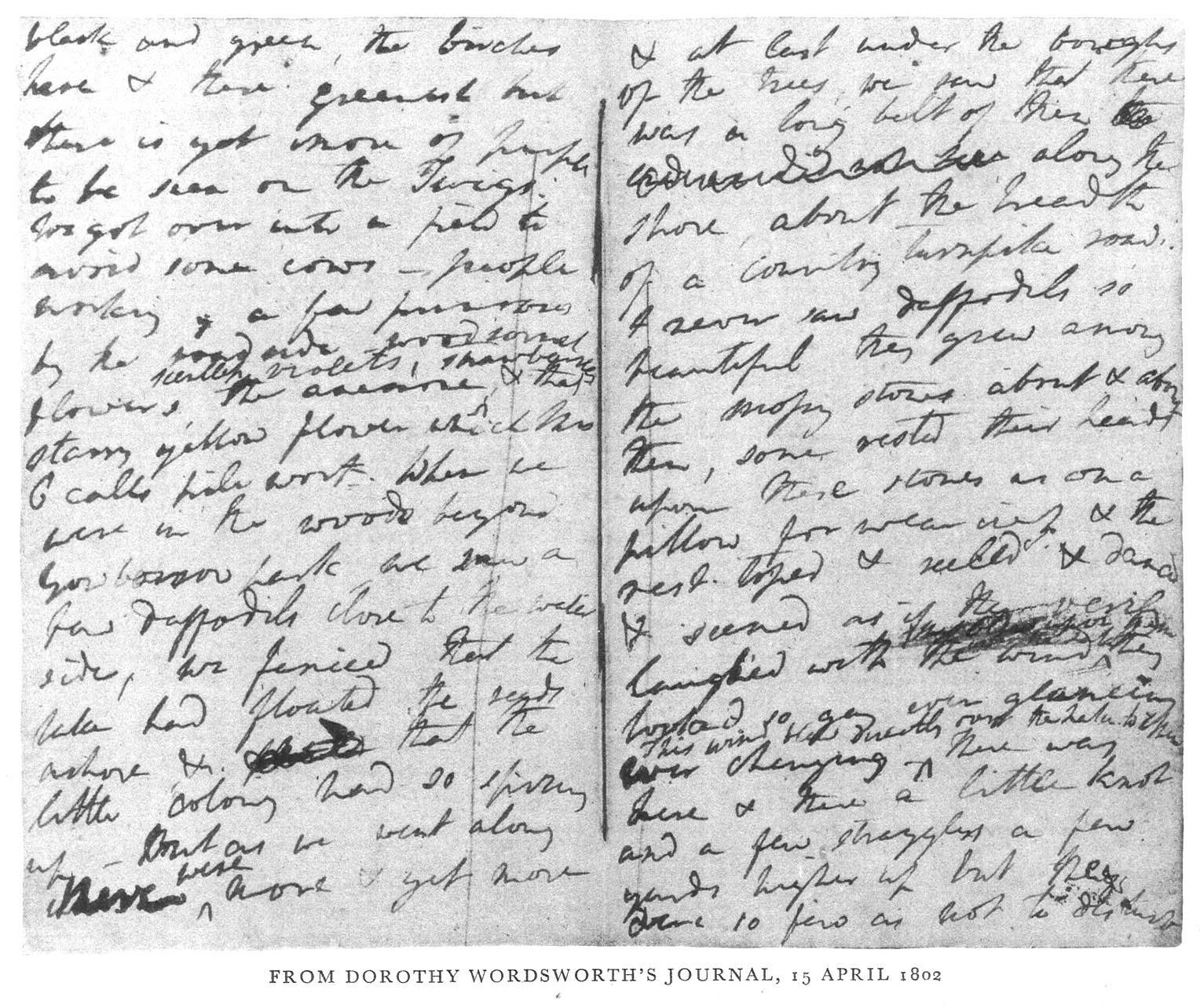
The other day Pat  Keane dashed off 10,000 words on Wordsworth’s daffodils and sent them to me wondering if I might want them for Numéro Cinq. He starts off with a detour through the mine field of contemporary American literary criticism, the still fresh battles fought between the proponents of intrinsic criticism and extrinsic criticism, the New Critics who value “close reading” and the contextual critics who bring in tradition, influence, history, biography and sometimes psychoanalysis to help explain a poem. Helen Vendler’s analysis of the Wordsworth poem stands as an example of the former and after giving it fair due, Pat launches into what he whimsically calls “a few contextual elements” — those, um, 10,000 words more or less, starting with Dorothy Wordsworth’s journal entry (see facsimile page below) on the day she and her brother saw the daffodils and ending with Immanuel Kant’s immortal line about the starry heavens and the moral law. This is a gorgeous essay on criticism, on the provenance of a poem, and on Wordsworth (and his sister) — also a wonderful re-visioning of a poem that sometimes is difficult to see because it has, yes, become oh so familiar.
dg
As my doubly plural title indicates, I’ll be wandering beyond the received text of one of the most familiar poems in the literary canon, “I Wandered Lonely as a Cloud”—Wordsworth’s best-known poem, though demoted by some to “that damned thing about daffodils.” Since its initial publication, in 1807, the poem has been parodied and admired, despised and exalted. Today, though it can still produce an occasional groan, it is generally ranked among Wordsworth’s small triumphs, one of his self-described “simple songs for thinking hearts.” That simplicity is complicated by the fact that, while we rightly consider it one of Wordsworth’s “signature” poems, it bears the signature of more than one Wordsworth; indeed, of more than two. Yet it remains quintessentially “Wordsworthian,” both intrinsically and thematically. For “I Wandered Lonely as a Cloud” gives us, writ small, the theme—“the spontaneous overflow of powerful feelings…recollected in tranquility”—of such indisputably major poems as “Tintern Abbey,” the opening Book of Wordsworth’s autobiographical epic, The Prelude, and the great “Ode: Intimations of Immortality from Recollections of Early Childhood.”[1]
SPACE
The mixed reception of the Daffodils poem is not an anomaly. Wordsworth’s road to recognition was a rocky one, and even after he had “arrived,” he was still subjected to withering criticism. No one who has read it can ever forget the opening of Francis Jeffrey’s Edinburgh Review reception of Wordsworth’s long-awaited epic poem, The Excursion. When it finally appeared, in 1814, Jeffrey famously dead-panned, “This will never do.” It’s hard for us to know whether to laugh or to cry; Wordsworth did neither. Seven years earlier, his friend and admirer, Margaret, Lady Beaumont, underestimating the “invincible confidence” of the poet, thought he would be distressed by the disparaging reception of Poems, in Two Volumes (1807). Responding, Wordsworth pronounced himself unperturbed by temporary attitudes. Quoting another friend well known to Lady Beaumont, he insisted that a “great and original” poet “must create the taste by which he is to be relished; he must teach the art by which he is to be seen.”[2] That was certainly the case with Wordsworth, who endured savage, often belittling criticism before he eventually triumphed, becoming the dominant poet of the 19th century, and, after a brief decline in the earlier twentieth century, reemerged in our own time as a monumental figure—widely, if not universally, considered the major poet to have written in English between Milton and Yeats.
SPACE

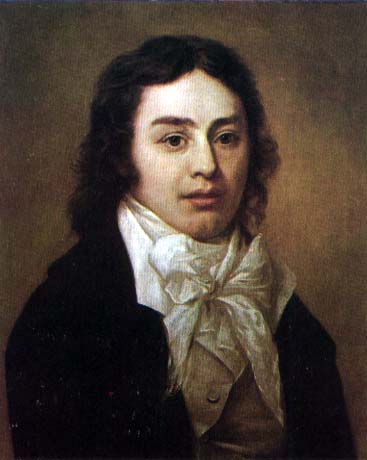
samuel

SPACE

The friend Wordsworth quoted to Lady Beaumont was, of course, Samuel Taylor Coleridge, who inspired, and was inspired by, Wordsworth and who, as a critic, did more than any other single figure to advance the case for Wordsworth as a major poet. But he was also aware of “defects” in his friend’s poetry, and readers who continue to resist that “damned thing about daffodils” will be heartened to know that he, too, thought that whatever flashed “upon that inward eye,” it ought to have been something rather more momentous than a bunch of “daffodils,” which he italicized to emphasize the trivial nature of what was being “retrospected.” As we shall see, given what he considered the bathetic emphasis on mere daffodils, he judged what have become the most famous lines in the poem—“They flash upon that inward eye/ Which is the bliss of solitude”—to be an example of “mental…bombast.”[3] As we’ll also see, though Coleridge presumably didn’t know it, those two lines were actually not written by Wordsworth, at least not by William Wordsworth. But this takes us outside the autonomous, internal world of the poem, and I want to begin with an intrinsic reading.

SPACE

The Daffodils and Helen Vendler

helenvendler

Helen Vendler

1

As it happens, the critic and teacher generally recognized as the most acute living exponent and practitioner of intrinsic criticism, Helen Vendler, writes at length about “I Wandered Lonely as a Cloud” in the third edition of her superb text for college students, Poems, Poets, Poetry.[4] After a brief two-page analysis of Robert Herrick’s “Divination by a Daffodil,” she devotes the remaining pages of her 11th chapter, “Writing about Poems,” to Wordsworth’s daffodils poem. As an intrinsic critic, Helen Vendler preaches and practices close reading, or explication. For her, a poem is essentially an autonomous artifact, a work of art to be experienced in and of itself. And it is to be experienced, she says (323, 329-31) in two somewhat different but equally indispensable ways: temporally (unfolding itself in time, with a beginning, middle, and end) and spatially (viewed from a distance as a space full of elements set in relation to each other). Vendler is, of course, aware of authorial and historical contexts:  who the author is, when he or she wrote, and under what circumstances. But in examining and writing about a poem, she is primarily engaged by the interrelated elements within the particular text itself—its words, families of words, sentences, sounds (alliteration and assonance), rhyme and rhythm, etc.

As one can see from what she has to say about many of the poems in her book, not least “I Wandered Lonely as a Cloud,” this focus on close reading is immensely illuminating. Praising “a good paper,” the sort she wants students to write, Vendler says such a paper “leaves your readers, when they come back to the poem, feeling ‘Oh, yes! And yes! Of course!’ It makes readers see aspects of the poem they may not have noticed themselves, in their more cursory reading of the poem, but now see clearly because you have showed them those things” (336). This is precisely Vendler’s own great gift. “Yes, of course; why didn’t I see that for myself?” so many of us have said over the years, responding to one or another of her brilliant close readings: explications which clarify almost everything. I said “almost everything” by design—as Browning’s Duke says in “My Last Duchess”—because, in her emphasis on the internal dynamics of the individual poem, Vendler omits most external factors. She’s perfectly aware of the contexts beyond the poem.  As she says herself of this particular poem, “I Wandered Lonely as a Cloud”: it can “be set in larger frames,” for example, “among other Wordsworth poems,” or “among other Romantic poems,” or “among poems about memory; and so on” (336). As I’ve already suggested, I will be exploring, among others, precisely those “larger frames”; but, even then, there is much to be said in favor of close reading.

There was a time, prior to the advent of the modern pioneers of close reading, the so-called “New Critics” of the 1940s and ‘50s, when it was perfectly acceptable for college professors, supposedly discussing with their students such a poem as (to choose an example once cited by the critic Richard Fogle in demonstrating old critical shortcomings) Wordsworth’s “Tintern Abbey,” to say little or nothing about how the poem actually “worked.” Instead, they would lecture about the “occasion” of the poem (the tour made by Wordsworth and his sister Dorothy); about the intense personal and literary relationship between the Wordsworths and Coleridge; and about the political context in which the poem was written (the era of the French Revolution, of which Wordsworth and Coleridge were initially ardent enthusiasts). And then, as class-time was running out, the professor would conclude by saying something like: “as for the poem itself—ah, beautiful, is it not!” This was not good enough: indeed, it was just such cursory, or negligent, treatment of poems that gave rise to the New Critics.

It’s not that such contexts don’t matter. Indeed, they mattered to Wordsworth himself, who sometimes incorporated them into the poem, or at least its title. For example, he makes sure, toward the end of “Tintern Abbey,” that readers realize that his sister has been present all along, as a silent auditor (making the poem a kind of surprise dramatic monologue). In addition, his own long title —“Lines Composed a Few Miles above Tintern Abbey on Revisiting the Banks of the Wye During a Tour”—gives us the precise circumstances of the poem’s composition. And his inclusion of the date, “July 13, 1798,” one day short of Bastille Day, the anniversary of the outbreak nine years earlier, of the French Revolution, is intriguing since the poem itself says nothing about politics, an absence which is itself not without interest.  Unfortunately, too many historically-sophisticated critics, especially the so-called New Historicists, have so emphasized this “absence” or “political evasion” on the part of Wordsworth—what is “repressed” or “not said” in the poem—that they de-emphasize what is there, actually present in the poem. Reading through the prism of politics offers its own illuminations, but this re-swinging of the critical pendulum has ironically brought us back to the situation earlier addressed by the intrinsic critics who preceded Helen Vendler: the need to read a poem as a poem, and not as something else, either a political tract or a “message.” In The Prelude and elsewhere, Wordsworth can hardly be said to avoid politics. But a poet has the right to choose his own subject matter and theme; in “Tintern Abbey,” his focus is on his psychological-imaginative engagement with the landscape.[5]

Wordsworth2

2

Vendler begins her discussion of “I Wandered Lonely as a Cloud,” by printing the poem in its final version, accompanied by an imaginary student’s running commentary, noting the poem’s four-beat meter and ababcc rhyme scheme, and raising questions.

I wandered lonely as a cloud
That floats on high o’er vales and hills
When all at once I saw a crowd,
A host, of golden daffodils;
Beside the lake, beneath the trees,
Fluttering and dancing in the breeze.

Continuous as the stars that shine
And twinkle on the milky way,
They stretched in never-ending line
Along the margin of a bay:
Ten thousand saw I at a glance,
Tossing their heads in sprightly dance.

The waves beside them danced; but they
Outdid the sparkling waves in glee;
A poet could not but be gay,
In such a jocund company;
I gazed—and gazed—but little thought
What wealth the show to me had brought:

For oft, when on my couch I lie
In vacant or in pensive mood,
They flash upon that inward eye
Which is the bliss of solitude;
And then my heart with pleasure fills,
And dances with the daffodils.   (WP 1:619-20)

Vendler’s hypothetical student, annotating the opening stanza, wonders why the “lonely” speaker is “like a cloud”; notices the natural scene of hills and valleys; and that “crowd,” generally used of people, here refers to flowers, as does “host,” usually describing “armies” (he or she omits “angels”); then remarks that the line “Beside the lake, beneath the trees,” offers a “closer focus than vales and hills.” The final line of the stanza prompts the student to ask how rooted flowers can be said to “dance”? With the second stanza’s “much further focus—up to the stars,” the student wonders about the “difference between shine and twinkle”; marks the expansion of never-ending and ten-thousand; notes that “saw becomes glance”; and that the dancing daffodils become people, tossing their heads. The waves of the third stanza are “like people too, dancing,” and the “flowers have feelings: glee.” The jocund company indicates that the speaker is “not alone anymore.” The crucial transition from saw to glance to gazed and gazed is noted, as is the glance back to golden in stanza 1 implicit in this stanza’s reference to wealth and show (itself a shift from company). Of the opening of the fourth and final stanza, For oft, the student notes, “past anecdote over, now present tense,” and follows that accurate observation with a flurry of marginal questions: “Difference between vacant and pensive? Flash; not dance or flutter or toss: why? Solitude: different from first lonely? Earlier, eye (outward and inward); now heart?” Finally, the student, observing “same rhyme-sound as in stanza 1,” has noticed at least the rhyme on daffodils in both the opening and closing stanzas.

Vendler then turns to the poem’s words, suggesting that students consult a dictionary to “check out etymologies and different connotations,” since poets have a “very specific sense of the aura around each word.” Her own search reveals words with roots in Old English (crowd, shine, twinkle, bliss), Middle English (glance, glee, gaze, flash), Latin (host, jocund, vacant, pensive, solitude), French (gay), and Greek, since daffodil itself derives from the Greek asphodelos. Wordsworth, she suggests, is “balancing” words, the Latinate (Latin-French) with the Germanic (Anglo-Saxon). She also notes the “families” of words that “help to organize the poem,” focusing on four inter-related clusters: “Glee, gay, and jocund  (a family of being happy, in terms of both meaning and—in the case of the first two—alliteration); Glance, glee, gay, gaze (words connected by alliteration, joining looking and happiness); Saw, glance, gaze (a family of looking); and Float, flutter, shine, twinkle, toss, flash, fill (a family of verbs of motion).”

Discussing sentences and rhythm, Vendler notes that the first two stanzas are periodic; the sentence is the stanza. But, despite our expectation that the pattern will continue, the third and fourth stanzas “together make up the third sentence,” with the “hinge” that joins them “the couplet, ‘I gazed—and gazed—but little thought/ What wealth the show to me had brought.’ This couplet leads into the exemplification of the ‘wealth’ in stanza 4.” And since the “third sentence is twice as long as the other two,” it “bears twice the weight.” The poem’s ababcc rhyme-scheme suggests, says Vendler, an initial statement (the quatrain) followed by an additional observation (the couplet). Of rhythm, she notes that the basic iambic beat of the first five lines is purposefully disrupted in the sixth line, where, “to emphasize the unexpected motion of the flowers,” Wordsworth shifts to a strong syllable followed by a weak: “Fluttering.” She concludes her thoughts on this subject by observing that a “careful reader will see that for his concluding rhyme (‘fills/ daffodils’) Wordsworth has reused one of the rhyme-sounds from his first stanza (‘hills/ daffodils’), giving us a strong sense of the end coming back to the beginning.” (In fact, if we count slant-rhyme, Wordsworth may be said to have reused two rhymes, the final stanza’s “mood” and “solitude” obliquely chiming with the first stanza’s “cloud” and “crowd.”)

Most importantly, Vendler invites us to look at the poem temporally, then spatially. We examine the poem temporally to see what changes we can observe as it moves from A (the opening, with the speaker lonely, as “unconnected to the world as a cloud when floating high above the earth”) to Z (where, though “still alone,” he is “no longer lonely,” since “now he feels the bliss of solitude”). How does Wordsworth move us, persuasively, from A to Z, the point at which, alone in his room, “suddenly, unasked, the daffodils flash into his mind so vividly that he sees them with his ‘inward eye’,” filling “that empty container, his heart,” with a pleasure that recaptures “his previous pleasure on that apparently forgotten day”? How does he convince us that the daffodils have “indeed lasted intensely in his mind, without any conscious effort on his part?” The explanation lies in “all the verbs of motion, all the verbs of seeing, all the verbs of delight”—in short, those “families” of words earlier discussed. Now it is the job of the reader-critic to see, along with much else, precisely how those verbs are deployed in the poem.

Looking at the poem spatially, Vendler draws our attention to three descriptive “glances” at the same phenomenon.” The first glance (“I saw”) shows us the daffodils as many (“a crowd, a host”), in a landscape (lake, trees), and in motion (“fluttering and dancing”). The second glance (“at a glance”) shows us the daffodils as many (like “stars that shine/ And twinkle on the milky way,” “ten thousand”), in a landscape (“along the margin of a bay”) and in motion (“Tossing their heads in sprightly dance). The third glance (“I gazed—and gazed”) shows us the daffodils as many (“a jocund company”), in a landscape (“waves beside them”), and in motion (“they/ Outdid the sparkling waves in glee”). If we considered these three descriptions temporally, we would distinguish between “seeing, glancing, and gazing.” But in considering them spatially, as three reiterated versions of “the same thing” (such “repetition” is actually “intensification”), what marks the daffodils is that (a) they are not alone, but many; that (b) they  feel “at home” in their natural setting; and that (c) “they are not gloomily rigid but in joyous motion responsive to the waves and the breeze.” As Vendler suggests without dwelling on the point, Wordsworth’s prepositions play a crucial role in positioning the daffodils and integrating them into their natural world. They are “Beside the lake, beneath the trees,/ Fluttering and dancing in the breeze,” “stretched in never-ending line/ Along the margin of a bay,” beside “the waves.”

We also notice that the poem, still being examined spatially, is divided into two parts: “outdoors (stanzas 1-3 and indoors (stanza 4).” The outdoor part, in the past tense, tells of the particular day when the poet saw the daffodils; the indoor part, “phrased in the habitual present tense (representing something that happens often), removes the daffodils from a physical scene (in nature) to a virtual scene (in the mind). Wordsworth makes explicit, at the end, the connection between what the eye has seen, glanced at, and finally gazed at (imprinting the scene firmly) and what the heart feels.” Bringing the daffodils indoors, Wordsworth wants us to “recognize that the poem has been brought to closure.” (330-31)

The interaction between speaker and flowers is made credible by the alternation between them. The speaker governs the first sentence, with the daffodils the objects of his observation; but this governing function changes, producing “an antiphonal structure of alternation…in which the poet and the daffodils engage in a ‘syntactic dialogue,’ as first one predominates, then the other. We ‘believe in’ the speaker’s interaction with the daffodils because the poem shows it happening.” In case we missed it, Vendler points out that Wordsworth has put the word dance, in one or another of its variants, in each stanza: dancing; dance; danced, dances. And we notice that “the word dance alliterates with daffodils, making them ‘belong’ together phonetically” (331). At this point, it’s up to the student to write an essay about how the poem “works,” and Vendler devotes the remainder of this chapter (332-40) to suggesting a variety of potentially fruitful approaches to the poem and to ways to organize a coherent and persuasive essay.

 SPACE

The Daffodils in Context

daffodils

3

Thanks to astute observation of the sort she wants students to emulate, Vendler has provided all the preliminary spadework as well as the framework for an intrinsic analysis. I will be doing my own share of close reading; but before returning to “I Wandered Lonely as a Cloud,” I want to bring in a few contextual elements, extrinsic to the poem, at least until its final form. To begin with, we can locate the actual incident that inspired the poem. As by now everybody knows, or else should know, the genetic episode was recorded by Dorothy Wordsworth in her Journal for Thursday, 15 April 1802. She tells us that she and William came across many flowers on this memorable walk, including the Lesser Celandine, that

starry yellow flower which Mrs C[larkson] calls pile wort. When we were in the woods beyond Gowbarrow park we saw a few daffodils close to the waterside. We fancied that the lake had floated the seeds ashore and that the little colony had so sprung up. But as we went along there were more and yet more, and at last, under the boughs of the trees, we saw that there was a long belt of them [six words crossed out] along the shore, about the breadth of a country turnpike road. I never saw daffodils so beautiful. They grew among the mossy stones, about and about them; some rested their heads upon these stones as on a pillow for weariness, and the rest tossed and reeled and danced, and seemed as if they verily laughed with the wind that blew upon them over the lake. They looked so gay—ever-glancing, ever-changing. This wind blew directly over the lake to them. There was, here and there, a little knot, and a few stragglers a few yards higher up—but they were so few as not to disturb the simplicity and unity and life of that one busy highway.[6]

The poem that resulted—originally titled “Daffodils”—was composed later, sometime between March 1804 and April 1807 (WP 1:1005). Some readers have preferred the journal-entry to the poem. A scholar no less distinguished than Ernest de Selincourt, referring to the “unforgettable walk” of 15 April 1802, describes the Wordsworths’ encounter with the daffodils, “which William records in verse,” as “more lovely in Dorothy’s unstudied prose.” Even those who may not agree can see his point. But that prose was not quite “unstudied.” Dorothy’s manuscript (reproduced by de Selincourt on the overleaf that follows his remark), shows that she deleted six words after “a long belt of them” (“the end we did not see”), and jotted in as an afterthought, “This wind blew directly over the lake to them.” It is also worth noting, as Pamela Woof does in her edition of the Grasmere Journals, that Dorothy wrote a letter to Mary this same day, in fact, immediately on returning home from the walk along Ullswater. In this account, the wind is “furious” and “sometimes almost took our breath away”; but, as Woof notes, “it is not a creative force: no daffodils are mentioned, no partnership with the wind in dance.”[7]

In 1815, Wordsworth gave the poem its present title, dropping “Daffodils” for, I would surmise, two reasons: first, to place initial emphasis on the isolated speaker (“I wandered lonely…”), second, to defer the surprised delight of his, and our, first encounter with the flowers to the poem itself. He also inserted a new stanza (see WP 1:1006n), beginning “Continuous as the stars that shine…” A cluster of interrelated questions arise. Why did he feel the need to add these lines? How does this new second stanza affect our interpretation of the poem? What else is there in the poem that isn’t in Dorothy’s journal-entry? Alternately, what does Dorothy give us in prose, “unstudied” or otherwise, that her brother doesn’t?  And what do the differences between journal-entry and poem suggest in terms of experiential response and aesthetic shaping, even, perhaps, in terms of female and male responses to the natural world? Whatever changes he made in shaping his own poem, does knowing that Wordsworth adhered so closely to Dorothy’s journal-entry alter our attitude regarding Wordsworth’s creativity? In what follows, I return to the Daffodils poem in connection with three Wordsworths (William, Dorothy, and Mary); then in connection with Coleridge and Emerson, on the subject of “eyes” and the sublimation of the commonplace. I’ll conclude by placing “I Wandered Lonely as a Cloud” in a larger Wordsworthian and even Coleridgean-Kantian context.

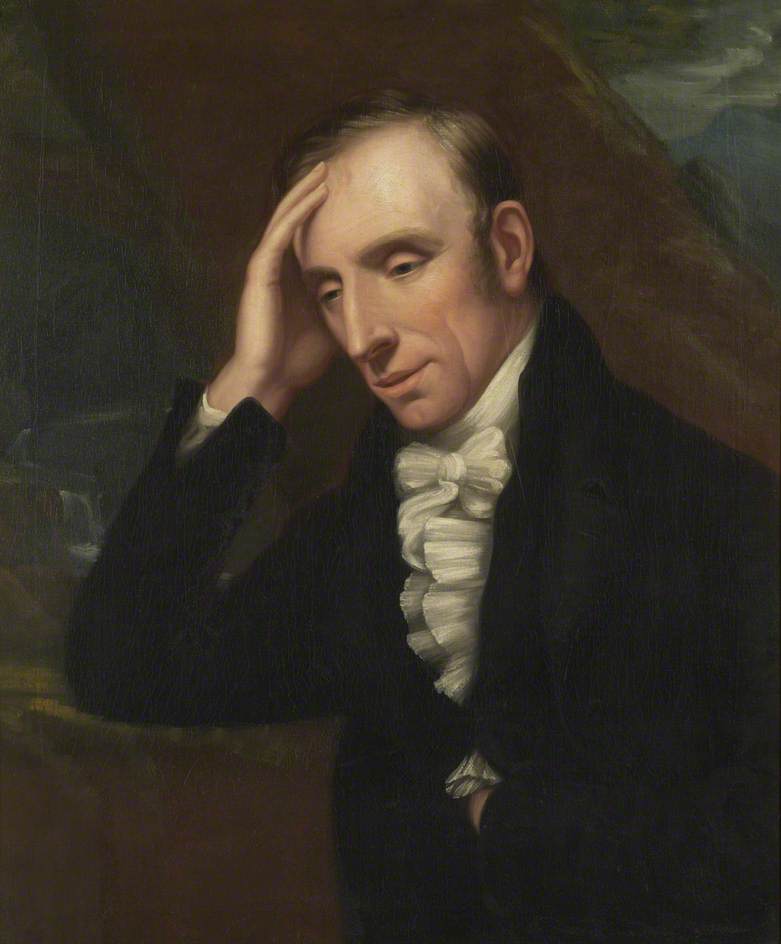
ww

4

Even though two years passed between Dorothy’s April 1802 journal-entry and Wordsworth’s initial draft of the poem, that remarkably perceptive and imaginative entry was obviously in the poet’s mind when he sat down to write, or, as was often his practice, began to chant lines while walking. Of course, we cannot know the precise extent to which he was indebted to his sister’s observations. Considerably, it would seem, though we cannot rule out the possibility that he may have had some influence on her wording in the journal-entry, given the crucial omissions in the contemporaneous letter to Mary, and, especially, given the closeness and reciprocity of the relationship between Dorothy and her brother.

Dorothy  Wordsworth journal

Reciprocity is, in fact, one key to the poem. “So much depends…,” William Carlos Williams opens “The Red Wheelbarrow,” a little poem as alternately loved and resisted by students as Wordsworth’s daffodils. Williams’s opening foreshadowed a mutual dependence: just as the poet depends on what he sees, the things of the world, as necessary raw material, so those “found” objects depend on the poet to perceive, frame, and so order them aesthetically—through unexpected line-breaks, division into three- and one-word couplets and juxtaposed colors and textures (“a red wheel/ barrow// glazed with rain/ water// beside the white/ chickens”)—that they are transformed into a work of art. In a similar reciprocity in “I Wandered Lonely as a Cloud,” the Wordsworthian speaker’s mood is affected by the daffodils, which, in turn, depend on the poet (and, in this case, Dorothy, in her journal-entry, though not in her letter to Mary) to record their gaiety as they “dance” in the breeze. At the same time, as that personification or pathetic fallacy indicates, Dorothy and William are also projecting, attributing human characteristics and emotions (primarily, joy) to the flowers. The speaker in the poem begins by “naturalizing” himself, comparing his loneliness to that of a floating cloud; then reverses the process by personifying the flowers; and, finally, internalizes their supposed joy when every subsequent recollection of them so “fills” with pleasure his momentarily empty heart that it “dances with the daffodils”—all, aside from the related “Fluttering” and “Tossing,” to an iambic-tetrameter beat.

When he started to write the poem, two years after Dorothy recorded her journal-entry, Wordsworth clearly depended on that entry, both to refresh his memory and for emotional coloring. In the poem, he deploys her observations selectively, emphasizing certain aspects, omitting others, most notably her reference to those daffodils that seemed to rest their heads on the stones they grew among. Dorothy, in fact, begins by noticing these presumably wind-beaten flowers resting their heads on the elegiac “mossy stones… as on a pillow for weariness.” Whether or not this reveals a specifically female sensibility, it is a sympathetic, even poignant observation unregistered in her brother’s poem. He focused instead, and exclusively, on the flowers animated by the breeze off the lake. According to Dorothy, they “tossed and reeled and danced,” a joyous movement replicated in the poem: “ten thousand saw I at a glance, / Tossing their heads in sprightly dance.” A later, more orthodox Wordsworth would dismiss Keats’s “Hymn to Pan” (which his young admirer had been pressed to read to him) as “a very pretty piece of paganism,” even though Keats’s main source was a favorite mythological passage in the fourth Book of Wordsworth’s own Excursion. Here, however, he adds to his sister’s head-“tossing” personification of the daffodils a light but detectably pagan note, their “sprightly dance” allying them with sprights or sprites: elfin supernatural beings. I’ll return to this point.[8]

Interestingly, the description closest to his sister’s did not appear in the poem until 1815, in the couplet concluding the stanza Wordsworth added that year. This addition may be his equivalent of the phrase she had deleted, “the end we did not see,” referring to the “long belt of them,” which, together with her reference to the Lesser Celandine, “that starry yellow flower,” may have led to Wordsworth’s belated insertion of this stanza, in which the multitude of daffodils that “stretched in never-ending line” are said to be “Continuous as the stars that shine/ And twinkle on the milky way.” This shifts the focus above the cloud that “floats on high,” and far above Dorothy’s “long belt”—now extended to stars, perhaps reminding Wordsworth of another “Belt,” Orion’s. Not part of our Milky Way, Orion, so familiar to stargazers, is the easiest constellation to find, and so the best way to orient ourselves to viewing the edgewise Milky Way’s “never-ending line,” or “busy highway,” of stars. In short, even Wordsworth’s most distant, sublime, celestial comparison, added more than a dozen years after she made her journal-entry, may still be partially indebted to Dorothy’s original description of the daffodils.

However we judge the relationship between his sister’s journal-entry and the poem, we know that Wordsworth, like Coleridge, valued Dorothy’s acutely sensitive perception of the details of the natural world. In the concluding lines of “The Sparrow’s Nest,” a short lyric grouped with “Daffodils” in the “Moods of My Own Mind” section of the 1807 Poems in Two Volumes, Wordsworth says of Dorothy (lightly disguised as “My sister Emmeline”):

She gave me eyes, she gave me ears;
And humble cares, and delicate fears;
A heart, the fountain of sweet tears;
And love, and thought, and joy.  (WP, 1:529-30)

Though every item in this litany of gifts to her poet-brother is crucial, his priority is, significantly, ocular: “She gave me eyes….” It seems all the more remarkable, therefore, that the lines Wordsworth himself described as the poem’s “two best”—“They flash upon that inward eye/ Which is the bliss of solitude”—were contributed not by the poet’s sister, but (he told Isabella Fenwick) by his wife, Mary. Dorothy may have given him “eyes,” but, in what borders on a co-operative family affair in the creation of this particular poem, it was another female member of the household who gave him his final and sublime image, “that inward eye.” “I Wandered Lonely as a Cloud” is nothing if not an “ocular” poem, one in which the speaker “saw,” and “saw,” and “glance[d],” and, more intensively, “gazed—and gazed”: a pattern culminating in that “inward eye” upon which those gazed-on and imprinted daffodils later “flash.” Wordsworth himself described the poem in 1815 as “rather an elementary feeling and simple impression [approaching to the nature of an ocular spectrum] upon the imaginative faculty, than an exertion of it….” (WP, 1:1006n)

But it must be added that it would be erroneous to over-emphasize the “ocular spectrum” at the expense of “the imaginative faculty.” Even in the note I have just cited, Wordsworth does not deny the exercise of the faculty of imagination, only of the sort of strenuous effort suggested by his italicization of the verb “exertion.” The point is confirmed by the fact that the note was written in the process of Wordsworth elevating the poem, previously located in “Moods of My Own Mind,” to a “higher” status among what he called, in the 1815 re-grouping, “Poems of the Imagination.” What we see with the physical or external eye still matters immensely, for without the initiating and necessary grounding in visual apprehension there would be no Romantic transcendence, defined by David Vallins as “at once a feeling of elevation or sublimity, and a process of contemplating, explaining, or evoking the unity of phenomena.”[9] In “I Wandered Lonely as a Cloud,” the “continuous,” integrated belt of daffodils is further unified and internalized through the power of the poet’s “inward eye.”

RalphWaldo_Emerson

Ralph Waldo Emerson

5

The phrase I’ve just quoted from David Vallins occurs in his analysis of the reinterpretation of Romantic ideas by Ralph Waldo Emerson. The legacy of the “inward eye” includes the responses of Coleridge and of his (and Wordsworth’s) American disciple, Emerson, both of whom had things to say about the Wordsworthian “eye” engaging the commonplace, the humble things of the world.  Coleridge was the first and, in many ways, the most astute appreciator of the poetry of Wordsworth, a poet he ranked with (and second only to) Shakespeare and Milton. But he devoted a whole chapter (22) of Biographia Literaria to the “characteristic defects” (BL 1:119) of his friend’s work. As indicated earlier, in that chapter, he cited the lines in which the daffodils “flash upon that inward eye/ Which is the bliss of solitude” as an example of a thought or image “too great for the subject,” and thus approximating “what might be called mental bombast, as distinguished from verbal” (BL 1:136). Just as Wordsworth was not minimizing the role of imagination in his 1815 “ocular” note on “I Wandered Lonely as a Cloud,” so Coleridge was not criticizing these lines in themselves; only their misuse, since their very sublimity leads us to expect a more significant “joy of retrospection”—such as the passing before “our conscience” of “a whole well-spent life”—rather than what he considered on this occasion the relative triviality and bathos of a recollection of mere “daffodils” (137).

Coleridge, whose compelling Mariner mesmerizes us as well as the Wedding Guest with his “glittering eye,” was not a man to undervalue the eye. In a crucial and influential passage from Aids to Reflection (1825), Coleridge identified, as a “higher gift” than the life breathed into man and animal alike, man’s “Reflection, or Reason,” associating it with the moment in Genesis when “man became a living soul” (Gen 2:7), and providing an echoing Emerson with what he would later call (in the “Idealism” chapter of Nature), the “eye of Reason.”[10] God has given us a house gloriously furnished, writes Coleridge, “Nothing is wanted but the eye, which is the light of this house, the light which is the eye of this soul. This seeing light, this enlightening eye, is Reflection.”[11]

Coleridge here aligns his biblical quotation—“And man becomes a living soul”—with the moment in “Tintern Abbey” (46-49) when, laid asleep in body, we “become a living soul.” Thus empowered, we are—in Wordsworth’s visual image—able to “see into the life of things” with “an eye made quiet by the power/ Of harmony and the deep power of joy.” Thus, Coleridge might have agreed with Wordsworth, who seems not to have been merely patronizing his wife when he described the “inward eye” lines to Isabella Fenwick as the “two best lines in” the poem. For many subsequent readers, they have certainly seemed to be the poem’s most quintessentially “Wordsworthian” lines, even if they are more Mary’s than William’s.

Of course, just as it is possible that Wordsworth had some influence on Dorothy’s journal-entry on the daffodils, Mary may, like Coleridge, have been remembering that “ocular” passage in “Tintern Abbey.” Three decades later, and across the Atlantic, Emerson, another admirer of Wordsworth, remembered both ocular images, connecting them with the premature death of his closest brother, Charles—a victim of the same disease, tuberculosis, that had earlier claimed both his nineteen-year-old his wife and his younger brother, Edward, and that had, moreover, threatened his own eyesight. Devastated by this third family tragedy within five years, Emerson wondered of Charles, “Who can ever supply his place to me? None,” he answers, for Charles was to him what Dorothy was to Wordsworth: “The eye is closed that was to see Nature for me, & give me leave to see.”[12] Emerson’s partial compensation came in the form of a metaphorical transmutation of his dead brother’s “eye” attuned to the natural world. In the most celebrated moment in his book Nature, written in the year Charles died, Emerson famously or notoriously describes a moment in which, “my head bathed by the blithe air, and uplifted into infinite space;—all mean egotism vanishes. I become a transparent eye-ball; I am nothing; I see all” (E&L,10; italics added). At once lonely and exhilarated, he experiences an uplifting, a rapturous and self-transcending unity with the divine in which “the currents of the Universal Being circulate through me; I am part or particle of God”: a version of Wordsworth’s less explicitly religious “sense sublime” of “A motion and a spirit, that impels/ All thinking things, all objects of all thought,/ And rolls through all things” (“Tintern Abbey,” 95, 100-102). Seven years later, in his great essay “The Poet,” Emerson looks back on that epiphanic moment, remarking how rare and difficult it is to attain “the all-piercing…and ocular air of heaven” (E&L, 451-52). Along with his brother’s “eye,” all-seeing but now closed in death, the American Transcendentalist seems to be recalling both the culminating ocular image in the Daffodils poem, that “inward eye/ Which is the bliss of solitude,” and that “Serene and blessed mood,” in which the affections gently lead us on until, our breath and even the motion of our human blood almost suspended, “we are,” to repeat the lines from “Tintern Abbey,”

SPACESPACESPlaid asleep
In body, and become a living soul;
While with an eye made quiet by the power
Of harmony, and the deep power of joy,
We see into the life of things. (30, 41-49; italics added)

space

Dorothy Wordsworth's silhouette

Dorothy Wordsworth’s silhouette

6

As with so many Wordsworthian roads, this emphasis on seeing leads back to Dorothy, who “gave” Wordsworth “eyes to see,” just as Charles’s “eye” was “to see Nature” for Emerson, and give him “leave to see.” Of course, Dorothy makes an appearance, albeit belated and unnamed, in “Tintern Abbey.” Though we do not find out until the final movement of the poem, “thou my dearest Friend…, My dear, dear Sister!” (119-120, 124), has been silently present all along, on the banks of the Wye, just as she was present when brother and sister saw the daffodils dancing in the wind beside Ullswater. But while Dorothy was there, and while her journal-entry inspired the Daffodils poem, her journal and her presence go unmentioned in “I Wandered Lonely as a Cloud.” It is not hard to guess why Dorothy was left out.

In what is perhaps the most repeated of all definitions of poetry, Wordsworth called it “the spontaneous overflow of powerful feelings…recollected in tranquility.” In the case of this poem, the supposedly spontaneous overflow took place over many years—from 1804, when he first drafted the poem, through its first printing in 1807, and its revised version in 1815, in which Wordsworth, though leaving the final stanza intact, improved the first stanza, replacing “dancing” with “golden,” and “along” with “beside” in lines 4-6. Some devotees of simplicity may prefer the original phrase in line 16, “laughing company,” to the permanent change made in 1815: “jocund company.” Though echoing the “large recompense” in “Lycidas,” the more-than-Miltonic Latinate and polysyllabic “abundant recompense” in “Tintern Abbey” seems ponderous. Here, the Latinate adjective seems less so; in addition, “laughing company” may have belatedly seemed to Wordsworth too close to Dorothy’s delightfully over-the-top surmise that the daffodils “seemed as if they verily laughed with the wind that blew upon them over the lake.” Most importantly, of course, in 1815, Wordsworth inserted an entirely new stanza. As earlier suggested, that stanza’s galaxy of “stars” may echo Dorothy’s “starry yellow flower” and  seemingly-endless “long belt” of daffodils;  and the new stanza concluded by directly echoing Dorothy’s description of the daffodils as they “tossed and reeled and danced.” Nevertheless, it would hardly do to mention that journal-entry, even in an appended prose note, since that would reveal that what was being “recollected” was less the poet’s “spontaneous” feelings than Dorothy’s, jotted down more than a dozen years earlier. An awkward affair best avoided.

Nor could there be room for Dorothy as a character in the poem. Though Keats would later famously and accurately refer to “the Wordsworthian or egotistical sublime,” the omission of Dorothy here has nothing to do with the “mean egotism” Emerson shed when he became a transparent eye-ball. Dorothy’s omission is thematic. “I Wandered Lonely as a Cloud” depends upon the speaker’s initial isolation, wandering “lonely as a cloud,” as preparation for the  moment when, “all at once I saw a crowd,/ A host, of golden daffodils,” and, caught up in their “glee,” becomes part of their “jocund company,” all leading to his very different final “solitude,” when emotion is recollected in a tranquility at once thoughtful and blissful, and his “heart with pleasure fills,/ And dances with the daffodils.” Indeed, the memory of the daffodils seems a talisman against loneliness. As long as he retains this, and other similarly vivid remembrances of Nature, Wordsworth will never be truly alone, or bereft of material for poetry. That initial loneliness and final solitude, associated with the “inward eye” upon which the remembered golden daffodils “flash,” is even more essential in this poem than it is in “Tintern Abbey,” where the repeated “I” finally yields to a petition to his beloved sister that she “not forget” that “after many wanderings, many years/ Of absence, these steep woods and lofty cliffs,/ And this green pastoral landscape, were to me/ More dear, both for themselves and for thy sake! (158-62; italics added). The poem rightly ends by focusing on Dorothy and past, present, and future, for though she has been silent, he has read his “former pleasures in the shooting lights/ Of thy wild eyes,” and caught “from thy wild eyes these gleams/ Of past existence” (121-22, 151-52; italics added).

An ocular presence in “Tintern Abbey,” as a poignant reminder of what were once his own unmediated “wild ecstasies,” Dorothy is an absent presence in the public encounter with daffodils, the poem inspired by her strikingly visual journal-entry. But we know from “The Sparrow’s Nest” that, along with her “eyes,” Dorothy also gave her brother “a heart” and “love, and thought, and joy.” All of these, thought included, are reflected in the final lines of the Daffodils poem. When he intensely “gazed—and gazed” at the daffodils, impressing them on his memory, the poet “little thought/ What wealth the show to me had brought,” but that “wealth” is revealed in stanza 4. There the poet, indoors and in either vacant reverie or in “pensive mood,” transforms an engraved but, at the moment, involuntary memory of the daffodils into a mature joy: a renovating spot of time now restored in the mind and incorporating, along with the initial joy, the “thought” absent in his original emotional and visceral response.

There are Then/Now parallels in the “Ode” and, earlier, in “Tintern Abbey,” which opens: “Five years have passed; five summers, with the length/ Of five long winters….” In the hovering on “length,” the seasonal references, and the triple repetition of that long-voweled “five,” we feel the “heavy and the weary weight” (39) of the world. Back then, when he first “came among these hills,” it was, says Wordsworth, “in the hour/ Of thoughtless youth.” “I cannot paint/ What then I was,” says the poet, who then proceeds to do just that, magnificently:

SPACESPAESPACThe sounding cataract
Haunted me like a passion; the tall rock,
The mountain, and the deep and gloomy wood,
Their colors and their forms, were then to me
An appetite; a feeling and a love,
That had no need of a remoter charm,
By thought supplied, nor any interest
Unborrowed from the eye. That time is past…. (77-85; Italics added)

A similar shift from feeling to thought, from past to present, comes, in “I Wandered Lonely as a Cloud,” with the pivot—syntactical and thematic as well as temporal—from the third into the fourth and final stanza. For now, when the poet is indoors, alone and reclining in “vacant or in pensive mood,” wandering in his mind, the recalled flowers “flash” upon his “inward eye,” his last and most piercing “glance.” That brilliant, intermittent “flash” gathers to a greatness the poem’s light-imagery (shine, twinkle, sparkling). It also becomes a flash-flood, for the sudden recollection of the flowers so “fills” the poet’s heart with pleasure that it “dances with the daffodils.” The “spontaneous overflow of powerful feelings” has been “recollected in tranquility,” by thought supplied, but retaining, in the mind’s eye, the original excitement of what he “saw” with the outward eye. The three “glances” in the poem, and its version of that empowered “eye” that enables us to “see into the life of things,” seem fused in a Marianne Moore poem that also shifts back and forth from perceiver to the object perceived, concluding that works of art “must be ‘lit with piercing glances into the life of things’.”[13]

SPACE

7

Despite Wordsworth’s final fusion of thought and emotion, head and heart, in the Daffodils poem, some readers will concur with Coleridge that too much is being made of too little here; that, following the sublimity of the “inward eye,” the final lines “sink” into bathos. Influenced by such responses, more by the negative British reviews he read than by Coleridge’s momentary fault-finding, Emerson was among those who at first scorned Wordsworth’s penchant for making the trivial sublime. In a June 1826 letter to his Aunt Mary (whose insight into Wordsworth was at the time deeper than his own), Emerson asked, “Is it not much more conformable to that golden middle line…to let what Heaven made small and casual remain the objects of a notice small and casual, and husband our admiration for images of grandeur in matter or in mind?”[14] He had been reading British reviewers who (however inaccurately) caricatured Wordsworth as blubbering over the flower at the end of the Ode. But gradually, as he read more of Coleridge and (with the help of this mentor’s genuine insights) saw more deeply into Wordsworth, he came to admire what he originally dismissed. In Nature and elsewhere, in locating the miraculous in the commonplace, Emerson was emulating Wordsworth, the great poet of the “lowly” and neglected, of the humble, common, and seemingly trivial. Wordsworth’s “imagination” was chiefly engaged, as William Hazlitt pointed out in The Spirit of the Age, “in raising trifles to significance.” It was “his peculiar genius,” Walter Pater added a half-century later, “to open out the soul of apparently little or familiar things.”[15] Wordsworth is able to do so, as Coleridge understood just as well, and even more intimately, than Hazlitt and Pater, because he makes us “see into the life of things,” and to see what had been passed over by earlier poets, who thought such things literally beneath their notice.

space

Emily Bronte

Emily Brontë

space

No doubt Dorothy helped her brother see. We will never know just how much “wealth” Wordsworth owed to her meticulous, affectionate, and imaginative apprehension of the “little things” of the natural world, especially flowers. It is a detailed, discerning, and passionate attention that anticipates Emily Dickinson. And the Wordsworths’ Daffodils also anticipated another Emily, Dickinson’s “gigantic Emily Brontë.”[16] In one of the most beautiful passages the latter ever wrote, Catherine Earnshaw’s daughter (the second “Cathy” in Wuthering Heights) describes her “most perfect idea of heaven’s happiness.” She would be “rocking” at the heart of the natural world, “with a west wind blowing, and bright, white clouds flitting rapidly above,…grass undulating in waves to the breeze; and woods and sounding water; and the whole world awake and wild with joy….I wanted all to sparkle and dance, in a golden jubilee.”[17] Cathy’s idea of heaven is an earthly paradise, its primary “literary” source obvious. The entire passage (clouds, waves, breeze, woods, water, the whole world awake and joyous), and, especially, Cathy’s wanting “all to sparkle and dance in a golden jubilee,” reflects Wordsworth’s “golden” host of “Fluttering and dancing” flowers that out-danced and out-sparkled “the sparkling waves in glee,” their “never-ending” line “Continuous as the stars that shine/ And twinkle on the milky way.” Cathy’s description suggests that Emily Brontë was also familiar with William’s source: Dorothy’s loving and dynamic description of those “beautiful” daffodils that “tossed and reeled and danced, and seemed as if they verily laughed in the wind that blew upon them over the lake. They looked so gay—ever-glancing, ever-changing.”

Wordsworthian Emerson was also attuned to the sort of earthly paradise that appealed to both Emilys. He began his 1838 Divinity School Address by fusing the “gladsome pagans” in what was his as well as John Keats’s favorite Book of The Excursion, those pagans who “looked” and “were humbly thankful for the good/ Which the warm sun solicited, and earth/ Bestowed” (4:932-38), with the “pagan” of “The World is Too Much with Us.” Quoting Wordsworth’s sonnet, Emerson shocked his devout audience from the outset by declaring that he, too, would rather be “A pagan suckled in a creed outworn” than a Christian impoverished by being cut off from vital, fecund nature. And he began his Address with a deeply responsive evocation of nature’s vital, sparkling, floral beauty. In “this refulgent summer,” it has been “a luxury to draw the breath of life. The grass grows, the buds burst, the meadow is spotted with fire and gold” (E&L, 75). Those meadows were alive with flowers aglow with the light of Wordsworth’s “golden daffodils,” and sharing the pagan vitality of their “sprightly dance.”

 SPACE

8

Having found the transplanted and transparent “eye” he was seeking in the aftermath of his brother’s death in Mary and William’s “inward eye” in the Daffodils poem, Emerson, reading  his favorite Wordsworth poem, the “Ode: Intimations of Immortality from Recollections of Early Childhood,” again found an emphasis on sight, on the mature eye, and, climactically, on a simple flower. More importantly, he was not alone in finding in this great poem lasting consolation for grief. Like so many, Emerson valued the Ode not only for its intimations of immortality, but for its appreciation of the natural world, both when it seemed, as in childhood, “appareled in celestial light,” and later, when Wordsworth loved it “even more,” though the initial radiance had been irretrievably lost. Innumerable readers in the nineteenth century and after have cherished the poem for the literally thoughtful consolation it offered to those who understand the pains as well as the joys of the human heart. In his “Memorial Verses,” written in the very month that Wordsworth died (April 1850), Matthew Arnold speculated that Time might bring us the wisdom of another Goethe, the force of another Byron; “But where will Europe’s latter hour/ Again find Wordsworth’s healing power?”[18]

That healing power takes linguistic form in the Ode. We can only reintegrate the sundered self, Hegel insists in the Logic, through knowledge, since, in his famous homeopathic metaphor, “the hand that inflicts the wound must be the hand that heals it.” As Helen Vendler demonstrated a third of a century ago in her challenge to Lionel Trilling’s celebrated essay, Wordsworth, in an intricate series of repetitions and alterations, had triumphed over what Trilling considered “the discrepant answers of the second part of the Ode.” The poem’s language reveals an autonomous pattern of self-healing—in Vendler’s phrase, a “homeopathic cure”—largely dependent on thought.[19] For example, in the Ode’s initial pastoral in stanza 3, while the lambs bounded to the shepherd-boy’s tabor and the birds sang a “joyous song,” to the poet “alone there came a thought of grief.” He claims, rather too quickly, to recover and, again “strong,” vows that “no more shall grief of mine the season wrong.” But when the pastoral is replicated in stanza 10, the true recovery fuses joy with cognition: “We in thought will join your throng.” And though the once-bright radiance “Be now forever taken from my sight,” we will “grieve not, rather find/ Strength in what remains behind,” both in the “primal sympathy/ Which having been must ever be,” and in “the soothing thoughts that spring/ Out of human suffering.”

In a now-familiar pattern, the Ode brings together the trinity of eyes, heart, and thought. For “though the radiance which was once so bright”—the celestial light attending the dawn of life, when we came from God, “trailing clouds of glory”—has “now” and forever been “taken from my sight,” the “clouds that gather round the setting sun” are said, in a reciprocal balance, to “take a sober coloring from an eye/ That hath kept watch o’er man’s mortality.” This is not the eye of that “Child,” over whom “thy Immortality/ Broods like the Day,” and who was addressed in stanza 8 as “thou Eye among the blind,” but of a mature adult acquainted with suffering and death. We have an elegiac “gathering” of the clouds around the “setting sun,” and a “sober” coloring imparted to them by a mature “eye.” But the Ode does not end in despair or defeat. Emerson concluded one of his most justly-famous notebook-entries, jotted down in the immediate aftermath of the death of his little boy, “I am Defeated all the time, yet to Victory am I born” (JMN 8:228). Concluding his Pindaric ode, a form used by the Greek poet to celebrate athletic triumphs, Wordsworth employs a similar race-image, pagan and Pauline (Corinthians 9:24), of loss and compensation, defeat and hard-earned victory:

Another race hath been, and other palms are won.
Thanks to the human heart by which we live,
Thanks to its tenderness, its joys, and fears,
To me the meanest flower that blows can give
Thoughts that do often lie too deep for tears.  (Ode, 199-203)

We had heard earlier in the Ode of “The Pansy at my feet” (54) and Wordsworth’s most sublime masterpiece concludes with the “meanest [or, as he first wrote, “humblest”] flower that blows.” And with this, we are back—though with a more sober coloring and accompanied by a decidedly different metrical music—to flowers that, recollected in tranquility, “flash upon that inward eye,” filling, to cite the Ode, “the human heart” and evoking deep “thoughts.” Thus, the conclusion of the Ode brings us, by a route Coleridge called “rondure,” and Joyce “a commodious vicus of recirculation,” back to Dove Cottage and environs. Back to Mary, who supplied that “inward eye,” and to Dorothy, who “gave” Wordsworth “eyes to see,” and who shared with him notebook observations that, while they had nothing to do with the metrical and Then/Now orchestration of the Daffodils poem, provided him with closely-observed and already imaginatively-organized raw material. When we recall Dorothy’s loving and detailed journal-description of the daffodils, and the principal gifts that, by his own account, she “gave” her brother—“eyes,” “humble cares,” “delicate fears,” a “heart,” which was the “fountain of sweet tears,” and “love, and thought, and joy”—it begins to seem appropriate (though by Wordsworth’s order the Ode was to stand last in every collection of his verse) that in John Hayden’s splendid two-volume edition, ordered by date of composition, “The Sparrow’s Nest,” begun in the same month as the great Ode, and, like it, first published in 1807, appears immediately after the Ode’s concluding lines. Dorothy seems an absent presence here as well, though it is crucial to note that, while the final word of the Ode is “tears,” no “fountain of sweet tears” actually flows. Whatever may be invented by careless readers, whether malicious or maudlin, the lines are clear: thanks to the tenderness, joys, and fears of “the human heart by which we live,” the humblest flower that blossoms and blows in the wind can evoke “Thoughts that do often lie too deep for tears.”

If Dorothy did not literally give her brother “eyes to see,” she certainly enhanced his own “eye” for detail and (in this instance) even design, supplying him with a vivid example of his own central theme: the joy intrinsic in vital, personified, nature. Dorothy gives Wordsworth, and us, a “long belt” of beautiful, joyous daffodils that “tossed and reeled and danced” in the lakeside breeze, recollection of which later fills with pleasure the thinking heart of the poet, so that it “dances” with those dancing flowers. Dorothy did not write the poem, but without her notebook-entry, recording precisely what she “saw” on that “Thursday, 15 April 1802”—“I never saw daffodils so beautiful”; and how they appeared to her (“they looked so gay—ever glancing, ever-changing”)—it is doubtful that “I Wandered Lonely as a Cloud,” now considered one of Wordsworth’s signature poems, would ever have been written. Along with the “eyes” he said she “gave” him, Dorothy’s “heart” and her ultimate trinity of gifts—“love, and thought, and joy”—inform her notebook-observation of the daffodils that “tossed and reeled and danced,” seeming to enjoy “the wind that blew upon them over the lake.” Wordsworth was inspired by these details, and, perhaps most of all, by Dorothy’s final noticing of a “few stragglers a few yards higher up,” but “so few as not to disturb the simplicity and unity and life of that one busy highway.”

Here, keen-eyed “ocular” observation kindles into a genuine Vision of what Coleridge called, in a line added to “The Eolian Harp” almost a quarter-century after he originally wrote the poem, “The one Life within us and abroad.” And that “one Life” necessarily extends from earthly flowers into the very universe itself, which seems to me to explain the need Wordsworth evidently felt to add, in 1815, that stanza in which the “ten thousand” daffodils he “saw…at a glance,/ Tossing their heads in sprightly dance,” are said to have “stretched in never-ending line/ Along the margin of a bay,” as “Continuous as the stars that shine/ And twinkle on the milky way.” It has been noted recently, by Pamela Woof, that “the permanence of stars, as compared with flowers, emphasizes the permanence of memory for the poet.”[20] And that’s true, too. But the addition of this stanza emphasizes even more, I would suggest, the extension into the interstellar universe of the continuity, harmony, and unity with which Dorothy concluded her journal-entry. Echoing her previous awe at encountering “more and yet more” daffodils, until, “at last, under the boughs of the trees, we saw that there was a long belt of them along the shore, about the breadth of a country turnpike road,” she ends by stressing (to repeat the key phrase) “the simplicity and unity and life of that one busy highway.”

Orion

Orion’s belt

As with the transmutation of yellow flowers into an angelic “host of golden daffodils,” in the alembic of Wordsworth’s creative imagination Dorothy’s imagery of terrestrial unity (flowers, trees, shore, and country road) is transmuted (through the oxymoronic fusion Thomas Carlyle and, later, M. H. Abrams, called “natural supernaturalism”)[21] into celestial unity: the shining and twinkling of myriad stars on the Milky Way. If, as the final line of this stanza strongly suggests, Wordsworth had returned for inspiration to Dorothy’s journal-entry, he may have linguistically associated her “long belt” of daffodils (as suggested earlier) with Orion’s Belt, and, consciously or unconsciously, echoed her reference, immediately preceding the encounter with the daffodils themselves, to one of his own favorite flowers, the Lesser Celandine, as a “starry yellow flower.” These details may or may not have prompted his belated but sublime likening of her “more and yet more” daffodils in a unified “highway” to our Milky Way’s glowing roadway, that arching band of “continuous” stars splashed across the night sky. Whatever its genesis, the added stanza completes the poem’s (and Dorothy’s) theme of continuity and unity by fusing flowers and stars, microcosm and macrocosm.

SPACE

A Kantian-Coleridgean-Romantic Coda

kant

Immanuel Kant

These thoughts recall the famous opening of the “Conclusion” of The Critique of Practical Reason (1788) by the preeminent philosopher of the age, to whose thought— a pivotal influence on Romanticism—Wordsworth, like Emerson, was introduced by Coleridge:

Two things fill the mind with ever new and increasing admiration and awe, the oftener and the more steadily we reflect upon them: the starry heavens above and the moral law within. Neither of them do I have to search for and conjecture as though they were shrouded in obscurity or in a transcendent region beyond my own horizon; I see them before me and connect them immediately with the consciousness of my own existence.[22] (italics added)

What Immanuel Kant says of the starry heavens above and the moral law within— “I see them before me and connect them immediately with the consciousness of my own existence”—Dorothy and William Wordsworth said of the now-famous daffodils: “We saw a few daffodils….we saw that there was a long belt of them….I never saw daffodils so beautiful….they looked so gay…” (Dorothy).  “All at once I saw…Ten thousand saw I at a glance….I gazed—and gazed…They flash upon that inward eye…And then my heart with pleasure fills/ And dances with the daffodils” (William). Seeing the flowers before them, and connecting them with the consciousness of their own existence, the Wordsworths here, as so often, affirm a loving unity with nature, with the Coleridgean “one Life within us and abroad.” As Kant continued, glossing his “two things,” his sense “of the place I occupy in the external world of sense” is enlarged by an intuition of relationship with the whole: “I am not in a merely contingent but in a universal and necessary connection… reaching into the infinite” (CPR, 154). In “I Wandered Lonely as a Cloud,” the extended, universal, even eternal harmony, the sense of interrelationship from which the “lonely” poet was at first alienated, is expressed in the immediate delight he takes in the daffodils, in the presence of whose companionable “glee,” a “poet could not but be gay.” But it is, to fuse half-lines from Yeats’s “Lapis Lazuli” and “Tintern Abbey,” a gaiety transfiguring all this unintelligible world—a world that at first seemed as aimless as the poet’s wandering, or as fluctuating as the flowers, whose natural “fluttering” was, however, instantly transformed into a no-less-joyous but ordered “dancing.” That dancing, floral and later human and emotional, is also mental, a matter of consciousness. And since that dancing company is “Continuous as the stars that shine,” it all seems part of a cosmic dance, the daffodils and the “heart” that “dances with” them participating in a post-Pythagorean harmony of the spheres.

The transforming power that fuses the infinitesimal with the infinite is that of the orchestrating mind, no longer passively afloat and wandering, but once more active and order-making. That change takes place under the auspices of Kantian Reason. According to Kant’s Theory of the Sublime, through the power of Reason, “a faculty of the mind surpassing every standard of Sense,” one is able to form “an idea of the Infinite.” Often retaining (a cause of confusion) the term “Reason,” the Romantics (Coleridge, Wordsworth, Emerson) identified it with Imagination, with what Coleridge called in the “Dejection” Ode, “My shaping spirit of Imagination” (86). The “wealth” the ocular show “had brought” to Wordsworth in “I Wandered Lonely as a Cloud” —as “Tintern Abbey,” the Ode, The Prelude, and the “Prospectus” to The Recluse demonstrate at length—is directly related to what Kant called the inner law, both moral and epistemological since, in keeping with Kant’s Copernican Revolution, the external world is shaped by what is within us: the co-creating mind, which fits Things to Thought.

In the poem in which he lays out his entire project, the “Prospectus” to The Recluse,  Wordsworth designates “the Mind of man/ My haunt, and the main region of my song,” adding that “the discerning intellect of Man,/ When wedded to this goodly universe/ In love and holy passion, shall find these/ A simple produce of the common day.” As simple and common, we might say, as daffodils. And even the shifting agency in the Daffodils poem, alternating back and forth from poet to flowers, is later philosophized in Wordsworth’s overt adaptation of Kant’s epistemology. At the crux of the “Prospectus,” Wordsworth proclaims “How exquisitely the individual Mind/…to the external World/ Is fitted,” and how, even more rarely and significantly,

The external World is fitted to the Mind;
And the creation (by no lower name
Can it be called) which they by blended might
Accomplish:—this is our high argument. (“Prospectus,” 61-71; WP 2:38-39)

At the conclusion of The Prelude, to which he always referred as “the Poem to Coleridge,” Wordsworth tells his friend and “joint-laborer” that

SPACESPACESACESPACESPACwhat we have loved,
Others will love, and we will teach them how;
Instruct them how the mind of Man becomes
A thousand times more beautiful than the earth
On which he dwells, above this Frame of things,…
In beauty exalted, as it is itself
Of quality and fabric more divine.[23] (14: 446-54)

I may seem to have gone far afield in contextualizing—by setting, in what Helen Vendler called “larger frames”—so “simple” a lyric as “I Wandered Lonely as a Cloud.” There is always the danger of losing the individual poem in a widening gyre of associations, however valid each may seem to be. But had he read the poem in this enlarged context—Wordsworthian, Romantic, and Kantian—Coleridge would surely have been less likely to accuse his friend of “mental… bombast” in making lowly daffodils exemplify “what we have loved.” For these flowers are loved things which, however “common,” are so cherished that, years later, in renovating memory, they “flash” upon the poet’s “inward eye.” And, in keeping with the “out-in-out” dialectic M. H. Abrams has rightly attributed to the structure of the “greater Romantic lyric,” the inward inevitably moves outward. By means of the very poem in which they are immortalized, the daffodils expand their power to delight beyond the immediate pleasure they gave to Dorothy on that long-ago April morning in 1802 and beyond that retrospective “bliss” experienced in “solitude” by her brother, whose suddenly overwhelmed heart dances with them. For, as readers, we, too, join their throng, first as delighted, then as thoughtfully delighted, participants in the daffodils’ “jocund company.”[24]

That is as it should be, for, perceptive as his admirer Keats was in identifying him with the “egotistical sublime,” Wordsworth is a poet who chooses to “sing,” as he says in the “Prospectus” to The Recluse, “Of blessed consolations in distress;/ Of moral strength, and intellectual Power;/ Of joy in widest commonalty spread” (16-18; WP 2:37-38). Along with the “moral strength” and “intellectual Power,” which he associated with Kant, Coleridge considered that last line so quintessentially Wordsworthian that he summoned it up years later in a pivotal afterthought. Just as Wordsworth had added, in 1815, a crucial six lines to the Daffodils poem, first printed in 1807, so Coleridge added, in 1817, several thematically-crucial lines to “The Eolian Harp,” a poem first written in 1795, the year he met William and Dorothy:

 O! the one Life within us and abroad,
Which meets all motion and becomes its soul,
A light in sound, a sound-like power in light,
Rhythm in all thought, and joyance everywhere— (26-29)[25]

Aside from the penultimate line (“sound” being necessary to a poem focused on a wind-harp, its music a response to the ever-changing breeze), the passage might have been written of the Wordsworths’ Daffodils. The “glee” of that “jocund company” in “motion” registers “Rhythm in all thought,” and truly spreads “joyance everywhere,” a bliss culminating in William Wordsworth’s preeminent addition to the joyance Dorothy had recorded in her journal that day: his internalization of the past scene in excited reverie. His fusion, in the present, of joy and “thought” as a result of the renovating “flash upon that inward eye” dramatizes precisely what Coleridge had in mind, and heart, when he cried out, “O! the one Life within us and abroad.”

–Patrick J. Keane

—————————

Patrick J Keane 2Patrick J. Keane is Professor Emeritus of Le Moyne College. Though he has written on a wide range of topics, his areas of special interest have been 19th and 20th-century poetry in the Romantic tradition; Irish literature and history; the interactions of literature with philosophic, religious, and political thinking; the impact of Nietzsche on certain 20th century writers; and, most recently, Transatlantic studies, exploring the influence of German Idealist philosophy and British Romanticism on American writers. His books include William Butler Yeats: Contemporary Studies in Literature (1973), A Wild Civility: Interactions in the Poetry and Thought of Robert Graves (1980), Yeats’s Interactions with Tradition(1987), Terrible Beauty: Yeats, Joyce, Ireland and the Myth of the Devouring Female (1988), Coleridge’s Submerged Politics (1994), Emerson, Romanticism, and Intuitive Reason: The Transatlantic “Light of All Our Day” (2003), andEmily Dickinson’s Approving God: Divine Design and the Problem of Suffering(2007).
Contact: patrickjkeane@old.numerocinqmagazine.com

Footnotes    (↵ returns to text)

  1. In context, Wordsworth’s famous definition is complex rather than paradoxical. His point is that  the spontaneity at the moment of composition is preceded by thought and influenced by poetic skill, and that—in a process central to my argument—the contemplative tranquility itself leads to a resurgence of emotion resembling the original emotion, but now actually “exist[ing] in the mind.” Here is Wordsworth’s complete sentence, quoted from the 1802 edition of the “Preface to Lyrical Ballads”: “I have said that [all good] poetry is the spontaneous overflow of powerful feelings: it takes its origin from emotion recollected in tranquility: the emotion is contemplated till by a species of reaction the tranquillity gradually disappears, and an emotion, kindred to that which was before the subject of contemplation, is gradually produced, and does itself actually exist in the mind.”
  2. The Letters of William and Dorothy Wordsworth. 2nd ed. ed. Ernest de Selincourt. Vol 2: The Middle Years, Part I, 1806-1811,  rev.  Mary Moorman (Oxford UP, 1969), 145-46 (21 May 1807). He adds that Lady Beaumont should “never forget” this point, which “I believe was observed to you by Coleridge.” In the “Essay Supplementary to the Preface” to the 1815 Poems, Wordsworth repeated the point, adding, “This remark has long since been made to me by [my] philosophical Friend. Wordsworth: The Poems, ed. John O. Hayden, 2 vols. (Yale UP, 1981), 2:944. (WP; though, for the major poems, I simply cite line-numbers).
  3. Coleridge, Biographia Literaria, ed. James Engell and Walter Jackson Bate [Vol. 7 of the Collected Coleridge, 1969-2001]), 2 vols. (Princeton UP, 1983), 1:136.  (BL)
  4. Helen Vendler, Poems, Poets, Poetry: An Introduction and Anthology (Bedford/St. Martin’s, third printing, 2010), Chapter 11, “Writing about Poems, 323-40.
  5. Predictably defending poetry and intrinsic criticism, Helen Vendler polarized a 1990 conference on “Revolutionary Romanticism” by fiercely rejecting what she characterized as Marjorie Levinson’s “vulgar” assault on “Tintern Abbey.” Pointing out that Wordsworth did not conceal (or “repress” or “exclude”) his “political investments and political disillusion” in his poetry as a whole, she called it “absurd that he should be obliged to mention them in every poem, or even in ‘Tintern Abbey’ alone.” Along with Levinson’s New Historicist demands, John Barrell’s criticism of the poem on gender grounds was also characterized as an assault in Vendler’s “‘Tintern Abbey’: Two Assaults,” in Wordsworth in Context, ed. Pauline Fletcher and John Murphy (Associated University Presses, 1992), 173-90. The debate is synopsized in my own Coleridge’s Submerged Politics (U of Missouri, 1994), 182-83, and, a decade later, in Eric K. W. Yu’s “Wordsworth Studies and the Ethics of Criticism: The ‘Tintern Abbey” Debate Revisited,” in Concentric: Literary and Cultural Studies 30 (July 2004): 129-54.
  6. Dorothy Wordsworth: The Grasmere Journals, ed. Pamela Woof (Oxford UP, 1991], 85. (DWGJ.)
  7. See Ernest De Selincourt, Dorothy Wordsworth: A Biography (Oxford UP, 1933), 137; DWGJ, 216n; and L, The Early Years, 1787-1805, ed. de Selincourt, rev. Chester L. Shaver (Oxford UP, 1967), 350.
  8. When, in 1817, Keats read the “Hymn” to the now-firmly Christian older poet, Wordsworth famously sniffed, “a very pretty piece of paganism.” This seems both condescending and  ironic, since his young admirer was echoing the rhapsodic aspects of the evocation of Greek mythology in a passage of The Excursion (4:858-64) his friend Benjamin Hayden (marking the lines in his copy) said “Poor Keats used always to prefer…to all others.”
  9. Vallins, Coleridge and the Psychology of Romanticism: Feeling and Thought (St. Martin’s, 2000), 5.
  10. Nature, in Emerson: Essays and Lectures, ed. Joel Porte (Library of America, 1983), 33. (E&L)
  11. Coleridge, Aids to Reflection, ed. John Beer [Vol. 9, Collected Coleridge] (Princeton UP, 1993), 15-16.
  12. Emerson, The Journals and Miscellaneous Notebooks of Ralph Waldo Emerson, ed. William H. Gilman, Ralph H. Orth, et al. 16 vols. (Harvard/ Belknap Press, 1960-82), 5: 152. (JMN)
  13. Marianne Moore, the penultimate line of “When I Buy Pictures.” In her note to the poem, Moore tells us that she borrowed the quoted phrase from A. R. Gordon’s 1919 study The Poets of the Old Testament (which may partially explain her insistence, in the poem’s final line, that an art-work “must acknowledge the spiritual source that made it”). But Gordon, whose final prepositional phrase, “glances into the life of things,” clearly echoes “Tintern Abbey,” may also have recalled the “glance,” and  more piercing “gazed—and gazed,” in the Daffodils poem.
  14. The Letters of Ralph Waldo Emerson, ed. Ralph L. Rusk (vols. 1-6 [1939]) and Eleanor M. Tilton (vols. 7-10, [1964]). 10 vols. (Columbia UP, 1939-1995), 7:148-49.
  15. The Complete Works of William Hazlitt, ed. P. P. Howe, 21 vols. (Dent, 1930-34), 11:88. Walter Pater, “Wordsworth” (1873), reprinted in 1889 in Pater’s Appreciations (Macmillan reprint, 1906), 48.
  16. Letters of Emily Dickinson, ed. Thomas  Johnson and Theodora Ward, 3 vols. (Harvard UP, 1958), 721.
  17. Emily Brontë, Wuthering Heights (Norton Critical Edition, 1972), 198-99.
  18. “Memorial Verses,” in The Poems of Matthew Arnold, ed. Kenneth Allott (Longmans, 1965).
  19. The Logic of Hegel, trans. W. Wallace (Oxford and Fairlawn, N.J.,1892), 56. Helen Vendler, “Lionel Trilling and the Immortality Ode,” in The Music of What Happens: Poems, Poets, Critics (Harvard UP, 1994), 93-114. “The Immortality Ode” first appeared in Trilling’s The Liberal Imagination (Viking, 1942), 129-53.
  20. Woof’s comment was made in a 2009 BBC program on “The Wordsworths and the Cult of Nature.”
  21. . The oxymoronic phrase, its terms at once  paradoxical and complementary, occurs as the title of chapter 8 of Book III of Carlyle’s  Sartor Resartus (first published in Boston, in 1836, with the help of Emerson). It later provided the title for M. H. Abrams’s Natural Supernaturalism: Tradition and Revolution in Romantic Literature (Norton, 1971), a landmark study of the secularization of spiritual motifs in German and British Romanticism.
  22. Immanuel Kant, Critique of Practical Reason. Introduction, Dennis Sweet (Barnes & Noble, 2004), 154.  But I have not adhered slavishly to this slightly dated translation, by Thomas Kingsmill Abbott.
  23. 1850 version, cited from The Prelude, 1799, 1805, 1850, ed. Jonathan Wordsworth, M. H. Abrams, and Stephen Gill (Norton Critical Edition, 1979), 483.
  24. I’m thinking specifically of the shift from the outward to the inward eye and then out again to the eyes of the poem’s readers; but Abrams’s essay on “Structure and Style in the Greater Romantic Lyric” is partially relevant to “I Wandered Lonely as a Cloud” in a larger sense. The Greater Romantic lyrics he has in mind usually begin, writes Abrams, with “a description of the landscape,” which “evokes a…process of memory…closely interwoven with the outer scene,” issuing in a “meditation,” in the course of which “the lyric speaker achieves an insight, faces up to a tragic loss, comes to a moral decision, or resolves an emotional problem. Often the poem rounds upon itself to end where it began, at the outer scene, but with an altered mood and deepened understanding which is the result of the intervening meditation” (77). Our less ambitious poem engages fewer issues. Nevertheless, though it moves from an outdoor to an indoor scene, it certainly “rounds upon itself” since, in the final stanza, the “outer scene” returns and is internalized. There is a deepened understanding as a result of a revived memory, taking the form, of a “wealth” previously not “thought” of.  In short, much, though by no means all, of what Abrams says here, including his later subhead-emphases on “The Coalescence of Subject and Object” (94) and  “The Romantic Meditation” (104), applies, mutatis mutandis, to “I Wandered Lonely as a Cloud.” Abrams’s essay, first published in 1965, is here cited from its reprinting in Abrams’s collection, The Correspondent Breeze: Essays in English Romanticism, Foreword by Jack Stillinger (Norton, 1984), 75-108.
  25. “The Eolian Harp,” in The Complete Poetical Works of Samuel Taylor Coleridge, ed. Ernest Hartley Coleridge, 2 vols. (Oxford UP, 1912), 1:100-102 (for the first version of the poem, see 2:1021-23). Coleridge added seven lines, of which I cite the first four.
Sep 112013
 

My father worked in the World Trade Center back in 2001. At thirteen, I only vaguely knew this about him. (What did I care? That clear blue Tuesday morning, it became unforgettable.) Some hours of early grief followed, which involved processing both my dad’s absence and larger, then-unarticulated existential anxieties: me, my family, America, etc.; safety and harmony, etc.

But my father (and everyone in his firm) got out, just like so many others. We were the lucky ones—it took years to understand how that day traumatized me nonetheless.

My point right now though, even as we ask the same questions we did following 9/11 (the more things change…), is that at that time, I possessed a therapeutic ace in the hole. I had a fantastic education, one that had introduced me by 10th grade to Plato, St. Augustine, Descartes, and Kant. In the years that followed 9/11, my community and I engaged in healing and assessment of the situation through the usual tried-and-true methods. We raised American flags. (I also endured some light torment as a French-American, witnessing “freedom fries” and other idiocy.)

But I also had Diogenes. I had Epicurus. I had Kant. Respectively, they forced me in the wake of 9/11 consider my outlook on life, my outlook on death, and my outlook on right and wrong. Plato’s cave gave me a strange hope about the power of education and knowledge—that it leads to wisdom and virtue. In my young mind this was all connected—the wealthy United States, my family’s fairly idyllic home, the spread of knowledge and virtue. I did not feel hatred for the terrorists. (Perhaps I felt pity or something likewise patronizing, but I forgive myself, for how patronizing can any thirteen-year-old be?)

Aside from a good hug, nothing makes a stronger impact on a child than the power of a new idea.

Twelve years on I’m older and have expanded my knowledge of philosophy (adding non-DWEM among other things!), so that I view current events with a more nuanced approach than simply pitting Diogenes’ cynicism against a vaguely American optimism (now I call this capitalism). The news has not changed much. I am thankful for having my father and for my education. Both have changed my life.

—Tom Faure