Aug 152017
 

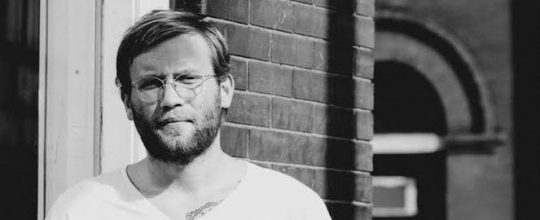
Grant Maierhofer

.

I walked through the city limits
(Someone talked me in to do it)
Attracted by some force within it
(Had to close my eyes to get close to it)

xxxxxxxxxxxx“Interzone” – Joy Division

Whether factually or not, I’d trace the severe, consequent moments throughout my life to stretches of movement. I pace. I walk. When writing my first novel, I’d finish some mornings at four and walk outside in my father’s neighborhood in underwear and lie down on the street at the intersection. Nobody came, I wasn’t worried. I’ve convinced myself somewhere over time that all we do is bound up in all that’s done: i.e., you pore over documents researching projects, say, and feel it’s this that leads to good days of work done. What about the menial tasks? The mailbox walks. The family calls. The television watched. The food prepared and not; eaten, not. We pay attention to apparently massive events of import and neglect the steps it takes from where you sit to the place wherein your bladder can be let. I do this, in turn. I care little while the small moments are happening and even belittle them to my detriment, often feeling I’ve done nothing all day when to recount them would require sincere attention. I think of walking in these terms. I thought of it as necessary toward a particular kind of relief nothing else brought. It wasn’t constant, I didn’t walk great lengths daily but when I made time for it something else seemed to happen.

Walking for me changed when architecture changed, cities or long rural stretches suddenly took on meaning, became signs of something, warped. In Jarett Kobek’s novel of the 9/11 attacks, ATTA, his iteration of Mohammed, Atta, wanders cities hearing voices in their materials. I hadn’t known this prior to reading but Atta was a student of architecture, had written a dissertation in fact regarding the imperialist dominion of metropolitan architecture over the Middle East. The heft of these sentiments is largely unimportant to my purposes here, but I often wonder about the post-9/11 psyche and its relationship to architecture. Like the possibility of burned, sacked, destroyed works of art—either by the hands of their creators or fascists or mere accident—I wonder if anticipation of destruction alters our sense of the landscape in ways it simply couldn’t prior to the explosive power of our present. To be sure, it isn’t only terrorists who alter our cities, our landscapes. I grew up in a town in apparent constant search for redefinition amid advancing norms. Restaurants in husks of old diners, college campuses redone in glass opposed to brick, these are familiar shifts to anyone alive today. Although his final acts warp any logic one might glean from either the real or fictional Atta, this notion of an intensely personal, intimate, physiological relationship to one’s comparably inanimate surroundings would seem a thing not duly mined, considering its likeness to questions of AI, the Singularity, or our soured relationship to ecology.

***

In Tsai Ming Liang’s brilliant short film, Walker, perhaps the polar opposite to Kobek’s citydweller can be found. What happens: a bald monk walks slowly, almost frustratingly so, through the city. He holds a bag and by film’s end removes—slowly—a burger from the bag, taking slow, meditative bites. It’s my understanding that this sort of movement is occasionally a form of actual meditation. This makes sense to me. Turning inward and simply sitting there is often trying, but doing this while focusing in minute detail on every movement made, taking deliberate steps, asserting the body’s form against the horror of the world, this makes perfect sense.

I’ve always viewed walking as a literary matter, an artful matter, long before discovering figures like Iain Sinclair, or Guy Debord, or Baudelaire and conceptions of the flaneur. Walking has always proven therapeutic, whether doing so aggressively late at night and letting the apparent danger of the world present itself, or doing it mildly one afternoon after being inside for too long, the act of walking has simultaneously transcended a basic corporeal state, and asserted one.

***

Rogers Park is a neighborhood in north Chicago. Where I lived you’d exit the El and through a smear of shops and bodies have encountered a wonderful nodding of demographics. I lived in an apartment on my own with one room surrounded by large family apartments always hubbubing and boiling these complicated wafts. I never came to know them of minor nods and kept to myself that year from this perpetual tendency I have of eating or not the wrong medicine, worldview, or daily set of acts that led through all their variation to the same gutless solitude, a bitter living spoken aloud to myself and only made to wane through incredible heaps of television and the few far-between obsessions with the arts.

Leaving my apartment after turning right once you’d find entry to a beach. This beach is on Lake Michigan and I typically walked along it late at night. At my entry, a jut of large rocks allowed for a sort of pier whereon you could easily fall into water were you careless. I was often careless and ill-dressed for whatever occasion it was but I never fell in. I’d walk out, say, mildly winded from the trek from studio there, and sit on some rock’s jagged seat to watch the sky and water. This area isn’t exactly dangerous regarding crime but all the same one would do well to focus on matters and turn any potential needs—directions, whatever—inward. For myself these were paranoiac times. I’d come upon a unipolar depression summer previous after meddling with my skull since a youth and being poked at by various abbreviated meds. Then I took a heap of medicine each day and returned to Chicago bright-eyed. Then I threw my medicine into the toilet and sat in the bath without good light and read at pages of Jim Thompson or Céline until dropping the former into the tub to watch it waterlog, and leaving apartment night on night with latter gripped to ward off the world’s moods and chisel numb idiot notes upon my head.

***

So this beach was particular, dirtied, humming and full of death. I’d wear what clothes were there and sit on wet sand spreading my arms out beside me making bellows.

An aside: on arriving second year in the city of H.H. Holmes I wound up broke downtown without means to ride the L back up to Rogers Park. It being midday and having eaten—I, bodily, have diabetes mellitus and thus would note these things at moments—I decided to walk home. This walk took me eight hours and for the last two I dug in the garbage bins lining the lake for sips at discarded Powerades as my blood sugar had made its plummet.

***

Endless hubbub has, can be made of the opening to Wim Wenders’s masterpiece, Paris, Texas. I first saw this film when living in Chicago. I watched it and, some point after Harry Dean Stanton’s miserado “Travis” made his long walk through the desert valley, I said to myself “this is my favorite film.” What happens in its opening, as noted: a man in a tattered suit and red baseball cap walks. He’s returning, it seems, as he’s so disheveled, and carries a two gallon jug with remnants of dirty water. Simple, droney guitar emanates, and his walk continues. I know of nothing like it in cinema, not to mention films taking place in America, and I can’t watch it without feeling buried in some abstract sense.

Just as often as walking shaped my days and hours were spent focused on the few feet of ground just next, I’d create arbitrary treks to add small blips of meaning to otherwise empty, useless days. This was at a time when I’d begun work on my second novel. I’d turned 21 and lived alone. I’d read Frederick Exley’s trilogy and Céline’s Journey and thus when I’d come home from school or movies or walks, I’d etch away at staccato bits of narrative I then called Shadows to the Light. I’d wake and have coffee and work, then walk for X amount of time. I’d return with ideas or scribbled notes and work until I couldn’t, then leave and scale the aisles of an all-night grocery not wanting to go home just yet.

***

Long walks then along the beach and through the park as long successful coffee’d stints of work. Short, staccato blips I’d map out imagined lines from block to block nearby so as to stave off this constant note of failure.

Exley walked, if memory serves, after a hospitalization; he’d sat on his mother’s couch with dog to watch television for months. Eventually, and abruptly, he took to foot and spent his days walking until he couldn’t breathe or take it. I admired this and understood. All my life I’ve tended to saturate my head in often rotten media: literature sure and film but also hours upon hours of television. I’d do this then and came to realize that movement, physical movement, could right the muck. Perhaps it’s never entirely right but it at least put the muck to work in interesting ways. I’d walk say after reading Jim Thompson in the tub or watching police procedurals and edges of paranoia scattered my thinking.

There is, then, at best, a kind of art ingested through covering the city, letting the city cover you. My body would be anxious, slow of step and in my head I’m frantic. In retrospect it becomes simple to toss figures at it. Remember the monk, remember Baudelaire, remember Rebecca Solnit and the foundation here, walking as transmutative, walking as compelling, fundamentally human, Iain Sinclair covering the M5 and allowing himself to become swathed in the narrative where he stepped. I’d aspire to it, and perpetually fail. I remember Molloy and steps taken into the unknown and bodies affected by their environment until all that’s left is a withering tramp, a citizen without shoes sucking on stones and keeping time this way. Once I felt chased through the park. I listened to music. I turned Beethoven loud in my ears and covered ground where nobody would follow. Followed still, I turned and faced the person. I screamed at them and wandered off. I was losing myself. An older man saw me later and spoke with me. He flattered me. He flirted with me, he told me all would be O.K. and the person likely just wanted to speak to me. I imagined a life with that old man. I wanted to hug him, to kiss him and feel his history pass through me. I stood there with him and eventually he did hold me. I do not know how I looked. A confused person, thinned by anxiety and in search of something. I sometimes met older men that way, though typically it never went beyond conversation, always in transit. He was sweet, however. He sort of held me in his words. That night I returned to my apartment and received a strange message. I didn’t know where it came from and it showed a male stood up in his kitchen, a kitchen. I didn’t respond but it didn’t make sense. I was losing it. I’d continue my frantic pacing contacting strangers online and speaking with them on the phone, always older men and women and always touched with some bit of the anxiety of lust. The problem of walking is imagining your lives in every step, what might’ve been. The problem of reflecting is you’re brought back, wherever you’ve been, to feel the heap of potential history wash over you. I walked, then, to put myself at the feet of living and submit to human beings, to open myself and fail to welcome entirely the lonely glints returned in eyes as I went past.

—Grant Maierhofer

x
Grant Maierhofer is the author of Postures, GAG, Flamingos and others. His work has appeared in LIT, Berfrois, The Fanzine and elsewhere. He lives and works in Idaho.

x
x

Jul 142017
 

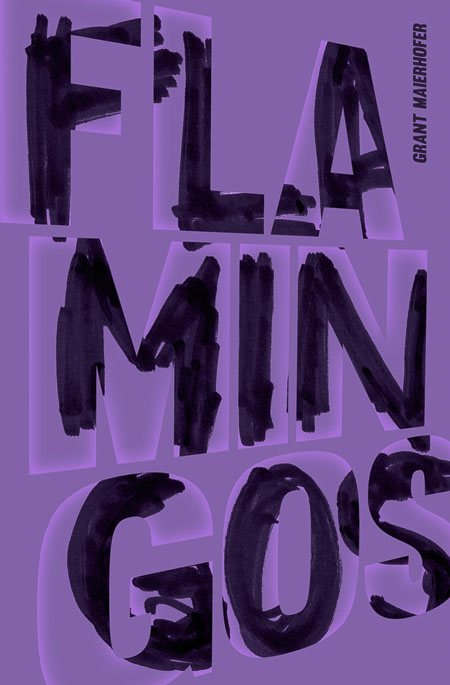
Grant Maierhofer Flamingos

Flamingos
Grant Maierhofer
ITNA Press, December 2016
ISBN: 978-0-9912196-9-8
188pp Paperback, $14.00

.

In a recent article published in 3AM Magazine, Grant Maierhofer explains his personal experience of reading Joyce’s Finnegans Wake. “Reading FW,” he explains, “is a bodily thing, and strangely so. I tend to find I’ll begin with resistance, certain I’m misunderstanding every letter until suddenly a dreamy rhythm overtakes me and I’m able to stomach paragraphs in breaths. I’ll often slow to crawls in turn and view the pages as discrete, visual, concrete passages rendered as micro- and macrocosmos for diligent poring and slackjawed stupor alike. The text seems to work on these levels because Joyce had thought the bulk of his life about what printed text might venture to do.” “I read Finnegans Wake,” he continues, “as an ode to forms, forms explored by Joyce himself and referenced throughout the text; forms shattered and rendered useless to traditional interpretive means by intuitive, heartily experimental—almost spiritually so—pages of linguistic forest fires simultaneously enacting and subverting their own interpretation; and forms Joyce still saw as viable means of depicting, defining, and recording human experience in a language at once the stuff of dreams, Esperanto, and music to which, I’ll agree, all art aspires.”

Reading and writing are, in fact, bodily things, although not many writers are fully aware of that. I would say that the great experimental and underground literary traditions—what Ronald Sukenick touted “the rival tradition”—are, at least in part, an attempt to re-embody the literary practice. Kathy Acker and Dennis Cooper—two of the authors often mentioned by Grant Maierhofer—are recent wonderful examples of this kind of stylistic exploration.

“This work will be a nightmare. You are no detective”—says an anonymous patient in Flamingos. It comes as no surprise that the most accurate words I’ve read about Flamingos thus far were by the Swedish-American poet and translator Johannes Goransson, who has been theorizing about the new “rhetorical punk” styles (using Eloy Fernández Porta’s term) he names “atrocity kitsch.” “This is a noir without the proper detective to piece back together the crime and its narrative”—writes Goransson—“This is self-surveillance under the influence of drugs, art, poetry. Without the narrative cure, the novel becomes sick.” Flamingos’s characters embrace the impossibility of the cure and celebrate the sudden joy of recognizing this impossibility and turning it into art. Art starts when you accept that, as Joyelle McSweeney wrote, “nothing can be undone, but everything can be done again,” because “the Artist cannot remove him or herself from the economy of Violence. Vulnerability to Art is Vulnerability to Violence; that’s what Vulnerability means: the ability to be wounded, to bear the mark of the wound, to suffer malignancy, and to issue malignant substances.” [1]

***

Germán Sierra (GS): One of the first things that called my attention in Flamingos—maybe because I have been recently doing some writing on the topic—was its performative structure. Later, I read in your very interesting research notes on Flamingos in Necessary Fiction that you want “an art a bit like life and stripped of tendencies toward understanding, the body and head rendered in text and the text as distillation of body and head — a performative thing.” I believe the idea of performance is very important in your work, and it becomes more evident in Flamingos. In my view, Flamingos could be perfectly imagined as a play—there’s even a Dramatis Personae list at the beginning—in which the characters project themselves on a group therapy-like background. This creates a flexible environment (much like social media environments) where fragments might work as independent monologues but they might also contain dialogues within themselves. You said that the book started with disparate elements and fragments, how did you came up with its final structure?

Grant Maierhofer (GM): This book took very different forms during its editing, and even really composition. I was working with smaller pieces in part because I’ve had an ongoing fascination with the fragment as a potent literary form, especially these days. As a result of this, the larger form would change depending on which fragments in which voice or register were working well. The two big influences early on were Ronald Sukenick and Kathy Acker, with Acker’s Empire of the Senseless and Florida offering an ideal reference point for these shifting, therapy-tinged voices. It wasn’t until I solidified a publisher with this early version, though, that the bigger structure became apparent. My publisher, Christopher Stoddard, offered to have me work with Travis Jeppessen on bringing these disparate parts together and finding coherence, a finished book. What I had were pages and pages of documents, the Flamingo sections written on neon index cards, others written on my phone or saved as separate chunks in Word, and a sense of how it fit to me but little desire to give it what seems a more traditional structural spine, removing this cast of voices and their more aggressive relationship to one another—something about the final text I feel good about, did not want to remove. So Travis, over the course of editing and having conversations, would argue from a reader’s perspective and desire for some coherence to these voices. The result, then, is my attempt to respond to him and any potential reader while hopefully holding onto the performative energy not only of composing, but of the relationships these voices—their passing referenced, syntactic disruption, etc.—have within the text. I think of Samuel Fuller and his Shock Corridor, or Lynne Tillman’s American Genius, or Shulamith Firestone’s Airless Spaces. These are compelling to me because they are overwhelming, and in many ways they’re overwhelming because you have disparate, perhaps opposed, voices or perspectives or even sentences clawing at and over one another for an audience’s time. To me, these seem like somewhat performative concerns. A writer generates something, hopefully to some degree indicative of the hell of being alive these days and making sense of the sea of information. A reader takes this in, and hopefully in that transmission perspective is gained, a quiet amid screams, or even a context for screaming. My favorite writers enact something on this order, I think. As well as musicians, painters, filmmakers. The final form, then, aspired to something like a chorus of escapees from modern life smearing mud on themselves and carving diagnoses on walls. How close anything comes is impossible to know, but this was my hope.

GS: Yes, I understand your process very well, as I usually work with originally separate fragments too. In my last novel, Standards, I spent more time on trying to find the “right order” for the fragments—which, from the beginning I knew it wasn’t the chronological one—than on writing them. The initial references you mention, Ron Sukenick and Kathy Acker, have been also very important to me. I’m especially happy to see Sukenick in this context, as I believe that, unlike Acker, he’s kind of in oblivion now. In my opinion, he deserves more attention. Some of his work is available online, but I’d like to see his books republished. Getting back to Flamingos, I like very much your image of a “context for screaming”—I believe this is a quite good definition of what experimental fiction has been pursuing for a while now, maybe because it’s harder to develop such a context in literature than in the audiovisual arts, where experimentation and risk have been historically much more appreciated. But I agree with you on the idea that we’re at a very special moment for literature, much like it happened from the late 70s to the early 90s when postmodernism mutated into avant-pop. I believe the literary use of language is becoming “counter-spectacular” as a way to provide alternatives to the “reality-as-show” we’re living into, and this is expressed through queerness, radical weirdness, obscurity and, particularly in Flamingos, madness. In my view Flamingos points to the recovery of the de-territorializing power of madness which had been recently re-territorialized by neuropharmacology and neuroscience: the therapy-gone-wrong framework works as a performative representation of our current society as spectacle-gone-wrong. This brings us back to Foucault and Deleuze, of course, but also to Beckett, Ionesco and Jarry. And it seems of particular importance in a moment when “reason” is often presented as “software for the show,” as something quantifiable that could be “traded.”

GM: Absolutely. Your initial comment, too, feeds this larger question of attempting to represent what’s been used as a limiting category, madness, in a (hopefully) more fluid way. I would feel awful if characters, or voices, or moments in Flamingos were easily quantifiable by diagnoses, and I think this is where literature presents unique opportunities that don’t exist as readily in other art forms. Bowie, for example, queered our sense of what the rockstar could be, but it required the extra performative dimension for this to fully resonate—he had to appear. The book is dedicated to Nick Blinko because Rudimentary Peni is one of the best musical iterations of the madness of living I can think of, and yet the feeling of listening to their ‘Inside’ or something, is far different from reading the mania encased in his novel The Primal Screamer, and it’s that difference I hope to pay attention to. I think of pure theoreticians working against heteronormativity versus the experience of reading The Letters of Mina Harker, in one sense a novel that chronicles a marriage between a male and female, but one that queers the institution of marriage far better than pure theory can by leaving in the mess of days, of lived experience. Somewhere, it might be included in James Miller’s biography, Foucault talked about seeing the work he did as closer to fictive, creative work. Sitting in archives and sifting through documents much like Kathy Acker did and assembling reams to counter the force of history. That slippage, that line between pure theorizing and enacting experience, performativity, or even language and experimentation therein, is why I see fiction as increasingly important in our time. It simultaneously offers new ways of reading notoriously dense theorists who worked against our dry, useless institutions, and new applications for reading more akin to experiencing performed art—relentless concerts that tear into the head, witnessing live artworks that ruin the artist like the early Throbbing Gristle/COUM Transmission stuff.

There’s been a long tendency of merely aping those who came just before. Duchamp talked about this somewhere, that artists might be better off pulling from random eras and movements—Brion Gysin’s idea of writing being about fifty years behind painting, etc.—and I find that very important. Not all writers or readers are engaging in the established traditions of literature as defined by institutions primarily dominated by heterosexual white men, and I’m of the view that the best work is being done against this. Read whatever you like, of course, but I think it highly important that at least some work attempt to bury any sense of an established canon. For me, that has meant seeking inspiration elsewhere, and the experience has proven the more fulfilling.

I think that what Sukenick did, and those aligned with him and those who followed at FC2, in turn, is probably the most interesting wave in American literature to yet occur, and all of it seems bound up in what I’ve just (poorly) attempting to state. I don’t know or care whether people will read those rather niche texts for fifty, one hundred years, because to me they’ve already reframed my sense of a broader literary culture and shaped my worldview. In some sense, that might make it even more compelling. We can read about the Black Mountain College, for instance, and feel completely lost in what seems like the most important academic/arts experiment in the 20th century, but all the while other students and teachers existed at other colleges in other arts movements never knowing about or at least acknowledging its existence. We’ll always have documentation of this sort of thing, and I believe it’ll always find some audience, but it seems quite alright that they be avid devotees and small movements like punk when compared to arena rock or something in its heyday. Nostalgia will always magnify it in turn, but nostalgia’s a toxic thing. I dunno, I veered off a bit there. These are the things I find compelling and why, maybe.

GS: Yes, I agree with you on the toxicity of nostalgia, this also points to the need to find different ways to think the past, more in the “archaeological” or “genealogical” mode like Foucault did. I find that many contemporary novelists are approaching the past that way, probably also because we’re living in very “aesthetically undefined” times, and we need to borrow aesthetical references from the past—avant-garde, modernity, post-modernity… Returning to your characters in Flamingos (and your previous books), one thing I like a lot is that they’re allowed—they allow themselves—to be wrong. I believe this is a very important feature in our days—when most people are obsessed with dichotomies such as truth/post-truth or facts/alternative facts. Actually, I find that the power of punk (and madness) resides in accepting the likeliness to be wrong but going ahead anyway—the “you-don’t-need-to-know-how-to play” thing, just jump on stage and do your best. In Flamingos everybody seems to admit being wrong—even Simon, the therapist, seems aware of being playing a role: “And I taught them. And I did not.” This is significant because, in my view, the most important thing for keeping a “sustainable” community is not truth, but trust. It’s possible to trust someone even thinking than she or he is wrong, and this is the essence of community and also the cognitive basis for a healthy skepticism. As Fernando Colina—a Spanish psychiatrist—wrote: “Reason is never there, reason is always about to come.” So maybe the punk gesture means that now: allowing yourself to be wrong to be able to catch reason as it arrives.

GM: I’m very interested in all of this, in part because my approach when writing anything has usually been one of immersion. I want to immerse myself in a voice, a worldview, a location, whatever. I don’t necessarily hope to find something close to Truth. I hope to enact something, to offer something, and I think community is a closer notion to it than artistic truth or even coherence. Possibility among individuals. Trust in that possibility. All of this is making me think of Vito Acconci. He started as a writer. Went to the best-known U.S. MFA program and wound up leaving to create situations and performance art, and thereafter to create very community-centric works of architecture and sculpture. He’s indicated that he did this because a growing dissatisfaction with the page as an art space. For me, for all of my dissatisfaction, the page is still my favorite space and words and other materials therein to transmit meaning still pull me more than anything else.

I think characters or even works remaining open to the prospect of wrongness is fundamental. If I didn’t feel this way I might engage in language through poetry alone, or nonfiction alone, but with fiction the assumed relationship to readers is precarious from the beginning, skeptical from the beginning, so there’s a good deal that can be done in terms of empathy, identification, or even anger or outright rejection of characters. I was very interested in this early on, I think, because I started writing while in rehab, and continued as a sort of breather from AA and NA and the like. In there I’d find myself telling stories depending on mood, or circumstance. Say I’m in a room with working-class older alcoholics in rural Minnesota, and I know I need to talk about my anxiety. I might talk about the same situation as I’d discuss in a meeting for addicts under 25, but it’ll be adjusted due to circumstance, and to speak to my anxiety where possible. I’m performing, then. Not dishonest really but calibrated so that I might get the most from a given meeting. Emphasize relationships and trust in therapy if that’s pressing on me. Emphasize relapse if I’m losing my footing and trust people can identify and offer insight. It wasn’t as conscious as it sounds now in retrospect, but it was all unquestionably bound up in how I started writing and came to need literature and art.

I started based on feeling, and need. Elias Tezapsidis talked about The Persistence of Crows and how it didn’t seem written for readers. I think that’s probably true, as most of my early writing was based on an urge to just occupy a mindset for X amount of time and see it transmitted to a measurable form, be it a book, or the early stories from Marcel, whatever. These characters could be wrong, then, or just buried in flaws and even total ignorance. They weren’t created as tools, or at least not pawns, but responses to a loneliness, a desire to open my head up.

After this I discovered writers like Christine Schutt, Brian Evenson, Maggie Nelson and more, so my concerns became more formal and structural. The object became the ideal, I guess, rather than the process and the feelings therein. Being wrong or being flawed is still a priority, as I am a human animal in 2017, but I’m also highly interested in the possibilities offered by fiction, by books, by words presented, not offered by other media.

GS: Your new book GAG is coming out in April from Inside the Castle. Is it possible to know a little about it?

GM: GAG began after my story collection Marcel went out of print. I wanted to destroy that, so I took the very first draft of that book and began cutting it apart. I got rid of huge amounts of that text, and started filling in the gaps with a narrative that’s sort of a nod to Dennis Cooper’s work, among others. Marcel proper is being reissued by Dostoyevsky Wannabe, so making GAG into an entirely new animal grew highly important. My process was similar in this to the composition of the PX138 3100-2686 User’s Manual, as indicated in the excerpt “Clog” on Queen Mob’s Teahouse. I would, say, isolate one small section of 100 words or so, inject it with new material, then automatically translate it through Korean translation software or something. Then, piece-by-piece, I’d translate it back so it would be slightly ruined, and rewrite it into a new document. Then I was making collages and adding text or warping it through that. Then the publisher would work with me on visual/typographical elements, and over time this new thing was born to do with suburban violence, ruined language, and distributions of power in America’s very problematic state.

Grant Maierhoff GAG

It’s been a long time in the making, but I feel very good about it overall. GAG and the Manual that’s coming out on Solar Luxuriance are sister texts, so having them released in the same year is a great feeling.

I’ve thought a lot about Dennis Cooper’s work since first discovering it, how he’s basically reshaped the potential of fiction with his GIF novels, and prior to that how The Marbled Swarm reworked how language can manipulate and fuck with readers. I wanted to honor his work and incorporate aspects I’ve loved from all of it in one print book. The GIF stuff, his blog, The Sluts and The Marbled Swarm, GAG was, among many things, an attempt to honor that body of work.

GS: It sounds amazing!  I just went through the first 20 pages or so in the PDF, and I think I got its feeling very well. I am very interested in this kind of composition processes—I experimented myself with the electronic re-translation of texts in some parts of my 2009 novel “Try Using Other Words.” What I’ve read thus far reminds me the destroyed, “dismembered” prose of other contemporary writers—besides Dennis Cooper—I now we both admire, like Leslie Scalapino, Blake Butler, Sean Kilpatrick, or the cyberpunk novels by the japanese artists Kenji Siratori. Cooper, of course, deserves special attention. He’s such a extraordinary figure in contemporary American writing, not just for his own work but also because of his continuous support of the experimental, underground, punk, or whatever literary scene! We all (not just American writers, but also people like myself who particularly enjoy this kind of writing) should be very grateful for his blog and his strong implication with fringe books no matter where they come from.  It would be difficult to understand the American literary environment of the last sixty years without the generosity of writers such as himself, Sukenick, Gordon Lish, Bob Coover…

So you have a lot of books coming out soon! GAG, PX138 3100-2686 User’s Manual, and Drain Songs, and I’ve read another three from the madness cycle are on the making: Girnt, Drome and Unacabine… I’m looking forward to all of them!

GM: I think I began writing as a means of leveling out a certain degree of misery I felt at being alive. Going forward, and becoming aware of worldly miseries and the struggles facing everyone, my response has been an odd mixture of wanting solely to champion the work of those who’ve said and done it better than I ever could, and devotion to writing things myself to attempt to process being alive in terms I’ve come to recognize in the works of others—many you’ve mentioned—that seemed, at least sometimes, to call for responses or communion. I read Jan Ramjerdi’s Re.La.Vir and suddenly GAG, a manuscript about fucked-up people in basements and assholes in suits controlling them, had a formal sibling. Sometimes it’s tempting to simply review books and point to Cooper, or Ramjerdi, or Delany, or Vollmann, as brilliant examples of what literature can do, can be in response to hellish situations and experiences. Sometimes, though, that temptation is odder, more deeply felt and sometimes even terrifying, and then my own writing seems to happen. I don’t know. If I’ve been productive it’s been the result of this and a good deal of self-hatred, disgust, and hopelessness. As defined earlier, though, I’m more interested in the extreme fringe-punk approaches of groups like Throbbing Gristle, or artists like Tehching Hsieh, who allow the work to ruin them and accuse them and eat them and harm them in the process, so that the end product looks less like a piece of protest art than Lucifer Rising. I think my writing started more straightforwardly, and I tend to detest my early stuff because of that, but now I’m preoccupied with experience, abstraction, and a kind of deep internal violence that hopefully comes across in these more recent projects.

I was very, very obsessed with Cooper’s George Miles Cycle for several months a few years ago, and even thinking about it now I get caught up in how transformative it was to read those books. As a result, I always dreamt of writing a cycle. It wasn’t until Flamingos was in a second draft that it became fully clear it could be done, so long as it wasn’t just a bad ripoff of Cooper. Madness, or mental illness, and many of the possible and horrific iterations therein, these are ideas I’m more comfortable engaging with as I’ve spent my life on the often ugly side of them. Fiction, in turn, seemed like a reasonable way of not speaking as an authority to anyone else’s experiences  of these things, so the project has persisted.

I think about Elizabeth Young’s close to her introduction to Pandora’s Handbag, which, paraphrased, goes something like: I guess if nobody’s writing the books I want to read then I’ll have to write them. Damn it. That pretty perfectly articulates my state most of the time. I read the work of others I love as much as I can. Sometimes a feeling is too personal or impossible or an idea’s too particular and thus I’ve got to write as well. That’s more or less how it goes.

GS: Your previous book Marcel is now being re-issued by Dostoyevsky Wannabe, which also published your poetry collection Grobbing Thistle. Flamingos was published by ITNA press, and GAG by Inside The Castle.  I love your publisher choices, all of them are small and independent but very well curated, very personal projects. How do you choose your publishers?

GM: In a weird way, although many conversations about the state of publishing are despairing, I feel as if we’re living in one of the most plentiful stretches of time for small presses, for publishers and writers interested in the work and the book as object, as experience, as performance, things are pretty good and compelling. I’ve been lucky to find presses willing to embrace uncertainty and experimentation, and really I’ve found them based on seeking writers and artists publishing through them. Inside the Castle reissued Hour of the Wolf, which, alongside Slow Slidings and Throw Yourself Out and See If It Makes Me Come, is one of my absolute favorite things M. Kitchell has yet written. John Trefry’s work as well, and the aesthetic prompts of the press, were as inspiring as synopses for artworks themselves, and I guess that fed into things in turn. Ditto for Dostoyevsky Wannabe, their approach seemed in line with what my favorite writers do. They’ve also published heroes of mine like Sean Kilpatrick, Gary Shipley and others, so when I wanted to find a press who’d really be on board for something experimental and fucked like Grobbing Thistle, they seemed perfect. Although much of Marcel is more straightforward, I feel it fits well with the cassettes DW puts out, and with the additional stories and whatnot it seemed worth reissuing. Another thing is, I have zero interest in what a lot of–especially U.S.–writers seem interested in as far as fame, or even a massive audience for the work. Presses have inspired me just as much as writers in this regard, with outfits like Cal A Mari Archive consistently publishing incredibly risky, innovative material, doing it with a personal touch that furthers the efforts of its writers, but not speaking to the larger culture of publishing at all, except to push back and whisper fuck you a bit now and again. That interest has led me to write how I’ve come to write, I think, and it’s also led me to the wonderful, strange, queer, outsider publishers I’ve been lucky enough to share work with. Small presses, in turn, are usually run by writers, which might be an ideal model, I’m not sure. Sometimes it can lead to an excess of dreaming that can’t quite materialize, but often it means that the entire experience is performative, engaged, and shot through with the same anger and desire that inspired the writing in the first place.

x
Grant Maierhofer is the author of Postures, GAG, Flamingos and others. His work has appeared in LIT, Berfrois, The Fanzine and elsewhere. He lives and works in Idaho.

x
x

German Sierra

x
Germán Sierra is a neuroscientist and fiction writer from Spain. He has published five novels—El Espacio Aparentemente Perdido, La Felicidad no da el Dinero, Efectos Secundarios, Intente usar otras palabras, and Standards—and a book of short stories, Alto Voltaje. His essays and stories have appeared in Guernica, Numéro Cinq, Asymptote, The Quarterly Conversation, Queen Mob’s Teahouse, The Casper Review, The Scofield, and in more than twenty collective books.

x
x

Footnotes    (↵ returns to text)

  1. McSweeney, J. The Necropastoral, Poetry, Media, Occults. The University of Michigan Press, 2015. p. 186
Jul 142017
 

Grant Maierhofer


My name is Lyle. I’ll leave it at that so far as ID. I’ll go on however to say that, if you’re feeling generous, I may contain multitudes. I may be dense with potential. I’m a failure in so many words. I’m tired of feeling this way and so I’m trying to contain those words myself, to write them out. I want my feelings to be expressed so I might move on from them. I want to put some distance between myself and this place wherein I find myself. Other night I went to the gas station only to find half of my face still caked with black makeup. I live in sorrow. My days are full of thorns, people and bosses. I tend toward the sad, the weary. I’m an avid person though, romantic. I want to contain the world. I am a male but I would like a womb to contain the world. I should be so lucky.


I think I’ve slept for most of my life. I don’t mean it literally. I mean that as I graduated high school, as I saw my youth pass, I had these glazed eyes and didn’t care to open them beyond mere ability to see. Sometimes this can happen. Sometimes people aren’t meant to express themselves in any recognizable way. My father was, by and large, this way. He had nasty tendencies, though. He’d hurt my mother loudly. I think this is what happened, anyway. I was sleeping.

Lately I’ve returned. I work now at the high school where I used to hide away. When you’re young everybody’s terrible. When you grow up everything’s terrible. Something changes between these in that things get worse, darker. Mostly, however, they are the same.

Each day I put on gray coveralls that you have seen. I push a cart that was given to me by an old man. This old man, my predecessor, had lost his wife. His kids were away, succeeding. This old man had lived a full life before this work. Then, losing his wife, his children, he found himself wanting. This old man sought work and found the position he’d occupied for seven years before I took it on. He trained me for a few weeks and then supervised, then left entirely. I think he might be dead.

The cart holds a garbage can that I’ll fill three or four times each day, depending. Kitchen staff attend to their cans and I’m grateful for it. Some days, events or come what may, I might focus primarily on trash. The school isn’t large. It would take an event or more to fill my can beyond three or four times each day, I’m saying. I remember when I was younger, going here, and we’d attempt to fill the can from distances with paper cartridges of milk. These were shaped like ships or small homes. We called them cartridges, and lofted them into the janitor’s can as he’d walk by. Looking back he’d never register this, even once maintaining composure when my cartridge of chocolate milk pelted his chest and landed. I’m now more understanding of his intimacy with death and suffering.


So anyway, I don’t live in my father’s basement. So anyway, I’ve got my own place. I’m fairly certain the person who lived here previous was a criminal, a felon. He left quickly and so far as I can tell the rent plummeted. My neighbors pay dearly. I pay a pittance because some crook likely opened his scalp where I eat my dinners. Give and take, sure. I spend my days when not working walking around this area. I like to grab a pizza, maybe, or Chinese, and sit with it staring off. I’d like to say I appear as some kind of threat. I hate this town, is all. I don’t think that’s what happens, though. Sometimes people recognize me and laugh. The worst is the high school kids. They’ll get pizza themselves, sure. Chinese, whatever. They’ll be out to eat and talking, talking and building their lives together. They’ll look over and see me, it’s often tough to stomach.


Then, after this, then, I’ll often try to make for the city. You understand, I hope. This town where I work is small but aware enough. They talk, you see. They’ll talk, each and all of them. I’m not a fan of talkers. I’m a fan of light. So what do I do?

In my room I go to the closet. There I’ve hung them, and others. Most nights I’ve got these leather pants, sure. I’ve got my T-shirts. I’ve got my boots, they shine a bit. I’ll put these on and sort of air my hair a bit. Somewhere when I was younger I loved KISS. Now they’re just O.K., mostly morons. I think maybe that’s where it started, though. So I’ll put on black lipstick. I’ll put on eye makeup and smear it down. I’ll light some Salems and put on my music. I’ll put on Pentagram. I’ll put on Venom. I’ll put on Saint Vitus and sort of air out. I’m tall, you see. My outfit’s black. My pants are leather. Living when I live, then, it can be tough to feel free. So where to go? I’ve found some places. I like the leather bars on karaoke nights. Mostly people there will want a pickup. It’s fine, sure. I’ve made it with men and women. I’ve dated a bit. I don’t go for this, though. I like the sounds. I like to feel a speaker press my body. Sometimes a burlesque, maybe, but often I’ll worry about teachers on a whim. Bored depressives with throbbers. Have at it, I mean. I’m O.K. with all types. I just want noise.

My favorite kind of blurs the whole bit. These barflies from the ’70s and ’80s had taken it upon themselves to give strange metal bands and such their due. Having no patience, however, for meatheads and fascism, they catered to groups of outsiders who’d play pool and dance, drink and come together, take drugs or write their names on walls. Some performance endeavor rumored to have been Prince’s fallback had his tenure at First Avenue, proved too tame, and these lifers took it upon themselves to keep his assless chapseat warm. Good citizens, all.

I’d like to state, however, a pressing thing: it took me fucking years to find my way. Where I worked, forget it. You find all sorts of lonely gentlemen after handjobs in parking lots. I partook. I’m grateful I partook as I was lonely too, but something always missed. I sat in audiences at drag shows and queer karaoke nights in otherwise square bars with no sense of welcome. I wore out my eyes on the internet until having eventually to masturbate myself to stupor. It took me fucking years.


I used to read a lot about New York and want to go there, before AIDS and before David Wojnarowicz had to sew his lips shut and before the murder and definition and language seeped through everything. I wanted bodies in rooms and their voices muffled against what? A shoulder or bathroom divider. It was my way home of seeking peace I think. I was always performing. I don’t know that this is a bad way to live. We have jobs, right? We have accounts and ways of being sought and keys to apartments and homes. We have children and responsibilities and worlds. I feel that we earn performance through this, even brief stints of fucking in cars, bodies blurring. The more I worked the more I drenched myself in black.


One day in question I had found myself hiding frequently at work. This happened often. I became tired of the same faces staring at me as I pulled their stuffed plastic bottles of trash from drinking fountains and whatever else. I’d clean the bathrooms thoroughly then. I’d work my way from floor to ceiling with bleach and whatever materials I had in decent supply as all of this was fairly unnecessary. Students were superficially disgusting. Teenagers were superficially disgusting. They’d cake layers of themselves onto the tiles but this was easily removed. What I was doing didn’t matter, but looked appropriate enough. I had let life reach me and get to me and all I wanted to do was curl up someplace institutional and weep. I couldn’t weep, though, so I did as I’ve suggested. I put things off as long as I could to get my work done. I smiled at my boss and I made sure every bathroom looked excessively clean and jotted somewhere that I’d done something of necessity.


At night, however, I might be free. I went to the gas station near me on walking home and purchased a tall can of cheap booze. I don’t often drink before arriving in the city but I was feeling rotten. On arriving home I removed all of my clothes from work. I paced around my living room smoking and cursing the day before opening my booze. My bathroom is small and dimly lit. My body looks alright in dim light, I’ve hoped. I looked at myself. I pulled my hair back and made lips at myself there in the dingy mirror. I ran my hands up the sides of my frame and felt my ribs, warmed a bit with pleasure or sex. I put liner on my eyes and smeared it down, kissing the mirror and leaving the day’s worker grease. I put black lipstick on and stood briefly on the tub’s ledge staring, then pulling on my leathers and a too-small shirt from when I played baseball as a boy. The shirt rose up just above my navel and as I hunched over to pull on boots I felt it stick first then rise above my spine, my lower back. The feeling of new fabric against me that smelled like smoke and perfume was enlivening. I wanted more.


I think about stories I could tell. My father could tell stories, could lie. I wonder about this. What creates a tendency toward fabrication? Is my split a fabrication? Would I be better off in therapy than writing out my thoughts? Where do I start and end of my need for writing is purely selfish? I do not have answers, but in the car I listened to Whitney Houston. I find what I think of as her transmitted vulnerability empowering. I left town and drove to the city amid lights and drank at my can of booze. I’d ease my arm out the window and let it sway there on wind. I’d smoke with the other as the can cooled my crotch. I felt feral. I felt set free. I felt my body boiling up with all the misery of my days and the stares of the students and I ran it out my hair, stared at myself in the sundown mirror and the running makeup, performing.


I wanted to quiet my head further so on arrival I drank several vodka tonics and sat sneering from the bar. I felt the booze warm my gut and my mood began to lift, yipping maybe toward a nice oblivion as the room filled up with nary clothed bodies kissing and sucking at each other. Men running hands over one another or women twirling hair to rhythms. Everyone reaching some fluidity and pushing to the edges of abject fucking on leather and neon fabrics only to be pulled back. I sat and watched until the pulse of it warmed me over.


I went into the bathroom after writhing against some fleshy bits and denim and found two gentlemen fucking. They were taller, like myself, so it wasn’t much to see them in the stall pressed to the wall and howling. The music in there was slightly quieter and thus I heard their groans as I stared into the mirror and ran the sink to wet my hands. Eventually I noticed someone crouched in the corner of the space and turned to see.

I haven’t made a point of meeting many people where I work. I don’t care for them nor they I. This is as it is. I am O.K. under these circumstances. This person I’d seen perhaps helping around the office, perhaps guiding buses toward the end of day. I can’t and couldn’t recall, but I knew her and knew her from work. I walked to her and registered a horror peeling the skin of her face back at being alive. Her eyes bugged out. The swelter of the room became heavy and miserable then. The gentlemen the stall over persisted in their fucking. She looked at me and didn’t seem to register a likeness, a fellowship in being human. I went to the sink for water and wetted a paper towel, returning and pressing it to her forehead. Her skin was pale. She was sweating incessantly. She smelled medical. I tried to touch my hand to her cheek to check the temperature there, encourage some level of identification. She grabbed my wrist and began pulling me toward her. I stood and she came with me. We stood together and she seemed barely to note the gentlemen in the stall near us. I don’t know or care much for drugs. I drink and have partaken, little more. This was something horrific. This was all the world pressing at my chest. I felt my fingers. They were dried up. They were shriveled. I couldn’t make sense of it. I’d run them under water awhile. I’d been sweating. I felt my chest heave and wanted to collapse.

The girl wanted to leave. I could see it. She wouldn’t vocalize. She grabbed my wrist again. We walked together through the black and swelter, the light and drink, until the cold night air shocked something into us. I felt myself coming together. I felt myself falling apart. I vomited there, or somewhere, walking toward my car. I vomited and it hit the knee of my leathers and I only know it in retrospect. She pulled my wrist. Next day, maybe, I noticed redness there. She was quiet. Her hair was short, brown but slicked in spots against her skull. Her shirt was white and not ripped but mangled against her chest, small gut and arms. She wore a coat and dressed in pants and shoes as if she’d only just left the school to come here. Her hands were shriveled and I felt them abrade my wrist and slither. I suppose she had a car as mine was only caked with my debris.


I don’t remember fucking then. I remember laying back or being fully prone on her backseat, our legs however they needed to be to mash us there. I remember staring up at the back window and feeling calm through its fog, its slightly frozen coat and her hands against my ribs. I do not think that she and I in fact fucked. Both of her cold hands, though, these pressed against the sides of me and held me there and she made no recognizable sounds. She made groans, sure. She perhaps whispered things against me and sweated through her clothes and mine. I felt the sickness of bile at the back of my throat and through to the next day. I can still feel the cold of her seat against my head. I remember knowing something. I remember the sounds of those gentlemen and wishing life could be that simple. I recognized her and felt pulled to her. I don’t know what my sense of responsibility was that night. I might’ve called 911, though I found no evidence the next day. We might’ve fucked, sure. I have experienced memory loss. I have missed days of my life staring off, asleep, not caring. I can piece together fragments only. Fragments of her wrists, say. Fragments of her hair and its slickness against my cheek, my mouth. The whispering and grunting at my chest, the howling even. These are my memories. This was an anomalous moment, a night that doesn’t fit. I found myself in complete lack of control and things seemed to spiral out in front of me. Perhaps she wanted to die. Perhaps she’d found that room to hear people fucking nearby so she might die near them. This makes sense to me. I can appreciate this impulse. Perhaps someone drugged her and she barely escaped. I trust the people there but I have a male body and there are differences, bars and clubs vary in degree of insidiousness or threat, perhaps. I’m uncertain how to piece anything together in retrospect. I only remember the window. I only remember the gloss of night and the armor of our coats around us as we held there against whatever death.

I woke with her stomach’s skin against mine, cold but for the small strip where we touched. I worried she was dead, then my head felt like it was being crushed beneath the sea, then a drunken bubble rose and I smelled vomit. I must have spoken with her but all I remember is her mumbling. I must have sat up and tried to figure things out but all that stands out are the lights on driving home. I think I spoke to her. I think I sat her up and made sure she could function well enough. I would’ve looked for something to straighten her out, a bottle of water maybe or a bit of food. I would’ve tried to do these things. I’m not sure which things I did and didn’t do. I hoped that I did everything. I woke later and hoped that I did everything.

I don’t know how to advocate or speak for another. I couldn’t have made her situation better or worse. She looked like me: her hair was matted in memory, her clothing a messy sprawl of unkempt materials, I remember all of it looking like escape, the both of us seemingly wanting to flee. I don’t remember what we said or whether we touched more on waking. I don’t remember if she was O.K. that night or what. I don’t remember feeling any relief or vomiting in my walk to my car. I only remember the lights as I began to surface driving across a bridge to my town. I remember sitting at a McDonald’s terribly early and drinking cup after cup of water and coffee, slowly putting myself back together only long enough to return to my small home and fall asleep caked in sweat and ugly smells until the afternoon.


Later on that week when I saw her outside of school as I walked my can toward the large dumpster I felt nauseous. I doubt if she recognized me. When I woke up from that night and looked in the mirror I might’ve been any anonymous body soaked in strobe and the mud of people. It didn’t matter if she recognized me. I walked by and felt my anonymity. I felt myself return to my youth in that hell and was calm and glazed over by the notion; asleep and it started at the eyes. Bells rang and children abounded. Groups assembled themselves at the doors of classrooms wherein they’d make minor messes throughout the afternoon. That evening two shows were being put on and I was asked to keep things orderly afterward. I’d accepted gratefully as things had felt amiss since waking in that car. I was always fairly close to death, I figure. I had never seen someone OD and this was something to process, maybe. I was feeling my whole world curl in on itself and become ruinous. I tended to ruin. I was a ruiner. I moved the can across the sidewalk having left a numbered door and made my way past the lot of them leading to lives filled with people. That night I might dress myself and lie on the floor naked to feel my limbs sprawl out. That night I might drink myself stupid and feel aligned with planets. I wasn’t sure. I walked by and felt the identifying touch of stomach as I passed her. Everything seemed O.K. Everything would be O.K. for me in turn. This has always been my problem. These have always been my problems. I am always gnashing my teeth against the low guts of life only to rise again to my mediocrity. I await the weekend when I’ll flee.

—Grant Maierhofer

x
Grant Maierhofer is the author of Postures, GAG, Flamingos and others. His work has appeared in LIT, Berfrois, The Fanzine and elsewhere. He lives and works in Idaho.

x
x