Jan 172011
 

The First Annual Numéro Cinq Erasure Contest

Here’s a mini-contest. Not so hard, not as daunting as writing a rondeau or translating from the Dutch without a dictionary. The words have all been written for you. You just have to find the story. This should be a dream for those of us who are imaginatively challenged. The text below is from Monsieur L’Abbat’s Fencing, or, the Use of the Small Sword published in Dublin in 1734 (text and illustrations from Project Gutenberg). Dg is not sure what makes a good erasure text, so this is somewhat experimental. Someone suggested using a passage from the Bible, but that seemed vaguely blasphemous. A sword-fighting instruction book has the advantage of a certain drama in the choice of diction. Conflict is of the essence.

Rules: There are always rules. An erasure is a text created by taking words out of an existing text. In the best of all possible worlds, you’d have been able to submit the original text with words blotted out—this would make for a certain drama of presentation. And dg supposes it would be possible for you to convert the text into a jpeg and then use a photo processing program to effect the erasures and then submit the final jpeg. But somehow the mechanics of this seem anti-inspirational. For the purposes of this contest, you just need to take out the words you don’t want and submit the remaining text. You can’t change the order of the words and you can’t change the capitalization. The words in your new text have to be exactly the same and in the same order as they were in the original. You can insert your own punctuation. Try to make it something sensible–a love story, perhaps. But it doesn’t necessarily have to be a story. It could be a poem or a scene. Let the words take you where they listeth.

Remember: at NC we value wit and arrogance as the paramount literary values.

The contest is open to absolutely anyone. Newcomers and people who cannot speak English are especially welcome. (People with memory loss issues would seem especially adapted to this contest.) Just sign in on the comment box and erase away.

Entries, as usual in these contests, must be submitted in the comment box at the bottom of this post (yes, yes, in the past, some NC members have been deeply confused on this point and entered under completely unrelated posts). Multiple entries are perfectly acceptable.

Entries must be submitted between midnight January 15 and midnight January 31.

There are no other rules except, of course, Gary Garvin will notice a loophole and dg will retroactively have to rewrite the rules. If anything is unclear, please mention it in the comment box.

Munificent prizes will be awarded (come to think of it, we forgot to award prizes at the NC party in Montpelier) as usual. A list of actual prizes will be provided upon request (send your requests to the chair of the Official Judges Panel).

dg

Here is the official contest UR-text

It begins here. When you have for some time used yourself to push and parry at the Wall, according to the Rules that I have laid down, you must, (tho’ ’tis not the Rule of Schools, especially when you push with Strangers,) you must I say, when you push with a Scholar of your own Master, push and parry a Thrust alternately, disengaging, and then do the same Feinting, and sometime after you shou’d make the other Thrusts, telling one another your design, which makes you execute and parry them by Rule, especially if you reflect on the Motions and Postures of the Lunges and Parades. Being a little formed to this method, you may, being warned of the Thrust, parry it, telling the Adversary where you intend your Riposte, which puts him in a condition to avoid it, and gives him room to redouble after his Parade, either strait or by a Feint, at which you are not surprised, expecting by being forewarned the Thrust he is to make, which puts you easily on your Defence and Offence: by this manner of Exercise, you may not only improve faster, but with more art, the Eye and Parts being insensibly disposed to follow the Rule, whereas without this Method, the difference that there is between a lesson of assaulting a Man who forewarns you, helps you, and lets you hit him, and another who endeavours to defend himself and hit you, is, that except the Practice of Lessons be very well taught by long exercise, you fall into a Disorder which is often owing to the want of Art more than to any Defect in Nature. The taking a Lesson well, and the Manner of Pushing and Parrying which I have just described, may be attained to by Practice only, but some other things are necessary to make an Assault well; for besides the Turn of the Body, the Lightness, Suppleness and Vigour which compose the exteriour Part, you must be stout and prudent, qualities so essential, that without them you cannot act with a good Grace, nor to the purpose. If you are apprehensive, besides, that you don’t push home, or justly, fear making you keep back your Thrust, or follow the Blade, the least Motion of the Enemy disorders you, and puts you out of a Condition to hit him, and to avoid his Thrusts. Without Prudence, you cannot take the advantage of the situation, motions designs of the enemy, which changing very often, according to his Capacity and to the Measure, demonstrates that an ill concerted Enterprise exposes more to Danger than it procures Advantage: in order to turn this Quality to an advantage, you are to observe the Enemy’s fort and feeble, whether he attack or defend; if he attack it will be either by plain Thrusts strait, or disengaged, or by Feints or Engagements, which may be opposed by Time, or Ripostes: if he keeps on his Defence, it is either to take the Time or to Riposte. In case of the first; you shou’d, by half Thrusts, oblige him to push in order to take a Counter to his Time, and if he sticks to his Parade you must serve in what Manner, in order to disorder him by Feints, and push where he gives Light. And ends here.
Dec 102010
 

Capture

.
Merge Right (or Left)

I’m on my way to see the play Studies in Motion, the true story of Eadweard Muybridge, the man who more than a century ago tried to stop time through experimental photography, but couldn’t stop the tragic entropy of his own marriage.  As I sit in my car, alone again, waiting to merge in a construction zone, I remember the essence of an old joke. An Edmontonian stuck in traffic comments to his friend that it’s a nice place to live, and will be even nicer when it’s finished.  This frustrating and seemingly endless road construction hints at a deeper truth.  The city is always building, always inventing itself, but it’s never clear what it’s trying to become.  There is always progress, but what is the goal?

The city is confused, juggling multiple and conflicting personalities.  Edmonton is isolated and extreme.  It is the northernmost, major city on the continent, and on a map, it sits apart from the other Canadian cities that huddle around the American border.  My life has been filled with long, contemplative hours behind the wheel, the endless patchwork of farmland and prairie mesmerizing me as I try to get somewhere, maybe to see her, maybe someone else.  This sense of isolation is fed by the severe climate: temperatures typically range between -40C and +30C.  People here have a sense of grim survival, gladly spreading their blankets on the flattened grass in Hawrelak Park in July, battling mosquito mobs, just to absorb a little of the solar radiation that will be such a rare commodity later in the year.  In deep winter, the sun is a weak orange orb, low in the sky, limping across the horizon for barely seven hours a day.  In my days as a cubicle drone, sunlight was only a vague dream.  Now it’s a little better: my office has a window that provides me a thin hope that I might survive the coming darkness.

Work Will Save You

People here like to think they are friendly and helpful, but sometimes, harder sensibilities prevail. Edmonton is an industrial city, a centre for the oil industry.  Not the oil executives, though: the pressed-white shirts, the money, reside in Calgary, a fact that only helps feed the city’s inferiority complex.  No, Edmonton is the service centre for the real work, a place where looming, skeletal refineries greet visitors from the east; where a gravel pit and fogged windows once provided the necessary seclusion for my young, urgent flesh to press against hers, only to be illuminated by a policeman’s light, a memory that was once a hot ember but is now a cold stone; where endless industrial parks of cinder block and corrugated steel circle the perimeter; where, from the clearly inferior position in my Honda, I must peer around pick-up trucks driven by real men.  Work matters here; idleness is a sin.  The first thing anyone you meet will ask you is “What do you do?”

Culture Frenzy

In a city of immigrants, one’s roots are celebrated:  the annual Heritage Day festival attracts hundreds of thousands of people, all eager to sample spicy ethnic food and over-amplified traditional music.  Every year, I navigate the mass of humanity that swarms Hawrelak Park, melting inside the red plastic tents as I search for the perfect curry.  Where you come from seems more important than where you are.  Similar numbers of people are attracted to a variety of summer arts festivals.  In August, the Fringe Festival transforms Whyte Avenue into a seething, chaotic display of alternative theatre and street performers.  This year, while munching on some unidentifiable, deep-fried morsel, I gave $20 to a New Zealander who was juggling basketballs while riding a ridiculously tall unicycle.  This guy deserved some reward for traveling so far to such a remote place just to entertain me on another empty afternoon.  An artistic feeding-frenzy consumes the city between June and August, an expression of the urgent need to pack as much culture and activity as possible into the few available warm months.

Too Much History Coming Down

History here waits like a prisoner on death row. Buildings more than fifty or sixty years old are often viewed as liabilities, more likely to be torn down than preserved.  New buildings imply progress and wealth; old buildings suggest inefficiency and poverty.  Architecture is functional and anonymous – best not to stand out too much.  There are exceptions, of course.  The new Art Gallery of Alberta stamps a striking presence on an otherwise humdrum downtown.  I love spending a few hours with the works of Picasso, Escher, the Group of Seven, or even Warner Brothers’ animators, then relaxing on the on the roof-top patio with a dark and bitter coffee, watching the traffic below. A lazy afternoon at the gallery was something that we once shared, when time mattered, when our hands would find each other’s even if our eyes were locked on the canvases.

Who Am I?

Edmonton may wear a blue collar, but it wears it on a lab coat: the city has been trying to reinvent itself as a centre of knowledge and research.  The University of Alberta, home to dizzying variety of programs, is still a place I will gravitate to on a Sunday afternoon, wandering empty corridors seeking out hidden passages, then later, sitting and reading a book while sipping my Java Jive special.  I spent four years as an undergraduate here, and I am always pulled back, like a marble spinning down a funnel.  The campus, a sprawling jumble of architectural styles, seems aloof as it overlooks the broad river valley, the largest continuous urban green space in North America.  The North Saskatchewan River, sometimes a slow moving, dirty green serpent, sometimes a haphazard, geometric collision of ice chunks, was once the boundary between two cities that became one.  As the largely undeveloped valley sprawls across the entire city, it pushes away at the edges, seeming to reject any identity that is imposed on it.  It is easy to get lost here if you leave the trail, and I have been entangled many times in the dense and unforgiving growth.

Weather Approaches

The play will be starting soon, but I am still waiting to merge.  The light has faded now, and the sky is beginning to threaten, to tease with a few snowflakes, a hint of the long chill that will soon arrive.  As I stare at the road signs, cells raw from the recent implosion of a twenty-year marriage, heart cracked, self-confidence shattered, immobile but unable to stop time, I consider my uncertain future and think that, yes, this city with no true identity, no definite goals, no sense of history, belongs to me.

It’s going to be a long winter.

—Glenn Arnold

.

Arnold

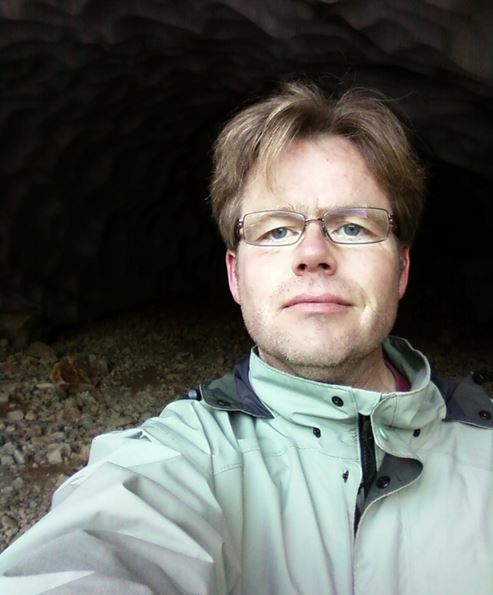
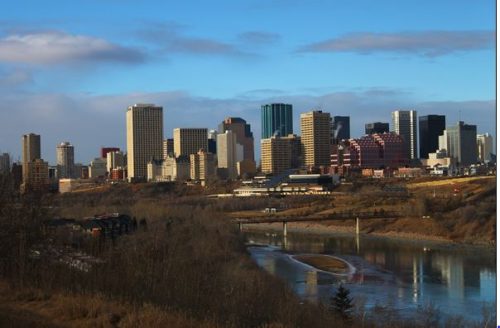
Glenn Arnold lives in Edmonton, Alberta, where it goes to -40 in the winter and there’s more oil than in Texas. Glenn took the photos of himself and the art gallery. His son Craig Arnold shot the street view, the refinery and the gorgeous cityscape down the valley.

.
.