Jan 042014
 

Dad photo

“Saltwater Cowboy” is a sharply perceived portrait of an extraordinary father, a man who served in the Navy, served on ships, all his life and left his son an indelible image of competence, courage, devotion and panache. Joe Milan lives in South Korea; this is his second contribution to NC. It’s a wonderful addition to our growing collection of fatherhood texts (we have a series of set essay topics — see them all here at Numéro Cinq Anthologies).

dg

My father said his life started at nineteen, the moment he decided to join the Navy. On a muggy August afternoon, he was sharing a bottle of Jack Daniels on a porch with a guy everyone called Bud. About halfway down the bottle my father blurted out, “Let’s go join the Navy.” They roared down the country roads in my father’s 60’s Datsun truck with holes in the floorboard, over the low hills of houses and trees where there are no dogs – only hounds — between the square plots of soybean and cotton, and into town to the recruiting office.

The recruiter showed pictures of girls and oceans and beaches and elephants of the Pacific and had them take the test and sign the papers. Two days later, after his family disapproved and said they wouldn’t let him go – “try to stop me” – my father and Bud were on a bus to Chicago and boot camp. They stayed the night in a motel along the way, and in the morning when my father woke, Bud was gone. Bud went home.

My father always left out everything that happened before that moment on the porch. For me, scraping the memories for stories my father told me when he had too much to drink, the moment my father’s life truly started was in a break room in a factory. After dropping out of high school, he worked at a rubber plant, constantly bombarded by chemical dust that stuck to his skin like paint. Once in the break room during lunch, a co-worker, who had lived his entire life in town working at the rubber factory, stood by the punch clock for a long moment. He looked around the room at the men in overalls, then down at his timecard. He muttered and then dropped to the tile floor, dead. Stroke.

* * *

Bedtime stories for me were Navy stories. Often they started when I asked about his tattoos, the cross anchors on his hands, the ships at full sail and winking girls in scanty sailor uniforms on his arms and shoulders. “Well, I got this one when we were pulling liberty in…” I heard about Singapore, Subic, Perth, Bangkok, well before Washington DC or New York. Every room was smoky. Dust trailed the speeding jeepnies and tuk tuks. Gun shots rang off in the distance. Men with names like Dirty Dan, The Fighting CB, and Matta gulped burning whisky and broke the empties on the dirt road and howled at the sky. Men fought over pool games and threw each other out of windows that had already lost their panes.

“Why, Dad?”

“That’s what young men do, have a good time,” he said. “It was fast living, boy. Real fast.”

My father, adventuring through these places, was as mythical to me as a Hollywood cowboy. And like a cowboy, he told me about vastness of space – blue fields of ocean instead of the prairie. The ocean could be as still one moment and stampeding over the deck the next. My father lived in the thick of dangerous waters and tumultuous towns.
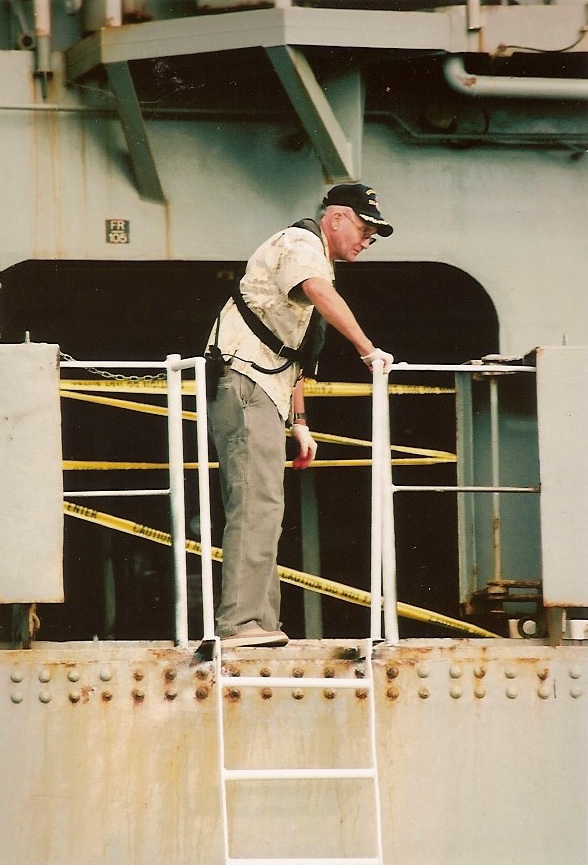
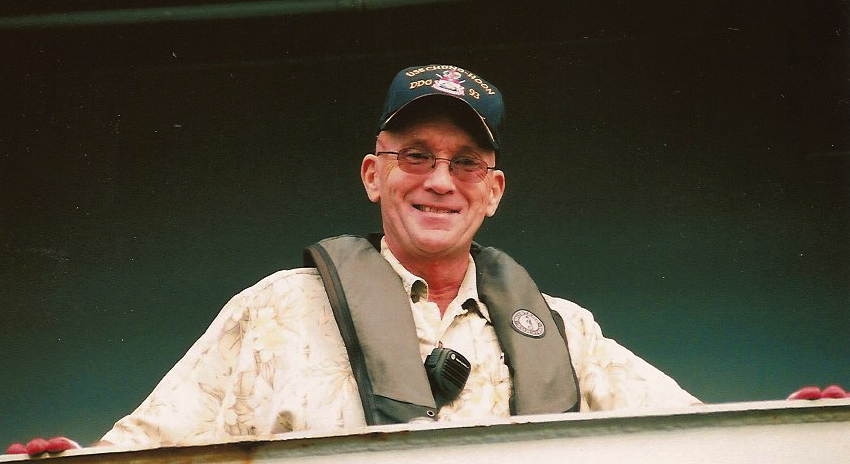
At work

If my father had faith in anything, it was that he could handle ships. There could be a twenty-knot wind out of the west, the port engine could die on the ship, the navigator could panic since the pier cleats weren’t where they were marked on the chart, and my father, looking out the window, could drive an eleven hundred foot carrier along the pier softly. “It’s what I do,” he would say. Within ten years of joining the navy, he had moved up the ranks from a sailor mop jockeying on the deck to a harbor pilot who docked ships into port and sent them out to sea.

Sometimes, when I was about ten, my father brought me to work. I rode the tugboats that dropped him off on Trident Submarines that he guided out into the dark tree-lined fjord of Puget Sound. When the job was done, the tugboat would come alongside the moving submarine and he would jump, without a lifejacket, back onto the tug as if it were nothing. As if one slip couldn’t send him under the icy water and the wake couldn’t suck him under to the propellers.

On the way back, my father would ask the tug captain if they’d let me on the wheel. I never wanted to be on the wheel. But soon I was grasping onto the wood handles, trying to not to hold my breath, steering the boat. “Just follow the wake of the other tugs,” he would tell me.

Advice from my father was always the same. On jumping from the high dive, “Just jump. Just go and do it.” On going to college, “Make it happen. Go and do it.” On becoming a writer, “Well, go and do it. Write.” Sometimes he added, “The worst thing you can do is overthink it, boy. Educated people sit around asking why the wind is blowing you toward the rocks. You don’t have time to ask. You just look out the window and react. Make a decision. Life doesn’t have time for you to worry it right. You just go out and do it.”

* * *

When my father retired from the Navy they gave him a party, a handshake and a shadow box filled with his service ribbons and brass plates recounting my father’s time in navy, most of it as a pilot. Piloting was what he wanted to do again. He studied charts, took tests and improved his maritime licenses. He applied for piloting jobs and flew out to Florida and Virginia for interviews. Each time he came back disappointed. And so we stayed near Seattle, not far from my father’s last duty station. Waiting, my father worked part time jobs, as a captain or a mate on ferries, tugboats, and science ships in the icy waters of the Northwest. There were a lot of days he didn’t work. On those days with a coffee in hand, he sat on the porch and watched the neighbor’s cat hunker behind the cul de sac sign and take a dump.

That’s also when people my father knew started dying. Bud was first, lung cancer. My uncle, my father’s brother, cancer. That one startles me even today. For the first and only time in my life I saw my father cry. After he hung up the phone, he clung onto my mother and me in the dark end of the hallway of our house. His face was hot and he heaved for air. My uncle died at fifty-four.

After eight years of trying, and waiting, he became a pilot again in Pearl Harbor, Hawaii. It was an October evening in 2003, after docking a couple of ships my father came home and had his first heart attack. On the phone he talked about his cholesterol levels as he would with tide tables or how much draft a ship had. Only when he had a physical would he signal his worry with a sigh and a “I gotta go, boy.” On the next call, “Boy, have a drink on me. The doctor said I’m in better shape then those twenty year old skulls on the ships I pilot.”

My parents came to see me in Korea to find me battered in the hospital. I had flown off a mountain bike crashed into a tree leaving my chest and spine a tangled mess of rattling broken bones to be fastened back together with bolts and plates of titanium, and someone else’s bones. The doctors told me I was lucky and I was: I would walk. I was alive. My father sat next to my bed, quietly rubbing the tattooed cross anchors on the back of his hand. Finally, he struggled out, “Sometimes a man has to know his limitations.” A line from Dirty Harry.

Rope ladder

* * *

After my parents separated, my father told me about a dream he kept having about a ship he had served on before he became a pilot. My father had taken the old and mothballed ship out to be sunk for target practice. The ship went down, then his shipmates from my bedtime stories – the same ones from that very ship – started dying. Diabetes. Suicide. Heart attack. It wasn’t just his old shipmates. A pilot from a nearby port in Hawaii fell off a rope ladder while boarding a ship and was sucked under the waves. My father started wearing life jackets. My father hated life jackets.

“I keep seeing it,” he told me over the phone, “just like it was after we had hung off the sides and painted it. I’m there on the pier with my sea bag over my shoulder and I’m about to go up the gangway and the old chief stops me. ‘Sorry boats, Milan,’ he tells me, ‘not your time.’ I can see them, my shipmates, hollering at the seamen, getting them heaving on the lines, the boatswain whistles blowing. Then I see them all go, steaming away, leaving me alone on the pier with the seagulls dropping clams.”

Then came the skin cancer. Small spots like freckles on his bald head got radiated, leaving little pink scars. It also had burrowed into his ear canal. The doctors took it all out and covered his earhole with a flap of skin from his leg. “They might take my job from me. Might say they I’m not fit to pilot,” My father worried over the phone. I told him if that happened, we’d just open a bar in the Philippines and drink cheap wine. “I wouldn’t survive a week.”

The last time I visited him in Hawaii, we went shopping at a maritime store for fishing caps to keep the sun off his head. He would try a hat on and look at the mirror, shake his head and put it back. I said that we could get a sombrero. He could be the Mariachi Pilot. Then I asked him, “Do you feel like you’ve lost something? Like you’ve lost a bit of breath?”

 He caught me off guard. “I don’t know, I guess. It’s like I lost something I can never have back.” He picked up a yellow fishing cap and looked in the mirror. He looked pale. He looked scared.

* * *

In college, I worked in film production. After the movie sets were torn down, when the only remains of the spectacle were naked concrete and traces of sawdust and sand, I’d always get a feeling that I was tiny and couldn’t say where the props had really been. I got that same feeling at my father’s memorial. There was a photo of my father from the bridge wing of a ship, grinning while looking down at the camera. He looked so happy. Yet, before I noticed the grin, I saw the life jacket.

One day I sat down at my desk and wrote this:

As the last hours of streetlight sliced through the blinds, my father stared up at the ceiling. Old photos in clean picture frames look out from the shelves. His shadow box is gathering dust. After a few sips of Kona decaf coffee, he sat and took his blood pressure. The machine groaned and tightened. It beeps and he wished he could still hear it without the muffle. The numbers say it’s a little low.

The harbor’s July air is thick and full of salt and diesel exhaust. The roads were still black from the morning mists. The waters rippled off the piers and the docked ships. From the wheelhouse of the tugboat steaming through the channel toward the job, my father didn’t notice the Arizona memorial raising its flag above the sunken hulk. His thoughts were on the job, and the depths of the harbor, the draft of the ship, and the breeze from the northeast. 

A cargo ship deep in West Loach waited for him. It was a complicated job that would need all his focus. His strategy is to pull the ship from the pier with tugs, back slow and turn the ship 90 degrees, using the tugs, avoiding the other ships and the unseen shallows. Once the ship was in the channel he could drive the ship past the last turn and out to sea. The job was like moving a semi-truck  out of a full parking lot, on ice, without brakes, with ball bearings instead of wheels, and little go carts pushing the trailer to keep it between the lines.

As he climbed the rope ladder to the access hatch in the wall of the gray hull, he clenched his teeth. Men can fall off into the green abyss. Big ships like this give men heartburn. They can smash into the pier or run aground. Lines from the tugs could part and whip back onto the deck. Anything can go wrong; everything can go wrong.

The sun broke through the clouds and it was hot under his life jacket.

 On the bridge, my father smiled, and shook the captain’s hand. Harbor Pilots are faces of calm. The ship’s engines hummed and the crew checked the computer screens and hustled the lines. From the bridge wing, the tugs were small, as if they hadn’t grown up yet. He swallowed, keeping in the tension, focusing on the images burned in his mind of where and when each movement would begin and end.

The tugs heaved and the ship growled and shuddered as propellers started backing. Coffee brown silt swelled up staining the water. The ship had a deep draft and the bottom wasn’t much deeper. Lines moaned, water churned, radios crackled, my father’s forehead beaded with sweat. There was a knot twisting and tightening inside him.

For an hour my father crisscrossed from the port bridge wing to the starboard and back again, gauging distances, calling corrections to conn, and to the tugs. He fought sudden breezes, the ever-changing depths, the weariness of his body. Then finally, it happened. They cleared the tight loach and were moving toward the channel to the last turn and the ocean.

With the job essentially done, he looked down from the bridge, past the anchor winches and the stanchions of the deck to the dark green water just ahead. This is when he would laugh. A country boy from the fields of Tennessee had moved a mountain of steel.

But as the adrenaline faded, he didn’t laugh. When the ship made its last turn at Whiskey point, the point where the harbor opens up to the unending field of green then blue water of the Pacific, where the white caps clapped all the way to the line where the water splits with the cloud splattered sky, he looked up and knew he had gotten the ship out safely. And that was it.

Whiskey PointThe approach to Whiskey Point

—Joe Milan

————————————————-

Joe Milan 3

Joe Milan has spent nearly a third of his life traveling and living outside the borders of the USA; his most recent landing is in Seoul where he writes and teaches at the Catholic University of Korea. He is a recent graduate from the Vermont College of Fine Arts MFA in Writing Program.

Jul 042013
 

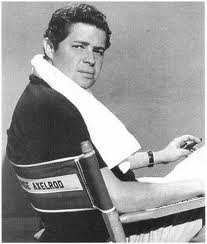
Axelrod

{space}

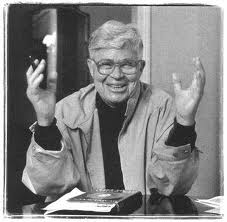
George Axelrod was a great Hollywood screenwriter who defined highbrow comedy and male-female relations for an era. In truth he may not have so much defined male-female relations as reflected them, the last “classy” gasp of the postwar male dominance in a culture that was fast changing. NC Contributor Steven Axelrod offers here a gorgeous addition to our Fathers Series, his loving but frank look at his father’s life and legacy, a monumental essay from the guy who knew because he watched, as only a little boy can, his father bestriding his world like a god, like myth itself, and finally crumbling from the pedestal.

dg

——

Phobias

My father,was afraid of everything, and he passed most of his fears down to me. Some of them remain latent, drugged guard dogs stirring in their sleep at a snapping twig or a heavy footfall: moments of agoraphobia checking into a big hotel in a new city. I consider hiding out in the room, I inventory the miniature bottles of booze; then I button myself up to the neck and the feeling passes, like a chill. I hesitate before boarding an airplane, flinch before walking into an elevator and I feel the ghosts of my father’s phobias haunting me, like his voice in the back of my head, that wry half-drunk ongoing commentary: “That was a room-emptier, dear boy.”

Yet he was capable of convulsions of courage. After stalling for weeks, my step-mother Joanie running interference for him with the studio or the producer or the star (“When I say I have sixty pages, it means I’m about to start”), my father would lock himself in a room and work for thirty hours straight until he finished the script, turning it in on time and camera-ready. It might seem like mere mulish persistence, but nothing frightened my father more than a blank page and a deadline.

working dad-1

In high school he sat with the visiting football team’s fans and cheered on the opposition. Then he took a bat from the athletic department, arming himself against the drunken jocks he knew would storm his room, seeking revenge. He never graduated from high school, though he told me his P.E. teacher there gave him the best advice of his life. “You’re useless at sports,” the man said. “You should play with the girls.”

Dad told me: “I’ve been doing that ever since.”

Women never scared him, I have to give him that.

SPACE

A Self-Made Man

cool dad-1

He arrived in New York City before World War II, with no credentials, no real education and a family who disapproved of his ambitions. He walked into radio writer-producer Goodman Ace’s office looking for a job. The interview was a brief one: “Come back tomorrow with ten jokes.”

He worked for several years on “Mr. Ace and Jane” and “Easy Aces” writing the type of malapropisms that would be associated with another cunningly professional air-head, Gracie Allen, years later: “He lives on the poor side of town, in those Old Testament houses,” and “You could have knocked me over with a fender.”

My father always had faith in his own talent. He never had much beyond it to trust. His grandfather was a tyrant, his father was a tyrant’s prey who gave up his own career in show business under the threat of disinheritance. His grandfather, Jacob Axelrod, was the son of a Silesian rabbi, a Tzadic of the Hasidim, and Jacob was next in line. He fled that responsibility and arrived at Ellis island with fifty cents in his pocket. But of course he also had the steel to stand up to the absolute ruler of his fiercely insular religious sect, the arrogance to defy his father and the courage to sail away into the unknown, owning nothing and knowing no one. Fifty years later he was a different kind of king – a real estate maven who had bought and sold dizzying amounts of property in lower Manhattan. No one knows quite how he did it; or why, ten years later, he threw himself off the roof of one of his own buildings.

When my kids were little, my ex-wife took them  to the refurbished Ellis island, where my daughter found old Jacob’s name on an interactive computer list of 19th century immigrants. “That’s Daddy’s ancestor!” she said.

“Yours, too,” her mother reminded her. It was a stunning moment for a twelve year old girl. She asked me about Jacob, but I never found out much myself – how he created his empire, or came to regret it so profoundly. But his son Herman, who attended Columbia University with Oscar Hammerstein and collaborated with the great lyricist on some collegiate Varsity shows, received  an ultimatum from Jacob: if he didn’t abandon show business and join the family real estate firm, he would be disowned and disinherited. So he knuckled under.

Interestingly, Hammerstein’s father was similarly hostile to his son’s career choice. But the old man died  before Oscar graduated. Herman had to wait another thirty years for his own freedom. The day after Jacob’s funeral, Herman quit the real estate business and took up painting and sculpture. His work had been exhibited in a dozen museums by the time he died.

Unfortunately, he never learned the essential lesson about parental tyranny: quarantine it in your own generation. Almost against his will, it sometimes seemed, he passed the paternal cruelty down the line, along with his brown eyes and his creativity.

He sent George to the Hill School which the boy hated; just as George sent my brother to Hotchkiss, which was just as bad. This heartless dictatorial compulsion loomed like a Biblical curse over all of us, and my brother never had children partly because he feared it so much. Would he have sent his own kids to military school and threatened them with exile if they didn’t join the family law firm? We’ll never know. But none of us would have been surprised.

So my father launched himself away into the unknown just as his grandfather had done. Unlike Jacob, he had no gift for intimidation, no uncompromising greed, no lust for power – just a wry sense of humor and a working typewriter. It turned out to be enough.

“Just finish something,” my mother told him. “You’ll sell it.”

 SPACE

The Best Day

So he did, which led to one of the great high points, the days he always rated ‘10’, in his life. This was the best one of all.

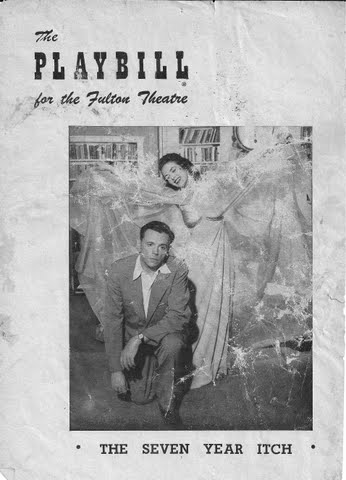
My father’s play, The Seven Year Itch, had opened and by the time rehearsals were finished he was sure he had a useless mess on his hands: snappy first act, weak second act, disastrous finish. Emlyn Williams  — best known for writing The Corn is Green — was performing in a play about Charles Dickens a block away and helped trim Itch with something he called  “interlinear cutting”: taking out individual words, clipping the play sentence by sentence without losing any major scenes. It worked. The play improved. It got tighter, and most of all shorte, but it remained flawed. My father was terrified of the reviews, and he stayed away from the traditional Sardi’s vigil of getting quietly drunk and waiting for the New York Times to hit the street. He left the theater after the first act and went home to bed.

He woke up the next morning to find no food in the refrigerator. My mother, two months pregnant with me, was busy with my brother Peter, fussing and colicky at age four. Their bank account was over-drawn, so he pulled on his Burberry raincoat, too thin for the early winter chill, and walked out into the spitting wet snow to beg a small cash advance from the box office.

The date was November 20th, 1952. The time was eight thirty-five in the morning.

He arrived at the theater, shivering, and just stood across the street, staring at the vision of his life from that moment on, absolutely and irrevocably transformed. The line stretched from the box office down 46th street, all the way to Eighth Avenue and around the corner, men and women in their bulky coats, shuffling in the wind-whipped sleet waiting for the box office to open two hours later. The first of them must have arrived before dawn.

itch playbill-1

He stood a watched them for a long time. Then he got his advance and took a cab home to read the reviews.

Six months later he was in Hollywood.

A year later he was divorced.

SPACE

Autobiography

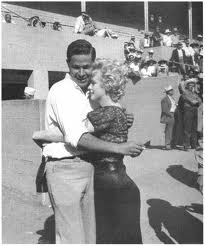
George  Axelrod and Marilyn Monroe

“People often ask me, which is more rewarding – parenthood or writing,” he used to tell me. “It’s funny because you and The Seven Year Itch were born in the same year. Itch is more successful than you, funnier than you, richer than you, more popular than you. It’s held up better than you. I’d say it’s no contest.” I tell people that anecdote and observe with detached amusement the shock on their faces. The remark was only incidentally cruel; much more than that it was simply an irresistible joke, one which he knew I’d get, and more importantly, one aimed more devastatingly at himself than at me.

He was a bad father, I suppose. But I inherited from him a need to be entertained and a delight at being amused that rendered his mundane failings irrelevant. He could always make me laugh.

Almost twenty-five years after Itch’s triumphant opening, he failed in his struggle to get another play, Feeling No Pain, mounted on Broadway. The gimmick of this new musical was that the protagonist had rented the theater for the night of his fiftieth birthday, to review his life in front of an audience of friends and enemies, colleagues and critics, before committing suicide on stage in the dramatic finale.

He wrote the lyrics for the songs, whose titles reveal his state of mind – “Are you Gonna Change” (The answer, emphatically no); “The Ladies Love Me” and the title number.

Jerry Lewis was committed but backed out. Jack Lemmon signed on but begged off when his wife Felicia balked at moving their kids across country for the length of the  run. With no star the project fell apart. I may have the only extant copy of the play, and even that manuscript remains incomplete.

The partial script gives some hints about why his first marriage failed. Richard Bender, the protagonist, imagines the relationship as a serialized radio soap opera. He brings out the performers and the mikes in the stripped-down stage version of a radio station recording studio:

BENDER

Okay, take it. We’re on the air.

(An ORGAN PLAYS a RADIO THEME; in the manner of radio actors, they drop the pages to the floor as they finish them)

 ACTOR

(As the announcer)

Ladies and gentlemen, once again we take you down Fifth Avenue to the corner of West Eleventh Street, up three flights and into apartment D for another heart-warming episode of ‘Our Gal Sarge’, a story which poses the problem: Can an attractive, well born, socially conscious young housewife, mother and ardent worker for the League of Women Voters find romance and happiness married to a handsome but frivolous and dissolute comedy writer so lacking in political awareness, that he would not even work for Henry Wallace?

BENDER

(He puts his hand over the mike and speaks to the audience)

These things were always written from the woman’s point of view.

My mother’s point of view? “I stuck it out for his psychoanalysis, but he wouldn’t stick it out for mine.” In fact, she thought my father’s psychiatrist was the heart of the problem. His solution to the problem of George’s phobias was “Just take a drink, it’ll calm your nerves.”

He took the advice and it almost killed him.

My mother wanted him to write something great; she wanted him to stop drinking and save his money. He wanted to write sex farces, get bombed and when he ran out of money just make more. My mother was a depression baby; my father  just thought she was depressed.

Joan Stanton, the stunning blond he met on a Fire Island beach that summer, saw things his way. When the call came from Billy Wilder, inviting George out to Los Angeles as the Seven Year Itch movie screenwriter, my mother begged him to save his soul and stay in New York.

Joanie at the B&W-1

Joanie booked the plane tickets.

She was always good at handling the details.

SPACE

The Golden Age of Hollywood

They lived quite a life, and I saw brief glimpses of it on school vacations: sitting around the pool with Tony Curtis, planning “Gemini” birthday parties, spending money in style, with houses at the beach and in town,  freezers full of steaks cooked on the built-in electric charcoal grill, the screenings and openings (Though he had to get drunk to attend them); and the movies themselves, on which his reputation still rests – Bus Stop, Breakfast and Tiffany’s, The Manchurian Candidate, How to Murder Your Wife. The banner quote in the Life magazine article about Murder, summed up his attitude in those days. Was Italian newcomer Virni Lisi a star? ”SHE’S A STAR BECAUSE I SAY SHE’S A STAR.”

Murder one sheet-1

The embedded video is from home movies taken by Roddy McDowall at Dad’s Holmby Hills house in the mid sixties. This was his glory time and you can see it in these silent sun dappled moments caught by Roddy’s ever-present 8 mm camera.

Glamor floated in the air like pollen. But it rarely merited more than a sneeze. I remember one afternoon, inspecting the wedding invitation from Frank Sinatra and Mia Farrow: a big glamor portrait of them, with the date and the RSVP inside. Mia Farrow’s mother was Maureen O’Sullivan, who played Jane in a series of Johnny Weismuller Edgar Rice Burroughs adaptations. Somehow this detail crystallized the absurdity of the affair for my father. He laughed and said “Me Tarzan, you Frank Sinatra’s mother-in-law.”

It was an immensely attractive world, a privileged realm of celebrity, warm winters and ripe orange, a sunlit David Hockney world of pale blue swimming pools and cool Mexican tile. An Architectural Digest world of dinners on the patio with views of the city lights, brilliant nights of conversation with the startlingly life-sized people most people would never meet, cashmere against the desert chill; palm trees swaying and bougainvillea blooming red among the faint smells of cut grass and eucalyptus. “One of the great pleasures of success in the movie business,” my father said to me on one of those evenings, “Is that the people you most want to meet want to meet you just as much.”

It was paradise. But it couldn’t last.

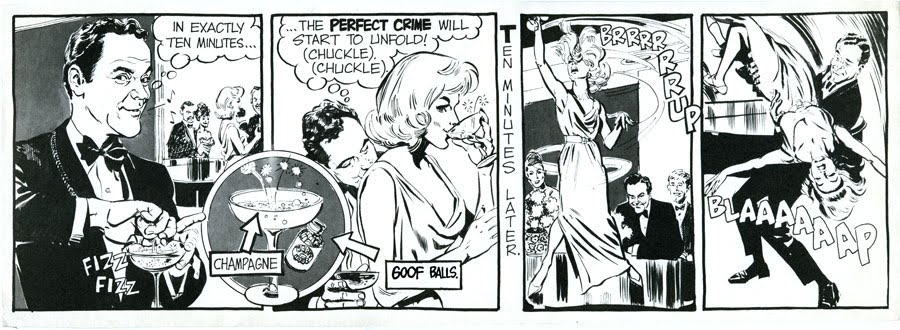
murder cartoon-1

My father started directing his own scripts, resulting in a brutal pair of flops. First came the quirky masterpiece Lord Love A Duck (“An act of pure aggression”), which “went from failure to classic, without ever passing through success,” as he liked to put it.

Roddy McDowall played Tuesday Weld’s  high school fairy godfather in that odd dark film, guiding her with faultless cynicism through the obstacle course of teen-age life, even organizing the death of her odious step-father. Ruth Gordon played the batty mother-in-law whose tart “In our family we don’t divorce our men, we bury them” summed up her caustic point of view. Ultimately Mollymauk, as Roddy’s character calls himself (“A bird thought to be extinct, but isn’t”) engineers his protégé’s rise to movie stardom, in the appropriately titled “Bikini Widow”.

The scene where Mollymauk teaches Tuesday Weld’s character to manipulate her father into buying her a load of cashmere sweaters is worth the price of admission all by itself. There’s a simple equation to remember, he explains: father + divorce x guilt2= sweaters to the 12th power.

Then came The Secret Life of an American Wife. My father judged movies by their titles as he judged champagne by how hard it was to get the cork out, with equal success. Even he knew that the film’s clumsy name boded ill. He preferred The Connecticut Look but studio marketing people worried that foreigners wouldn’t understand it. , (“What do you think she’s talking about when she refers to her ‘rapidly spreading Connecticut behind?” I remember him shouting at some studio bean-counter)

Except for a lovely one act chamber piece between Anne Jackson and Walter Matthau buried in the middle of the picture, it deserved the ignominious fate that spiteful critics and an indifferent audience forced upon it.

With the drinking getting worse and the failures piling up behind him, even Joanie, who was so good at manipulating people and bullying them, couldn’t get my father’s career back on track. She used his friends and colleagues to build her own decorating business, and would gladly tell anyone who asked (and some who didn’t) that she’d been the real breadwinner in the family for decades. She owned a shop in Beverly Hills called The Staircase, which featured the circular staircase from The Seven Year Itch as its main decorative motif. She sold Porthault sheets there and expanded her business exponentially with a Who’s Who of Hollywood celebrities. She had the glow of a pregnant woman when she was in the middle of some massive Bel Air renovation; my father used to say “She’s lovely when she’s with house.”

SPACE

“What Have You Written Lately?”

And so, after raising two children (one from Joanie previous marriage, and a daughter of their own), after flipping twelve houses (including one on Carbon beach they sold because Joanie couldn’t stand the sound of the ocean), after their opposite career trajectories, hers to the top of what you might call celebrity interior design, and his to the bottom of a world he had owned in another era, she handled his induction to the Bette Ford Centre, and paid the bill for his rehab.

They’d been separated for a while before that, and Dad had been living a different version of the high life, a mockery of his earlier glory, paying a spectacular Las Vegas hooker full time wages to act the part of his girlfriend, and later, moving back to London, almost killing himself in a savage bender after a battle with the Grosvenor Estates over the matter of a bicycle left in common hallway.

He returned from his ordeal in Palm Springs hurt and humbled, beaten but not broken, determined to stay sober for as long as he could. And I couldn’t help thinking of Neil Simon, with whom he’d toiled in writers’ rooms in the late forties, with whom he had clashed over Dad’s miscasting of Simon’s weakest play, during the winter of 1966. Walter Kerr memorably began his review of The Star Spangled Girl this way: “Neil Simon didn’t have an idea for a play this year, but he wrote one anyway.”

As alcohol scuttled my father’s career in the seventies and eighties, Neil Simon steamed along imperturbable and majestic, like some Cunard luxury liner of comedy. Even his wife’s tragic death and his private struggle to start living again generated a hit play.

Maybe his shrink said “Man up” instead of “Hit the bottle.”

It was a peculiar sad time, those decades of ruminant sobriety between Dad’s stay at Bette Ford and his reversion to white wine on his death bed. He was struggling  to start his career again, taking meetings just as I was, doing odd writing jobs for mentally defective, drug-addled producers, just as I was doing. He was a has-been, I was a never-had-been, but nevertheless, we had a lot in common.

One incident in particular sums up that era. It was the spring of 1978. He was called into a studio meeting “with a bunch of twenty year olds” who told him they wanted to do a glamorous World War II period piece thriller, full of romance and intrigue, set on a train. He told them, “It’s been done. The picture is called The Lady Vanishes.” Blank stares. “Directed by Alfred Hitchcock?” Nothing. He told them to screen the 1938 classic and get back to him. Sure enough, they called the next week and set up another meeting. “We loved it,” they told him. “It was awesome. We want you to write it.”

He explained that it had already been written, generally the first step in the film-making process.

“No, no,” the twenty year-old VP development told him. “The movie’s in black and white. We want you to write it in color.”

So he did, carefully annotating the green plush sofas and the red wine.

Dad was flown to the location to coach Cybill Shepherd on her line readings, but his ideas didn’t register and his opinions didn’t prevail. “Let’s see what she brings to it,” the director finally decreed. “As far as I could tell,” Dad told me, “She brought a nice head of hair and a Porsche.”

The near-misses and dead-ends continued: the script he wrote with Joan Rivers that the fine intellects at Universal determined to be ‘too vulgar’ (but wasn’t that the point?); another original that featured an impossibly boring Secretary of Defense (Even when warning the president of imminent threats, he’s so dull that the President nods off, the  red telephone “slipping through his nerveless fingers”). The man happens to be a separated-at-birth triplet. One of his brothers is a brilliant stand-up comedian, the other a drunken, gambling addicted sociopath. When they all get together, hi-jinks ensue. It was called The Importance of Being Irving, and like so much that Dad wrote, it fell apart in the third act. He knew it, and tried to get various writer/stand-ups to help him revise and star. He said he was ‘too proud’ to ask his pal Steve Martin, who would have been perfect for the role and could have helped with the writing also. Too bad: I really wanted to see that one.

 SPACE

Grandpa

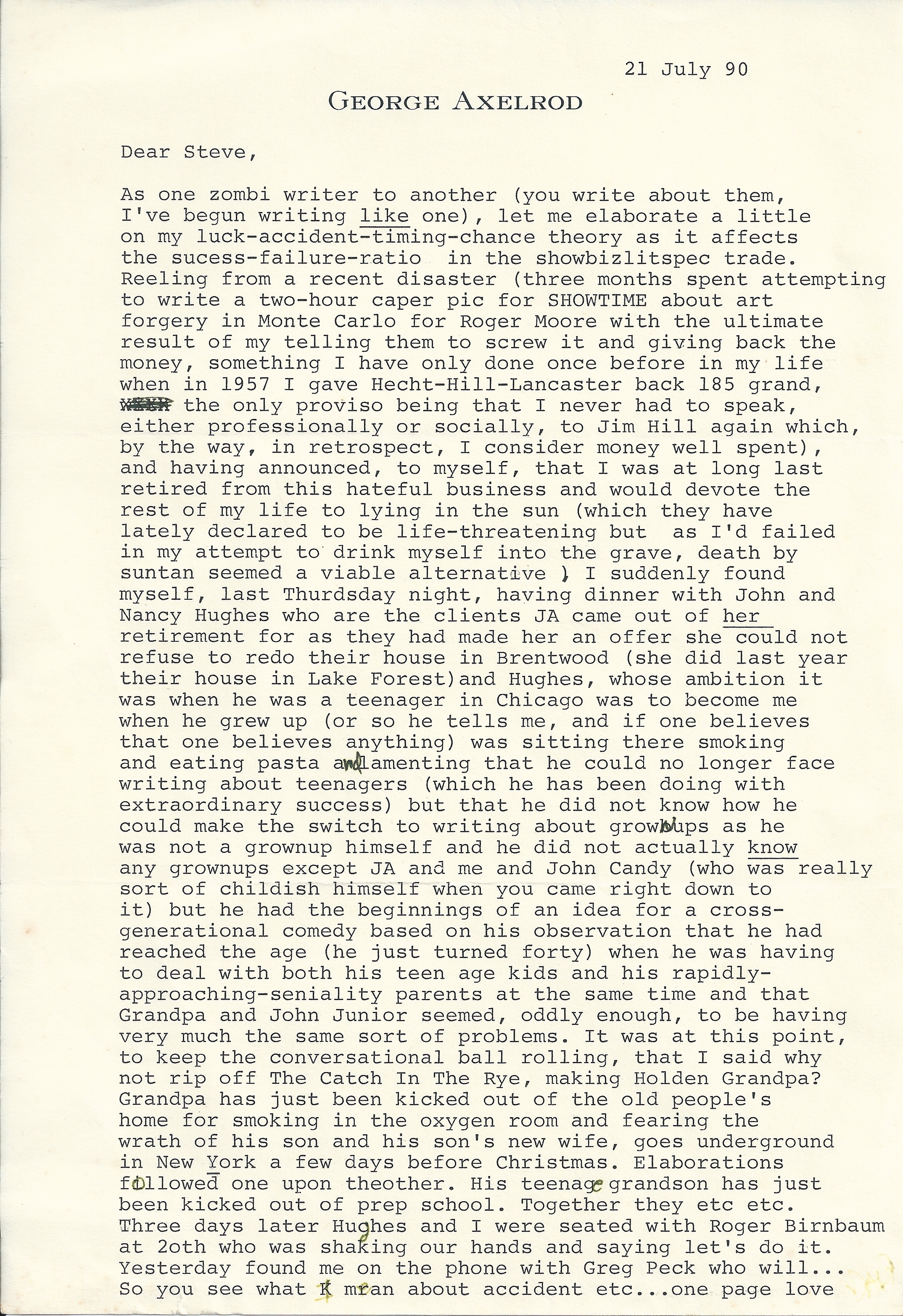
Then there was Grandpa. Like so many abortive projects, this could have been the one that turned things around for him. He described the origin of the project in one of his famous one-page letters:

Dad's letter-1

What could go wrong? It started with a few months of radio silence from John Hughes, then a full page ad in Variety clarified the situation. Hughes was making Home Alone 3, and the subtitle was Lost in New York. Hughes had taken what he needed from George’s idea and left him with the unsalable remnants. Or so it seemed to my father. He no longer had the heart to begin again.

In 1988 my step-brother Jonathan organized the re-release of The Manchurian Candidate, and the video below — a round-table discussion with star Frank Sinatra and director John Frankenheimer — gives an invaluable glimpse of my father during this difficult period.

http://youtu.be/gH0duNvNJ8E

SPACE

Twilight of the Gods

George and Joan were back together after his boot camp stint of high-toned rehab in Palm Springs, and  the Sunday lunches remained a pleasure, a luxurious testing ground of excellent food and sophisticated talk. To this day I judge people at least part by how well they would have fit into those long tipsy afternoons overlooking the smog-bound clutter of the city and the blue desert of the Pacific. Would Joanie have said of this girlfriend or that one, “Charming girl, very bright. Wonderful addition to the life.”? Would my father have flirted with her shamelessly, asking her his patented trick questions (“When did you know you knew?”), while Joanie sipped white wine, and watched out of the corner of her eye while she discussed the seating hierarchy at Morton’s? I often think about that question and I always know the answer.

Of course Joanie ruled those gatherings with her perfect social graces and her iron will. But she let George hold court at the table. She ruled him in every way, until the very end, when she gave him an order he couldn’t follow. Dying of cancer just after the 9/11 attacks, she wanted him to take a Krevorkian-style cocktail of drugs and die with her. I know it sounds like something out of a gothic novel or some camp film with over-the-hill movie stars, Whatever Happened to Baby Jane, perhaps: a deranged, wild-haired Bette Davis, screeching “we’re going to die TOGETHER!” But if you knew Joanie, nothing could surprise you.  This was a woman who could break the lock of her teen age daughter’s diary, breeze past the pathetic note asking her not to read further, and then not only read it cover to cover, but declaim the dirty parts aloud, to her daughter’s hated boyfriend,  the next night at dinner.

My father managed to refuse her somehow, despite the giant force of her will. She actually was weakening at last, like an exiled dictator or a great writer falling into dementia, and he lived two more years after she died. They were bedridden years,  he needed help with the mortifying basics of life, but he was still able to fly an entourage of medical personnel with him to  Las Vegas for a final gambling blow-out, still able to make me laugh over a good bottle of  Pouilly Fuisee.

Of course I couldn’t help thinking that he was burning through the last of what would have been my inheritance – money saved and still coming in from both his work and Joanie’s, as projects she had initiated – like the new nursery wing in Norman Lear’s Vermont mansion – rolled on without her.

And then he died and I flew out to Los Angeles for  the memorial service.

I knew I was going to speak in front of the gallery of his surviving friends and I flew out a week early. I spent the time writing and memorizing my eulogy. I could feel the ghost of my father’s own nervous panic addressing a crowd, and I fought it down just the way he did in his later years, when he couldn’t get drunk first any more: relentless preparation and unlimited effort in the name of making the excruciating look easy.

The euology isn’t much, really — just a hint of who he was, like the menu posted outside a four star restaurant or a photograph of the Grand Canyon.

This is what I said:

 SPACE

A Brief Farewell

Old dad-1

I’ll make this short, because that’s how Dad liked it. He had a rule at dinner. Everyone wanted to tell the story of the book or comic book they had just read, or the movie or TV show they had just seen. That was fine, as long as they could do it in three sentences. It was great – all you’d hear for minutes at a time was the sound of grinding teeth as various kids tried to boil down a Star Trek episode, or Lawrence of Arabia … or Moby Dick into three sentences. You could almost hear them: “OK – there’s this whale … no. There’s this guy who was chasing the whale … no, wait …”

It was okay. You were better off listening at that table, anyway.

You could learn a lot at dinner; sometimes meals turned into informal writing seminars. My Dad loved verbs, and he hated adjectives. Once he challenged me to describe something we were eating, some little meat pastry. I said it was flaky and savory and delicious.  Three adjectives: no good. He used two nouns and a verb: “calories, lashed together with garlic.” He taught me Logan’s Law: (The theatre director Josh Logan was a great mentor for him and one of his best friends for more than thirty years)  “A hit movie or play is a series of scenes culminating in a final scene through which the hero learns something about himself, always emotionally and always for the better. “ And it’s true – from Breakfast at Tiffany’s to Rocky to The Lord of the Rings. Dad said a great thing about cutting once that always stuck with me. ‘You turn the story upside down and shake it. All the loose stuff falls out.”

He was always proud that he put a phrase into the language with the title of The Seven Year Itch. But he put a lot more phrases than that into my language. To this day I can’t look at a fattening dessert without hearing him saying “..and the best part is … it tears the weight off you.” I can’t sit looking at a blank page without his credo coming to mind: “Will write, if cornered.” I looked at the airline meal on the flight out here, and heard him say “Toy food.”

And as for the word ‘totter’, they should just retire it from the language now that he’s gone, the way they retired Wayne Gretzky’s number when he quit playing hockey.

Dad could be a tough audience. I’ll never forget watching a young comedian trying his act on him one Sunday at lunch. Dad just sat there saying, “Good. That’s funny.” But he never even cracked a smile. Finally the comic got exasperated and said “Don’t you ever just laugh?” Dad shrugged. “No,” he said. “But don’t feel bad. My eyes are twinkling merrily.”

I wrote a suspense novel and asked him to cut it. He took more than a third of it out.  When I complained, he shrugged and said, “I could cut a minute thirty from the Book of Genesis if I really had to.” The edit was a huge job and a lot of work, taken from his own busy schedule. But the gesture was typically generous. My friends and I often heard him ask, “How much money would change your life?” If you thought about it and told him, he’d give it to you. It didn’t always take much. One night when my friend Stephen Salinger was broke and waiting on tables at Ma Maison,  my Dad tipped him a hundred dollars. It did the trick; Stephen never forgot that night. Dad once ordered a bottle of Mouton Rothschild ’59 in the Oak Room at the Plaza, just to show me what great wine tasted like.  When he knew I needed it desperately, he swept me off to London for my senior year of High School … and thirty two years later, it’s  still the best year of my life.  I learned much more from him than I did in school – antiquing on the Portobello road, or at the Turner show at the Tate. He had to drag me out to see the Noel Coward tribute at the British Film Institute. Hey, I was seventeen. It was a great night as well as Coward’s last public appearance ever.

It’s strange, standing in this house without Dad and Joanie here. Not even this house exactly… there have been so many over the years. This is just the most recent one. All of them, from 1018 Benedict Canyon to 301 North Carolwood, from 56 Chester Square to Malibu to Lloydcrest Drive, all had the same spirit. And most of them had the same bar. I got drunk for the first time in my life at that bar. And I don’t think I’m the only one. Anyway … for most my life these houses have been like the world capital of wit and sophistication.  If any of them are haunted, there are going to be some great parties going on, with some very classy ghosts.

Dad was a wonderful host, but he was cripplingly shy.

He was full of contradictions, mostly between the cynical things he said and the big-hearted way he lived. He used to say there was no one as tedious as a reformed drunk. But he was one himself for the better part of two decades with no loss of charm or style. An English magazine once asked him to comment on the phrase  “All the world loves a lover.” He said, “Funny you should ask. Right now my son is in love, my daughter is in love, my cook is in love, my secretary is in love, even the man who picks up my trash is in love. They stand under my window all night long, baying about it.  So in response to your question, I would have to say that all the world does not love a lover.  In fact all the world is bored to tears by a lover.”

This from a man who was married – with a one short break – to the same woman for more than fifty years. He had nothing against love. He just couldn’t take it seriously.

If there is a heaven, and I know he didn’t believe in that stuff, I can picture him at some celestial Ma Maison (The number is still unlisted), St. Peter bringing him  a bottle of white wine to the table instantly. Dad is ordering lunch – that was his specialty just like Patrick O’Neal’s character in Secret Life. There are some old friends around the table. Maybe he’s even pausing between courses, looking down on this gathering today, listening to my little speech. Not laughing, of course.

But perhaps his eyes are twinkling merrily.

Right now, I’d be happy to settle for that.

I tried to side-step any obvious sentimentality. He hated sentimentality. He used to say every Steven Spielberg movie could be titled with the prefix, “How I spent my summer vacation” (As a sharecropper, in a Japanese internment camp, hiding an alien, chasing a shark, saving Jews from the Nazis). He would walk out of a play if the curtain rose to reveal a refrigerator on the stage (he hated ‘kitchen sink’ drama) and once dragged me out of Man of La Mancha in a theater with no center aisle.

My stepbrother was brusque and succinct at the memorial service, my brother and sister read from prepared notes, though Nina’s gesture of chucking her cell phone into the swimming pool felt spontaneous. Our father hated the telephone (“For a dime anyone in this country can ring a bell in my house”) and he especially hated cell-phones.

Everyone seemed to think I spoke extemporaneously. Dad would have liked that. And I killed.

He would have liked that best of all.

 —Steven Axelrod

————————————–

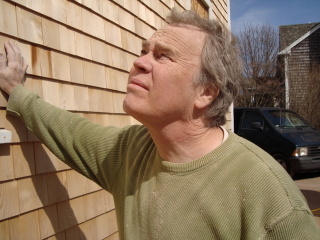
Steven AxelrodSteven Axelrod holds an MFA in writing from Vermont College of the Fine Arts and remains a member of the WGA despite a long absence from Hollywood. In addition to Numéro Cinq, his work has appeared at Salon.com and various magazines, including PulpModern and BigPulp. A father of two, he lives on Nantucket Island, Massachusetts, where he paints houses and writes, often at the same time, much to the annoyance of his customers.

Click here for the complete NC Fathers Series.

Feb 102013
 

Bunkong Tuon

God damn it! Books make a difference. They get under your skin and into your brain and attach themselves to your DNA and change you. They become your father and your mother, your brothers and sisters and best friends, your confessor and therapist, your spirit guide and your kindly mentor. They make you fall down and weep, and they make you race to the barricades.

Bunkong Tuon’s grandmother carried him out of Cambodia on jungle trails on her back. In California, he was a lost kid, a dropout working in a donut shop, too bereft to find a footing in the West. One day he pulled a book off a library shelf and it changed him. The book and the author became this fatherless exiled orphan’s new father.

I still have a tough time reading these lines, they are so full of youth, splendor and joy, the young man (or woman) setting out on a life of books and writing.

I also remember walking into a local pawn shop and buying a used typewriter, the one where the keys got stuck after striking the second or third letter.  Still, I typed the night away on that thing, while my aunt slept in her room and my uncle made donuts at his shop in Bell.  I remember the cockroaches coming out of their crevices to keep me company.  It was magical then; the tuition was cheap, something like 200 bucks for each semester, and I had few responsibilities other than to read and write whatever I wanted.

This is a poignant, moving essay about loss, fathers, books, and writing. It is a lament and a confession. It is also a strangely hopeful message for us all.

dg

§

Maybe it was the wine in me that made me blurt out, “You know, I’m annoyed with having to defend ourselves all the time.  The writers I read in my twenties saved my life!”  Then I began to tell the story of how I fumbled into a local library, picked up a book from the shelf, read it from cover to cover, then went back to the same aisle and chose other books by that same author.  I told my friends how the author spoke to me that day and how he changed my life.

This happened at a party to celebrate the end of another academic term.  We were talking about the plight of the Humanities.  A few years ago, a local university eliminated several language, literature, and culture departments.  That fall, the President told the American people that, in order to build a strong future for our nation, we must support our education system—only math and science were specifically mentioned as important areas for development.  In the face of the current 7.9 percent unemployment rate, all of us knew how hard it was to talk about the values of the Humanities to our students, to explain to them why reading, discussing, and writing about literary texts matter.

The hostess of the party, a good friend, asked, “So tell us, BK.  Who was that author you were reading?”

And I couldn’t utter his name.  I was ashamed of him.

Once in an interview with the Franco-Swiss director Barbet Schroeder, this writer got mad drunk, cursed his wife, and literally kicked her off the sofa.  He was not a good man, but he was my literary father.

As for my biological father, I have written about him with pride.  My poems are a kind of love letter from an orphan to a father he never knew.  In “Cambodia: Memory and Desire,” I wrote, “My father sold ice cream in train stations,/ competing with street peddlers with his/ good looks and easy talk” (323).  In “Lies I told about Father,” I went even further with my admiration.

With a son’s quiet adoration, I chiseled you:
a gangster from the East, a Khmer Krom
whose veins bled out Khmer characters (not Vietnamese),
who, guided by fate, found himself in the West
and married mother for her virtue and beauty.

In my poems you drink because, well, real men
drink, curse, and sleep around (the cursing
and sleeping around, you didn’t do, of course,
because of your love and respect for Mother).

My father is mythic in my writing.  He is clearly someone I’m not: a “gangster” with a sense of adventure, a man’s man who can hold his liquor and charm his way out of troubles with “good looks and easy talk.”  The truth is: I never knew my father.  He passed away in Cambodia in the 1980s, while I was a high school student in Malden, MA. When my grandmother, uncles, and aunts left for the UN camps along the Thailand-Cambodia border in 1979, my father decided to stay in Cambodia with his new family.  Like many other Cambodians who had fallen victim to Pol Pot, his wife, my mother, had passed away from sickness and starvation under the Khmer Rouge regime in 1976 or so.  My father took another wife several years later, when Vietnamese forces liberated Cambodia.  Fearful that, as a stepson, I might be mistreated by my new family, my grandmother took me away from my father, carrying me on her back as she and her children trekked across the border, avoiding landmines and jungle pirates, to where the UN had set up a camp, rumored to have an abundance of food and medicine.

This is the story I’ve inherited from my grandmother, aunts, and uncles.  It is the story of a father I never knew, and, in the absence of knowledge, I have the freedom to invent him in any way I want.  Out of a desire to be like my cousins who have the good fortune to have fathers, I “chiseled” him, in that freedom that only imagination provides and that desires shape, in a way that made sense to me, an orphan refugee child.  In my writing about him, I never once mentioned the stepmother and my half-brothers.   The father possesses masculine qualities, or what, at the time, I imagined “masculinity” to be, with the hope that someday I would inherit those qualities myself: rough on the outside but gentle on the inside, good looking and, more importantly, good with words.  He is not necessarily a man of letters.  As long as he is comfortable in a social setting, able to leap with ease from one social group to the next, then this man is my father.  He is the father I never knew; he is the father I created.

The literary father, the one I knew, is the one I’m embarrassed about.  He is Charles Bukowski, the Los Angeles poet of the damned.  In his own belligerent way, the guy saved me, saved me from an early death of the mind and spirit.  In the early 90s, I was working for a maintenance service company in Long Beach, California.  From six in the evening to four in the morning, I’d go to people’s houses, offices, private and religious schools and scrub their tubs, mob their floors, and empty their trash.  Before that, I’d worked at my aunt’s donut shop in Bell, California.  I was never good at customer service.  Although I didn’t get fired, my aunt was quietly relieved when I found a job elsewhere.  And before being a failed donut maker in Southern California, I was a college dropout in eastern Massachusetts.  One day, I just stopped attending classes at Bunker Hill Community College.  I had gone there because a friend’s mother had taken me by the hand, had driven me to the campus, and had enrolled me.  And before community college, I had been a high school punk who had ditched classes one day to go skateboarding, had forged my grandmother’s signature the following day, had been busted and had been sent back home for a two-day suspension.  The school graduated me because they didn’t want me to come back.  They didn’t know what to do with me, just as I didn’t know what I was doing reading Shakespeare and Chaucer in English classes.  Neither the books nor the teachers could explain why I felt so different from my surroundings.  Nothing made sense.

But, for some reason, the world according to Bukowski did make sense to me.  On that day in the local branch of the Long Beach Public Library, Bukowski spoke to me.  I can still remember that day: a typical sunny Southern California day, nothing strange about it.  I got up about ten in the morning after a night of cleaning toilets, mopping floors, and emptying trash bins, and mysteriously, I felt an urge, a summoning, to go to the library.  I borrowed my uncle’s car, drove to the nearest library, and sat in its parking lot, watching children and their parents going in and out and thinking about that closeness—that intimacy and trust with another human which seemed to evade me somehow.  Once the parking lot was empty of people, I got out of the car and made a beeline for the library’s entrance, which I walked quickly through, eyes downcast, towards the walls of books on one side of the large room, where I could hide myself.  I roamed in aisles of books until I found myself in front of the A-B row, picking up and putting back several books until I came to Play the Piano Drunk like a Percussion Instrument until the Fingers Begin to Bleed a Bit.  The world then opened up for me.

It was a world of men and women who had lost their way, a world of sadness and cruelty with occasional beauty, a world of outsiders living on the cultural margins.  Somehow the filth he described in those poems felt pure and honest, and the madness seemed sane, a logical outcome of being exiled from Eden for so long.  Writing, for me, and I think for Bukowski too, has to do with working with that state of exile, where loss is the center of many ghostly things and homelessness is what you have always known.   I don’t think we can ever fill that void, so we write about it.  No matter how much we believe in the transformative power of words and the imagination, loss is eternal.

After devouring Play the Piano Drunk, I began picking out other poetry books by Bukowski and reading them in that section of the A-B row: Burning in Water, Drowning in Flame, The Days Run Away like Wild Horses over the Hills, Dangling in the Tournefortia, and that wonderful collection of poems and short stories, Septuagenarian Stew.  I can’t imagine what it would be like to sleep in roach-infested bungalows and seedy motel rooms, buy cheap wine by the gallon at a liquor store on L.A.’s skid row, or bet on luck at your local race track, but I could relate to the feelings of alienation, loss, desperation, and loneliness from which Bukowski’s bums, drunks, gamblers, and prostitutes suffer.  It was the feeling of being broken and living with it, although I knew then, just as I know now, that our brokenness has different sources.  For me, it was that historical rupture of being ripped away from home—from my mother, my father, my Cambodia.  My poetry collection, Under the Tamarind Tree, came out of this historical moment; it’s a story of a refugee child trying to piece together the broken pieces of memory, of places and lost time, and rebuilding himself.

The title poem, for instance, has to do with my most powerful and early memory of loss, the death of my mother under the Khmer Rouge regime.  Here is my exile from Eden.

The child is sitting on the lap
of his aunt, under the old tamarind tree
outside the family home.

The tree stands still, quiet
and indifferent.  The house sways
on stilts cut from the bamboo tree

in the backyard, where grandfather’s garden lies.
Monks in saffron robe, and nuns with shaved heads,
their lips darkened with betel-nut stain, sit

in the veranda of the family home, chanting prayers
for the child’s mother in Pali, which sounds like
a nursery song from which the boy is excluded.

Incense perfumes the hot dry air.

There emerges a strange familiar song
between the child and his aunt that day—
a distant song, melodic but somehow harsh,
as if the strings are drawn too tight—

Each time the child hears Buddhist prayers
coming from the house, he cries;
each time he cries, the aunt, a girl herself,
pinches the boy’s thigh.

The boy cries because he doesn’t understand
why strangers are making noise while his mother
is trying to sleep.  His aunt pinches the child’s thigh
because it is her first taste of loss.

The Khmer Rouge eliminated from their utopia, their Cambodia in Year Zero, any trace of Western influences, which they saw as corroding the country’s moral and cultural fiber.  Schools, banks, the free market, hospitals, and religion were abolished.  Monks were forced to defrock or face death.  That was how my grandmother came to marry her second husband, the only grandfather I knew.  But, in this poem, I gave my mother a proper funeral rite.  In the face of filial duty and an orphan’s desire to do something right for a mother he never knew, I gave her the dignity and respect of which the Khmer Rouge had deprived her and many others.

On that day in the library, I also found in Bukowski a voice that was clear, direct, and raw.  I was a kid who had barely made it through high school only to become a community college dropout, but I actually understood what I was reading.  There were no tricks, gimmicks, and secret codes to be deciphered by the select few, the educated and well-informed readers.  When the wellspring of Bukowski’s poetry books ran dry at that library (the Dana Branch of the Long Beach Public Library), I turned to his semi-autobiographical novels.  Post Office, the book that put Bukowski on the map, wasn’t exactly Ulysses or Finnegans Wake, and Ham on Rye was no A Portrait of the Artist as a Young ManBut they were easy for me, a college dropout, to understand.  Bukowski was a writer for the common man, who recognizes immediately when someone is in pain, when he is burning in water and drowning in flame.  Pain is pain: it’s immediate and real, and Bukowski was good at capturing it unflinchingly.

So free, so private, so enormous, that moment in the library, that rebirth, and like any birth, so full of possibilities, so hopeful, so alive.  In “How Everything Changed,” I described what happened to me that day:

It was in one such corner, hidden away
from the sight and sound of suburban
mothers and their children, where I
picked a random book off the shelf:
a book of poems by that drunken
old man, a book filled with social misfits
and outcasts, drunks and prostitutes,
barflies, cockroaches, and vomit;
at that moment, I felt my first breath.
I was gasping for air.
I felt my own sweet suffering in others.
Loneliness was extinguished,
and compassion bloomed in my chest.
I am telling you this, so that you know
in the worst storm of your life this mad love
can hit you, smashing you into billion pieces,
interconnecting with everyone and everything.    

On that day, I was somebody new.  I didn’t want to die anymore.  After the poems, short stories, and novels (it had to be in that order, for my child’s mind was still learning to build a mental picture from each joining of words) came the essays, where Bukowski introduced me, in his own arrogant way, to other writers.  Somewhere, somehow, in that web of intertextual electricity, I came to Hemingway and Carver, the French poets (Rimbaud, Baudelaire, and Genet, who scribbled his own dirty notes in prison), and the Russians like Chekhov, Tolstoy, and that great psychologist and spiritual advisor, Fyodor Dostoyevsky.

I wanted to be a writer then, but I knew I couldn’t write.  I didn’t have an education.  I enrolled myself at Long Beach City College, taking classes that interested me, classes in philosophy, history, anthropology, and English—relearning the basic skills of reading and writing and returning to those books I was required to read in high school and couldn’t get through the first page.  I remember reading late into the night Shakespeare’s King Lear for an English class and being moved to tears.  (Many years later, as an English professor, I watched a Shakespeare & Company’s performance of the play with friends from the college, and I still couldn’t hold back the tears.)  As for Chaucer, I found his Canterbury Tales as dirty as, heck, even raunchier than Bukowski’s Notes of a Dirty Old Man.

I also remember walking into a local pawn shop and buying a used typewriter, the one where the keys got stuck after striking the second or third letter.  Still, I typed the night away on that thing, while my aunt slept in her room and my uncle made donuts at his shop in Bell.  I remember the cockroaches coming out of their crevices to keep me company.  It was magical then; the tuition was cheap, something like 200 bucks for each semester, and I had few responsibilities other than to read and write whatever I wanted.  I wrote songs and poems, with occasional flash fiction thrown into the mix.  The writing was amateurish at best; the topics were the usual explorations of angst, love, and death, but there were a handful of poems that were honest, reflecting my life experience, such as “Early Saturday Morning in Malden, MA (1986)”:

Saturday morning
grocery shopping at the only Asian
market in the city;
putting back fish sauce and soy sauce,
picking up milk, bread, and cereal,
I told Grandma to be quiet—

Because Jeanine and her mother were there too.

When I had too many credits at LBCC, they gave me an Associate Degree and transferred me to California State University in Long Beach, where I took a poetry workshop with Gerald Locklin.  Locklin was a rock star to me.  He was the only person I met who had met the man himself, drank with him, and invited him to read at the university.  Bukowski had already been dead several years; so Locklin was as close as I could ever get to my literary father.

After Long Beach, I went to graduate school at the University of Massachusetts in Amherst. I was simply fearful of the life of poverty that Knut Hamsun’s nameless character had suffered in Hunger.  I knew enough of hunger in the refugee camps to keep me from falling into romantic revelries about the starving artist.  In graduate school, I did what I had to do.  Most of my time was spent deciphering the works of Derrida, Foucault, Lacan, Bhabha, and other theorists.  Nevertheless, I managed to eke out a memoir, Under the Tamarind Tree, on which my poetry collection is based.

Then I won the academic version of winning the lottery: I got a job after graduation.

I now teach at a private liberal arts college in upstate New York, working with students whose life stories aren’t exactly like mine.  I’ve shared my story with those students who have come to my office and seem to have lost their way, reminding them of the magic and possibilities in life’s offerings, of finding one’s voice and passion and, in the words of Joseph Campbell, of following one’s own bliss.  But I have yet to talk openly with my colleagues about Bukowski without feeling anxious.  At a place where I can’t afford the cars that some of my students drive, I feel embarrassed, inadequate, that the writer who influenced me, who gave me life, was a bum who roamed skid row, jumping from one rooming house to the next, working odd jobs and writing in roach-infested motel rooms, cursing the world for worshiping other writers while forsaking him, being god-awful mean to women and men, to whites and blacks alike.  I already feel different enough with the way I look and how much money I have in my bank account; I don’t want to also feel different intellectually.

Listen, I’m not suffering from what Harold Bloom calls the anxiety of influence.  I don’t have an oedipal complex with Bukowski: I’m neither denying his influence nor trying to topple him, nor do I tremble under the shadow of his great name or from holding his books in my hands.  I know who I am, know where I came from, and know what kind of stories I like to tell.  Maybe, as is the case with our biological fathers, we don’t choose our literary fathers, no matter who they happen to be.  Maybe Carver is right.  “Influences are forces—circumstances, personalities, irresistible as the tide,” he writes in “Fires.”  Carver became a poet and a master of the short story because he didn’t have time to work on a novel.  When he was learning his craft, Carver was a young father who had little money and felt overwhelmed by parental responsibilities.  He tells us:

During those ferocious years of parenting, I usually didn’t have the time, or the heart, to think about working on anything very lengthy.  The circumstances of my life, the ‘grip and slog’ of it, in D.H. Lawrence’s phrase, did not permit it.  The circumstances of my life with these children dictated something else.  They said if I wanted to write anything, and finish it, and if ever I wanted to take satisfaction out of finished work, I was going to have to stick to stories and poems. (34)

Under “those ferocious years,” Carver didn’t have a room of his own in which to develop his craft. It was his teacher, John Gardner, who offered the young writer his office in Chico State University to write on weekends.  So, by necessity, by circumstance, Carver became Carver.

As for me, I became who I am because of Bukowski, because of the circumstances surrounding my early years, because I left home and lost my way.

I wish I could go back to that party and, without hesitation, without much anxiety, answer my friend’s questions, “Who was the writer who influenced you so much?  What was the book that you read in that library?”

He was Charles Bukowski, a poet from L.A.  The book was Play the Piano Drunk like a Percussion Instrument until the Fingers Begin to Bleed a Bit.

 —–

Works Cited

  • Carver, Raymond.  Fires: Essays, Poems, Stories.  New York: Vintage Books, 1989.
  • Tuon, Bunkong.  “Cambodia: Memory and Desire.”  The Massachusetts Review.  45.3 (2004):
    319-329.

—Bunkong Tuon

————————–

Bunkong Tuon teaches in the English Department at Union College, in Schenectady, NY.  His poetry and nonfiction have appeared in The Massachusetts Review, The Journal of War, Literature & the Arts, The Truth About the Fact: International Journal of Literary Nonfiction, genre, The NYAPD Journal,  Khmer Voice in Poetry, and In Our Own Words: A Generation Defining Itself.