Mar 062014
 

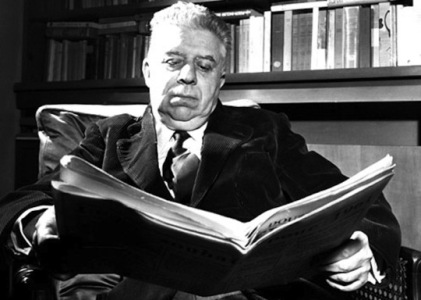
Montale 1970Montale and Friend

First, a few disclaimers: My knowledge of the history of Italian poetry is limited.  There is Dante’s Divine Comedy, which I studied reluctantly in college and have only grown to appreciate over the years, especially the brave and foolish translations that try to bring Dante’s terza rima forward from rhyme-rich Italian into rhyme-impoverished English. After Dante there is…let’s see…Petrarch and his sonnets, with their non-Elizabethan rhyme scheme, and… Boccaccio was a poet, wasn’t he? But all I remember of Boccaccio is that he wrote The Decameron, and those are stories written in prose.

At this point I have to jump from the Middle Ages up to the 1800’s – there was an Italian poet named Leopardi, but I know nothing about him, only his name and that he lived around the time John Keats lived. There it is: in one jump, five centuries of Italian poetic tradition lost to me. In the 1900’s there was someone named Campana – or was Campana Spanish? No, Italian, I think. And there was definitely a modern Italian poet named Ungaretti but I’ve never read his work – or was Ungaretti a woman? No, a man, I’m sure. I remember thinking his name sounded like an expensive espresso machine.

So in writing about Eugenio Montale, a Nobel-Prize-winning poet few North Americans have heard of, I admit freely that I am not a fluent guide, only a fan. I don’t know the traditions that his work springs from.

11/12/1960  Eugenio MONTALE nel salotto di casa sua (1896 Genova - 1981 Milano)  Poeta italiano FARABOLAFOTO 391103

I do know he was born in Genoa in 1896 and died in Milan in 1981. Growing up, he spent holidays with his large family in Monterosso, one of the Cinque Terre villages which hangs dramatically from  the cliffs of Liguria, a landscape that shows up literally and metaphorically in much of Montale’s poetry. I know he had a contentious relationship with Ezra Pound, who was arrested for treason after a pro-Fascist stint as a radio broadcaster in Mussolini’s Italy (Montale was famously anti-Fascist, forced from his job after refusing to join the Fascist Party.)

In preparation for this look at Montale’s work, I consistently ran up against the term “hermeticism” to describe his circle of poets. Hermeticism? And specifically Italian hermeticism? The term was tossed around casually enough and linked to French surrealism, but I had to go to the Encyclopedia Britannica for a solid definition (“…modernist poetic movement originating in Italy in the early 20th century, whose works were characterized by unorthodox structure, illogical sequences, and highly subjective language.”) In other words, the poet locks himself into his poems and leaves the reader out. Since I disagree with that assessment of Montale’s poems, I don’t believe it’s the reason behind why the poet is not well-known here.

One credible reason might be his late-in-life pessimism, seldom far from the surface. In fact, his Nobel Prize lecture is not the most optimistic of speeches, ending on this downbeat note: “It is useless then to wonder what the destiny of the arts will be. It is like asking oneself if the man of tomorrow, perhaps of a very distant tomorrow, will be able to resolve the tragic contradictions in which he has been floundering since the first day of Creation….” Poets with a reputation for pessimism are not embraced warmly by the general public. (As counterbalance to this reputation, try the charming video at this link, which shows Montale having a great time with an interviewer, then reading a section of Ossi de seppia which begins, “Forse un mattino andando in un’aria di vetro, /arida, rivolgendomi, vedro compirsi il maracolo….” (Maybe one morning, walking in air / of dry glass, I’ll turn and see the miracle occur….”

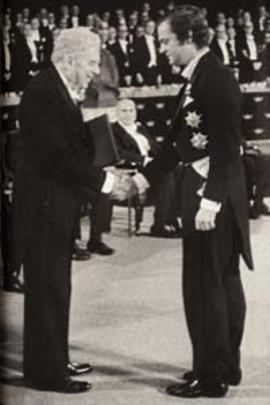
Montale - Nobel PrizeMontale receives the Nobel Prize from the King of Sweden

Another contributing factor to his lack of popularity here is this:  Even North Americans who love poetry – and practice it – are sadly uninformed about individual poets (and whole schools of poetry) beyond their borders, including poets who have achieved fame at a broad international level. Is it the fault of our insularity – an ocean wide and deep at each edge of our “sea to shining sea” – and of our misguided sense of exceptionalism in general? Maybe the triumph of English as a global language has become a linguistic substitute for the defunct geographical concept of Empire. If that’s true, we can claim our ignorance is due in part to our superiority – an oxymoronic (and ridiculous) conclusion. Or maybe our educational system simply fails us, and we are left with wide swaths of ignorance in certain areas, including the learning of foreign languages to begin with. Maybe I shouldn’t even say maybe to that.

There’s one more possibility I can think of, a more attractive one which does less finger-wagging and makes me less embarrassed by gaps in my education, and that is the one Robert Frost offered: “Poetry is what gets lost in translation.”  If we accept the idea that the key element which distinguishes poetry from prose is its musicality (and not just those line breaks) then we have to accept the idea that translations which cannot capture the cadences of the original are, to a certain extent, failures. As Iris Murdoch said after being questioned by someone about her translations of French poetry, “The activity of translation…turned out to be an act so complex and extraordinary that it was puzzling to see how any human being could perform it.”

Adequate literal translations – yes, those are possible. Brave attempts to reproduce formal elements – rhyme and meter – and make them work alongside the literal translation? Yes, those exist and are laudable. But can we ever hear and know, at a visceral level – heartbeat and hoofbeat – the effect of a poem whose original language is not our own? I’m not sure. I suspect not. And maybe it is this – translation’s intrinsic failure – that makes us avoid poetry written in other languages. Vladimir Nabokov said it well in his poem “On Translating Eugene Onegin”: Reflected words can only shiver / Like elongated lights that twist / In the black mirror of a river / Between the city and the mist.

Which brings me back to my reading of Eugenio Montale, the great Italian poet of the 20th century, whose translated poetry deserves to be much more widely read, but whose name usually evokes the response “Who?” His poems seem to me to be filled with music.  Though I don’t speak Italian, I do speak Spanish, and I’ve always thought that the Latinate origins of those two languages helped me in my reading of Montale. But is my sense of its musicality justified?

Here is the original Italian of one of his most famous poems, published in his first poetry collection, Ossi di seppia  (“Cuttlefish Bones”), in 1925.  The English translation follows. To my ear (as I imagine it read aloud by someone who speaks fluent Italian) it sounds like river water rippling around well-polished rocks:

I Limoni

Ascoltami, i poeti laureati
si muovono soltanto fra le piante
dai nomi poco usati: bossi ligustri o acanti.
lo, per me, amo le strade che riescono agli erbosi
fossi dove in pozzanghere
mezzo seccate agguantanoi ragazzi
qualche sparuta anguilla:
le viuzze che seguono i ciglioni,
discendono tra i ciuffi delle canne
e mettono negli orti, tra gli alberi dei limoni.

Meglio se le gazzarre degli uccelli
si spengono inghiottite dall’azzurro:
più chiaro si ascolta il susurro
dei rami amici nell’aria che quasi non si muove,
e i sensi di quest’odore
che non sa staccarsi da terra
e piove in petto una dolcezza inquieta.
Qui delle divertite passioni
per miracolo tace la guerra,
qui tocca anche a noi poveri la nostra parte di ricchezza
ed è l’odore dei limoni.

Vedi, in questi silenzi in cui le cose
s’abbandonano e sembrano vicine
a tradire il loro ultimo segreto,
talora ci si aspetta
di scoprire uno sbaglio di Natura,
il punto morto del mondo, l’anello che non tiene,
il filo da disbrogliare che finalmente ci metta
nel mezzo di una verità.
Lo sguardo fruga d’intorno,
la mente indaga accorda disunisce
nel profumo che dilaga
quando il giorno piú languisce.
Sono i silenzi in cui si vede
in ogni ombra umana che si allontana
qualche disturbata Divinità.

Ma l’illusione manca e ci riporta il tempo
nelle città rurnorose dove l’azzurro si mostra
soltanto a pezzi, in alto, tra le cimase.
La pioggia stanca la terra, di poi; s’affolta
il tedio dell’inverno sulle case,
la luce si fa avara – amara l’anima.
Quando un giorno da un malchiuso portone
tra gli alberi di una corte
ci si mostrano i gialli dei limoni;
e il gelo dei cuore si sfa,
e in petto ci scrosciano
le loro canzoni
le trombe d’oro della solarità.

William Arrowsmith is probably the best known translator of Montale’s work, but the following English translation of “I Limoni” is by poet Lee Gerlach (who also deserves to be more widely read.) I prefer it especially for that wonderful turn of phrase “the jubilee of small birds,” which Arrowsmith translates as “the gay palaver of birds”:

The Lemon Tree

Hear me a moment. Laureate poets
seem to wander among plants
no one knows: boxwood, acanthus,
where nothing is alive to touch.
I prefer small streets that falter
into grassy ditches where a boy,
searching in the sinking puddles,
might capture a struggling eel.
The little path that winds down
along the slope plunges through cane-tufts
and opens suddenly into the orchard
among the moss-green trunks
of the lemon trees.

Perhaps it is better
if the jubilee of small birds
dies down, swallowed in the sky,
yet more real to one who listens,
the murmur of tender leaves
in a breathless, unmoving air.
The senses are graced with an odor
filled with the earth.
It is like rain in a troubled breast,
sweet as an air that arrives
too suddenly and vanishes.
A miracle is hushed; all passions
are swept aside. Even the poor
know that richness,
the fragrance of the lemon trees.

You realize that in silences
things yield and almost betray
their ultimate secrets.
At times, one half expects
to discover an error in Nature,
the still point of reality,
the missing link that will not hold,
the thread we cannot untangle
in order to get at the truth.
You look around. Your mind seeks,
makes harmonies, falls apart
in the perfume, expands
when the day wearies away.
There are silences in which one watches
in every facing human shadow
something divine let go.

The illusion wanes, and in time we return
to our noisy cities where the blue
appears only in fragments
high up among the towering shapes.
Then rain leaching the earth.
Tedious, winter burdens the roofs,
and light is a miser, the soul bitter.
Yet, one day through an open gate,
among the green luxuriance of a yard,
the yellow lemons fire
and the heart melts,
and golden songs pour
into the breast
from the raised cornets of the sun.

As much as I admire this translation, it’s clear that the music in the first stanza alone – the long “e” rhyme of all those internal and end-line words (ascoltami, i, poeti, laureati, si, nomi, usati, bossi, ligustri, acanti, erbosi, fossi, ragazzi, i, ciglioni, ciuffi, negli, orti, gli, alieri, limoni)  has been lost. Does Gerlach’s free-verse English have a subtle music of its own? It does (“Tedious, winter burdens the roofs, / and light is a miser, the soul bitter.”) But does this evoke, much less reproduce, the music of the original? Can we say we understand what Montale does with sound in his poem by reading this translation?  No.

Montale - Lemon Tree“…the yellow lemons fire / and the heart melts….”

In fact, the more aggravating question might be this: Do we understand the sound register of the original at all? Or do we romanticize the Romance languages, pleased by their multisyllabic flow, believing them to be mellifluous just because we are accustomed to the monosyllabic chunks of granite that English inherited from its Anglo-Saxon ancestors? Montale himself felt his native tongue was weighed down by exactly what I take to be its quickness and its flow, saying once that he fought “to dig another dimension out of our heavy, polysyllabic Italian.” One critic I read said he would have to go all the way back to Dante to hear an Italian poem as guttural as “I Limoni” (specifically referring to the doubled consonants in many of the Italian words.)

Guttural? That surprised me as much as the word “hermetic” did when applied to a poem which feels so wide open, accessible, and generous-hearted.  Maybe “guttural” in this case suggests a sprung rhythm I can’t quite hear, in the style of Gerard Manley Hopkins, whom Montale read and was influenced by.  If so, the translation provided here fails in a more serious way, since Hopkins (“fresh-firecoal chestnut-falls; finches’ wings, / landscape plotted and pieced—fold, fallow and plough….”) is nowhere to be found in it. I’ve wondered at the translatability of Hopkins – Montale was only one among others who attempted to translate the English poet into Italian, a formidable task considering Hopkins’ penchant for vocabularies and phrasings that were Germanic.

There might be poets who are singularly unsuited to translation into particular languages. And maybe the whole idea of what is “lost in translation” has less to do with poetry and more to do with cultural constructs in general; that is, maybe the failure of some translations (“Translation is the art of failure,” said Umberto Eco) is not only a failure of sound reproduction but of emotional connotations, linguistic anomalies and cognitive connections.  The way we think (and so, the way we hear and process language) is determined by our mother tongue.  It’s enough to make a translator throw in the towel – but thank goodness, some do not. If translation is our only access to certain poets, isn’t a flawed attempt better that no attempt at all?  For anyone who wants to explore issues of translation more deeply, try reading Douglas Hofstadter’s quick essay, “What’s Gained in Translation,” as a teaser to get you interested in his doorstop-size book, Le Ton Beau de Morot: In Praise of the Music of Language.

In any case, I don’t hear Hopkins in Montale’s “I Limoni.” And I can’t quite see the “obscure” nature of Montale’s poems that so many critics moan about. Yes, his poems are deeply personal. No, his frame of reference is not everyone’s – it includes his wife, his lovers, a landscape (Liguria) we are not completely familiar with, and politics that we are only marginally aware of. Montale was a firm anti-Fascist, and some of the allusions in the poetry will go over the heads of people unfamiliar with how those political issues played out in Europe during the 1930’s and 1940’s.  We have to pause and hunt a bit to understand a few of the references. Easy, no. But “characterized by unorthodox structure [and] illogical sequences” as the Encyclopedia says?  I don’t see it.

Maybe this is just a case of a poet’s work being ahead of its time, in the way paintings by Paul Klee might have seemed indecipherable to those who loved Monet.  To put it in a more contemporary frame, maybe people two generations out will be reading the work of L=A=N=G=U=A=G=E poets and wondering why people (me, for example) once thought of them as non-linear, illogical and difficult. It pleases me to think that the critics might be wrong about the “difficulty” of Montale’s work.  As the poet himself once said, “I have never purposely tried to be obscure and therefore do not feel very well qualified to talk about a supposed Italian hermeticism, assuming (as I very much doubt) that there is a group of writers in Italy who have a systematic non-communication as their objective.”

My goal is not to argue with literary critics but to encourage the reading and enjoyment of Montale’s work. You don’t have to figure out whether his poetry is fluid or guttural, emotionally open or hermetically sealed. It’s intriguing and worthwhile, no matter what labels are attached to it. I am all for reading any poet who calls nature “rough, scanty, dazzling” and who says, “I wanted my words to come closer than those of the other poets I’d read. Closer to what? I seemed to be living under a bell jar, and yet I felt I was close to something essential. A subtle veil, a thread, barely separated me from the definitive quid. Absolute expression would have meant breaking that veil, that thread: an explosion, the end of the illusion of the world as representation. But this remained an unreachable goal. And my wish to come close remained musical, instinctive, unprogrammatic. I wanted to wring the neck of the eloquence of our old aulic language, even at the risk of a counter-eloquence.”

Montale published only five books in fifty years of writing, so he was not prolific. I’ve brought this up previously as one possible cause for poets being under-appreciated, though the spacing of books is less the issue here than the suspicions we all have about translation in general. But consider the lovely English translation (by William Arrowsmith) of  “Il fuoco e il buio” :

Fire and Darkness

At times, because of dampness,
gunpowder fails to flash, and sometimes
catches without matches or flint.
A pocket lighter with one drop
of fluid could do the trick. And anyway
there’s no need for fire at all,
indeed, a good sub-zero curbs
that boring great-grandmother, Inspiration.
She was none too spry a few days ago
but she managed to disguise her wrinkles.
Now, ashamed of herself, she seems
to be skulking in the folds of the curtain.
She’s lied too often, now let darkness,
void, nothingness fall on her page.
Rely on this, my scribbling friend:
Trust the darkness when the light lies.

If you have only one book of Montale’s work on your shelf, it should be The Collected Poems of Eugenio Montale 1925-1977; the entire collection is translated by William Arrowsmith.  It’s still possible to get the poems in individual volumes: Ossi di seppia (“Cuttlefish Bones”), Le Occasioni (“The Occasions”), La Bufera e altro (“The Storm and Other Things”),  Xenia and Satura; it’s interesting to see how different translators handle the original Italian (poets Charles Wright and Jonathan Galassi take on the task with different collections, and Ghan Singh both translates and analyzes Montale’s work.)  But The Collected Poems, set out in the chronological order in which the poems were published, offers both Italian originals and English translations (on facing pages for easy comparison) and it is carefully indexed with both Italian and English titles of poems, making individual poems easy to find. The real genius of this collection for anyone interested in translation is the section containing William Arrowsmith’s notes – 107 pages of them in a 793-page book. In an age where translators rarely get any public recognition for their work other than their names in smaller-than-average font on the title page, that kind of permission given the translator – to go into the particular nuances of translation and the frame of reference of the original – is exhilarating. As poet and critic Rosanna Warren says in her introduction to the collection, “In each phase, [Montale] invented new ways of putting poetic language under stress and of realigning poetry with prose.” Warren, by the way, goes on to praise Arrowsmith for what she calls his “idiomatic, surging versions, ever alert to the pull and swerve of the original.”

Here’s one more small poem to pull you Montale’s direction:

My Muse

My Muse is distant: one might say
(and most have thought it) that she never existed.
But if she was my Muse, she’s dressed like a scarecrow
awkwardly propped on a checkerboard of vines.

She flaps as best she can; she’s withstood monsoons
without falling, though she sags a little.
When the wind dies, she keeps on fluttering
as though telling me: Go on, don’t be afraid,
as long as I can see you, I’ll give you life.

My Muse long since left a store room
full of theatrical outfits, and an actor costumed by her
was an actor with class. Once, she was filled
with me and she walked proud and tall. She still has
one sleeve, with which she conducts her scrannel
straw quartet. It’s the only music I can stand.

For all his insistence on the inadequacy of language to capture the true essence of anything (he called it “inexpressibility”) Montale managed to use the tools of language with grace, clarity and power.

— Julie Larios

 Author Photo

Julie Larios is the recipient of an Academy of American Poets Prize, a Pushcart Prize for Poetry, and a Washington State Arts Commission/Artist Trust Fellowship. Her work was chosen for The Best American Poetry series by Billy Collins (2006) and Heather McHugh (2007) and was performed as part of the Vox series at the New York City Opera (2010). Recently she collaborated with the composer Dag Gabrielson and other New York musicians, filmmakers and dancers on a cross-discipline project titled 1,2,3. It was selected for showing at the American Dance Festival (International Screendance Festival) and had its premiere at Duke University in July, 2013. For five years she was the Poetry Editor for The Cortland Review, and her poetry for adults has been published by The Atlantic Monthly, McSweeney’s, Swink, The Georgia Review, Ploughshares, The Threepenny Review, Field, and others. In addition, she has published four books of poetry for children. She lives in Seattle.

Mar 072011
 

Richard-JacksonRichard Jackson, Betanja, Slovenia, June 2008. Photo by Douglas Glover

Richard Jackson is an old friend, an eminent colleague at Vermont College of Fine Arts where he teaches poetry and translation, and an indefatigable traveler and spirit guide (dg spent nearly 2 weeks in Slovenia with Rick, during the 2008 VCFA summer residency—see  photo above—dg is still recovering). Richard Jackson is a prolific poet, a great humanitarian, a man of immense culture and erudition, and a gifted translator. He raises the bar. When you’re around Rick, you want to read more, see more art, learn more languages, and travel to distant fabled places.

dg

.

I

Why translate? Kenneth Rexroth, one of the most influential translators, writes in his essay, “The Poet as Translator,”– “The writer who can project himself into exultation of another learns more than the craft of words. He learns the stuff of poetry.” Translation is at the heart of poetry– a poet like Rilke writes in his “Ninth Elegy” that when the poet

returns from the mountain slopes into the valley,
he brings, not a handful of earth, unsayable to others, but instead
some word he has gained, some pure word, the yellow and blue
gentian. Perhaps we are here in order to say: house,
bridge, fountain, gate, pitcher, fruit-tree, window–
at most: column, tower….But to say them, you must understand,
oh to say them more intensely than the Things themselves
ever dreamed of existing.

Rilke’s notion that words only metaphorically stand for ideas, sensations and feelings suggests that they are themselves a form of translation. Of course, this could lead us quickly into a maze of problems and suggest that even a poem in our own language must be “translated.” What is at issue in translating poetry is the very nature of poetry, and the very nature of language. The main problems and debates that arise concerning the translation of poetic works occur when one realizes to what extent the essence of a poem lies, as Rilke and Rexroth suggest,  beyond the words per se.

First, I want to point out that literary translation differs in many important respects from the kind of translation that is usual in a language class. Literary translation, for one, involves a good deal of interpretation about intent and effect. For another, it is often not so interested in a literal “transliteration” as much as finding a corollary mood, tone, voice, sound, response–any number of issues can be raised here. John Dryden, the great neoclassical poet, wrote in his “Preface to Pindaric Odes,” that translation should be “not so loose as paraphrase, nor so close as metaphrase.” A poet such as John Nims feels that the most important thing to translate is sound; for him, the pure music of the poem is most crucial. James Wright in translating Hesse’s poems aims to duplicate their emotional effect more than any technique such as sound per se. Robert Bly’s translations are extremely loose yet often capture the essence of Neruda’s and Rilke’s spirits.

“Poetry is what is lost in translation,” wrote Robert Frost, a notion we have probably all heard. “Poetry is what is gained in translation” wrote Joseph Brodsky, the Nobel prize winning Russian poet who also spoke several languages. Or as Octavio Paz, the Mexican Nobel prize winning poet says, “poetry is what gets transformed.” Ezra Pound, in “How To read,” describes three aspects of the language of poetry: melopoeia, its music; phanopoeia, the imagistic quality; and logopoeia, “the dance of the intellect among words.” It is this last aspect that Pound says is the essence of poetry, Rilke’s unsayable. What Brodsky, Pound and Paz were driving at was that there are intangible things, that the realm of the wordless and visionary, as Dante himself says in Paradiso XXXIII , is both untranslatable while also being the essence of poetry. Brodsky may be echoing Boccaccio’s notion in Genealogia Deorum Gentilium, X,7, where Boccaccio says that in listening to the Greek Iliad in Latin translation “some passages I came to understand very well by frequent interpretation.” And the renowned Swedish poet, Tomas Transtromer, writes that a poem is a manifestation of an invisible poem that is written beyond languages themselves. “Languages are many but poetry is one,” says the Russian poet Andrei Voznesensky.

Where does this leave us? Yang Wan-Li, a Chinese poet, once wrote about poetry and translation: “If you say it is a matter of words, I will say a good poet gets rid of words. If you say it is a matter of meaning, I will say a good poet gets rid of meaning. ‘But,’ you ask ‘without words and without meaning, where is the poetry?’ To this I reply: ‘get rid of words and get rid of meaning, and still there is poetry.’” It is that intangible that is left that is the object, I suggest, of good translation. That is why the contemporary poet and translator, Jane Hirshfield, says: “A literal word-for-word trot is not a translation. The attempt to recreate qualities of sound is not translation. The simple conveyance of meaning is not translation.” She is perhaps echoing the great Latin poet Horace who writes in his “Art of Poetry” (Ser. II,iii)that a good translation of Homer can exist only:

if you don’t try to render word by word like a
slavish translator, and if in your imitation you do not
leap into the narrow well, out of which either shame
or the laws of your task will keep you from stirring a step.

The step image, by the way, is a pun of the use of “poetic feet,” a way to measure rhythm. Horace’s and Wan-Li’s notions have been echoed through the ages. In our own day Octavio Paz says: “After all, poetry is not merely the text. The text produces the poem: a sense of sensations and meanings….With different means, but playing a similar role, you can produce similar results. I say similar, but not identical: translation is an art of analogy, the art of finding correspondences. An art of shadows and echoes….of producing, with a different text, a poem similar to the original.” This leads us to an essential irony: Stephen Mitchell, the well known translator of Rilke, says that “with great poetry, the freest translation is sometimes the most faithful.” And the great English poet, translator and critic, Samuel Johnson, who was one of the most conservative critics of the neoclassical period, wrote: “We try its effect as an English poem; that is the way to judge the merit of translation.”

.

II

Let’s look at a small portion of Dante’s text, the opening stanza of the Inferno, as a way to see look at the problems involved in such judgements . The four versions I’ll briefly look at are John Ciardi’s standard translation which strives to duplicate the colloquial effect of the language as well as some rhyme, Mark Musa’s relatively accurate literal version which uses a three line unrhymed stanza which renders an accurate sense of the poem’s meaning and scope, even the play of its metaphors, yet does not provide any of the poem’s tonal qualities,  Robert Pinsky’s terza rima version strives to capture more of the varied aspects of Dante’s language, and Michael Palma’s new colloquial terza rima version that adds a great deal of interpretive material. One could say, as with Ovid, that in all these translations one is not reading Dante but only a translator, but of course that is also true for an Italian of today who must not only cope with archaic words and word forms, but also the different force and even connotative meaning of images and metaphors. We can gain a basic insight into these versions by looking at the opening stanza:

First here is the Italian and a literal transcription:
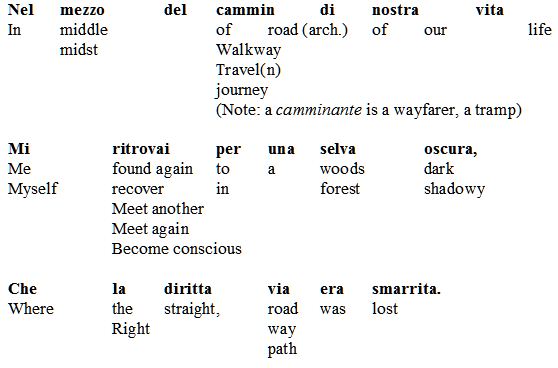
jackson-trans-image

The road, first of all, is both literal, and as we soon learn, spiritual, the Biblical, “straight and narrow” road to salvation. Note that the loss is in the passive voice—Dante the pilgrim narrator is incapable of admitting at this point in the poem what Dante the poet knows: he is ethically confused and about to lose his soul. Ritrovai has special problems: to be lost and found is a basis of the Christian faith Dante is writing out of, yet the primary meaning of the word in the reflexive (mi ritrovai) is to meet another, also to come to consciousness, —which explains why some translators will use “came to myself” (though some use the reductive “awake”) emphasizing the spiritual split inside the narrator. Similarly, “straight” and “right” might be spiritual equivalents, but they suggest two different moods, the second being more directly a matter of ethics. Similarly dark and shadowy pose two distinct choices, both with Biblical connotations, shadowy suggesting more of the Hebrew Bible.  Note also that Dante uses two words for the road—perhaps suggesting the road mortal people usually take as opposed to the correct path of righteousness.

While Ciardi’s version retains much of the colloquial energy of the original, he makes the narrator admit his fault (“I went astray”), which goes against the dramatic unfolding of the poem, for Dante’s narrator does not understand his own guilt and is in fact filled with pride and the inability to perceive sin accurately. Ciardi gives us:

Midway in our life’s journey, I went astray
From the straight road and woke to find myself
Alone in a dark wood. How shall I say….

Much of the drama of the poem rests in his struggle to separate his emotional sympathy for sin from his rational knowledge of evil. This sort of split is not something common to Ciardi’s own poems, either, which are straightforward and confessional– as is his translation. In many ways we are reading Ciardi using Dante as a way to describe his own self. To really understand what Ciardi is doing and the relation between his poem and Dante’s, one should read some of Ciardi’s poems along with his translation: what we find is the same forceful, direct, driving voice that the translation offers. Understanding this, we can extrapolate in order to imagine Dante’s quieter and more lyrical voice behind Ciardi’s. We can under stand, for example, that “Went astray” seems to lower the stakes while it lowers the linguistic level in a way that works better in Ciardi’s own poems than in this translation. We begin, in other words, to understand Ciardi’s approach as a sort of “common man” approach to the poem.

Mark Musa’s version suggests that Dante’s drift was part of a sleep, for now he awakens, a very literal and reductive interpretation of mi ritrovai not as a coming to consciousness, but a mere waking up– Musa’s pilgrim also states that the wandering was his own fault, as Ciardi’s does. By using “path” he also emphasizes the physical dramatic setting of the woods:

Midway along the journey of our life
I woke to find myself in some dark woods,
for I had wandered off from the straight path.

Musa’s use of “some” suggests a kind of casualness, at least as much as Ciardi’s, though he probably means it to heighten the narrator’s sense of being lost. This casualness– perhaps a product of our age’s fascination with freer verse forms and the looser Wordsworthian and Frostian blank verse– dominates Musa’s account, which is hardly a poetic step above the plain prose account of Mark Singleton. Musa doesn’t really provide a range of rhetoric, a range that is essential to Dante’s poem, and which a translator like Pinsky strives for. If we use Musa’s account, then I think we have to look at the influences that have led him to his form– to much of the poetic strategies of mainstream contemporary American poetry (he’s not a poet himself). Still, understanding that allows us to start to be able to perhaps take a step back towards understanding the difference in poetics between our world and Dante’s world, and gauge at l4ast the force of his metaphors which Musa remains absolutely loyal to.

For my money, the best current versions are those by Robert  Pinsky and Michael Palma. Pinsky’s tries to be formal where Dante is formal, more rough and colloquial where Dante is Colloquial, imitates formal elements in the rhetoric such as anaphora and parallelisms, and generally keeps the tone. He also suggests something of the pace of the original, ironically by condensing it somewhat. Here is Pinsky’s opening:

Midway on our life’s journey, I found myself
In dark woods, the right road lost. To tell
About those woods is hard—so tangled and rough…

Pinsky leaves the responsibility for the way being lost ambiguous which I think is a good interpretation of Dante’s sense of things at this point. Pinsky places the reference to the tangled wood, which occurs in Dante a few lines later, at this point, allowing, as dante intended, the tangle refer to the pilgrim’s words nand ideas as well as the physical path. If we continue through his version we find Pinsky echoing the harsh onomatopoeic effects Dante uses to describe the lawyers in later in the poem, and imitating the song-like anaphora Francesca uses to seduce the Pilgrim in her “imbedded” lyric within canto V. Pinsky raises and lowers the linguistic register just as Dante does and the reader leaves the poem with a pretty fair sense of what the poem is trying to do.

Michael Palma’s version, which seems to lean on Pinsky’s, uses slant rhymes as well as full rhymes, and also the interlockings of terza rima in an interesting new version, though one must be also aware of interpretive additions or juxtapositionings which place in a half notch below Pinsky’s version:

Midway through the journey of our life, I found
Myself in a dark wood, for I had strayed
From the straight pathway to the tangled ground.

Of course, some of what he adds is to fill out the rhymes, but in doing so he inadvertently emphasizes the physical journey over the spiritual with “tangled ground”  by including it in this first sentence rather than a tad later where it actually occurs. And he also allows the narrator to be more conscious of what his own culpability is than Dante’s narrator, as Ciardi and Musa do– all three of them perhaps falling prey to the sort a sort of guilt complex that seems to have entered much contemporary poetry and consciousness. Palma’s very colloquial version also seems to sometimes create a suburban inferno; his use of “pathway” here suggests a kind of jogging path, an effect one also sees in Longfellow’s 19th century version.

One could say that in all these translations one is not reading Dante but only a translator, but of course that is also true for an Italian of today who must not only cope with archaic words and word forms, but also the different force and even connotative meaning of images and metaphors. One answer is simply to not read any version because it is not the author per se, but that would lead to a pretty narrow view of our literary heritage. (What would happen if the same principle were applied to the UN where speeches are given and translated but cannot translate nuances of meaning, tone, voice, rhythm, etc.?)

.

III

In recent years translators have taken to collaborative efforts, often translating language they do not know or know very little. Such collaborations, usually between a good linguist or native speaker and a good poet have resulted in some stunning translations. Usually the poet is provided with a literal translation, then works with the translator over phrases and words with colloquial, historical or metaphoric resonance, and then the poet comes up with a poem that is a version, imitation (fairly close) or adaptation (loose). This, too, is an old practice: Johnson, for instance, describes it in his description of Pope’s work on The Iliad. When Pope or any translator poet felt himself “deficient” in understanding, he would make “minute inquiries into the force of words.” Chapman, for example, besides Pope, clearly worked this way. The aim of these efforts is to provide, as Johnson, sought, the best poem in English. The result of translation in the context I have been discussing is, as Johnson notes, a way to enrich both languages just as Pope’s translation of Homer “tuned the English tongue.” Pond puts it this way: “it is in the light born of this double current that we look upon the face of the mystery unveiled.” Pound says that his translations of Cavalcanti are not line by line by rather “embody in the whole of my English some trace of that power which implies the man.” Clearly the notion of translation here is far different than what the average person thinks.

The French poet, Paul Valery, in his The Art of Poetry, writes that in translating Virgil he wanted to change parts for he felt a merging with the author: translating was creating, he felt. In a similar way, in our own time, Pulitzer Prize winning poet and translator Charles Simic writes: “translation is an actor’s medium. If I cannot make myself believe I am writing the poem I’m translating, no degree of aesthetic admiration for the work will help me.” Judith Hemschemeyer, who translated perhaps the greatest poet of the century, Anna Akhmatova, describes a slow process of first getting a basic sense and then working to duplicate various effects depending upon what she felt the main strength of a particular poem to be. And well known American poet Galway Kinnell describes, in his preface to Villon’s poems, how “one can be impeccably accurate verbally and yet miss the point or blur the tone quite badly….I wanted to be ‘literal’ in another sense. I wanted to be more faithful…to the complexities of the poetry, both to its shades of meaning and its tone. At the same time I wanted the English to flow very naturally. Therefore I avoided transferring ‘meanings’ from one language directly into another.” Kinnell goes on to say he attempts to “internalize” the French: I would not merely be changing language into language but also expressing what would have become to some extent my own experiences and understandings.” If that seems strange, remember that whenever we read a poem in our own language we bring our own experiences, contexts, and notions to the text, and they interact to form a unique experience called the poem. One could argue– and many critics and linguists today do so– that we translate even as we read within our own language. reading Kinnell’s poems and Kinnell’s translations involves similar activity, and not unlike what we would do when reading Villon in the original. So what is Villon’s poem? As read by a French scholar? a French poet? a good reader of French? a bad reader? Do the poems exists in some absolute Platonic place where all the meanings and effects are intact? Do they exist in individual reader’s responses? Somewhere in between? These are precisely the issues a translator and a reader of translations must face. “It is because it is impossible that translation is so interesting,” wrote William Matthews who has translated Ovid, Horace and Martial.

In a letter about the nature of poetry to his brother, Gherardo, Petrarch wrote of the Biblical poetry that they “never have been, or could be, easily translated into any other language without sacrificing rhythm and meter or meaning. So, as a choice had to be made, it has been the sense that has been more important. And yet some trappings of metrical law still survive, and the individual pieces are what we still name verses, for that is what they really are.”  Still, unsatisfied finally with that, Petrarch wrote his own sequence of Salmi Penitenziali in a single year in imitation of the Biblical psalms, but using phrases and ideas from the originals. In the “Preface” to his “Familiar Letters” Petrarch wrote that “The first care of the poet is to attend to the person who is the reader; this is the best way to know what to write and how to write it for a specific audience.” In a sense he prefigures Johnson’s concern, cited above, that the purpose of poetry is to be read.

How, then, to restore poetry’s original sense of freshness, of movement, and yet take into account a modern audience is always the issue. Translators like David Slavitt, with Ovid and Virgil, and William Matthews, with Martial and Horace, have magnificently transplanted these poets to our own times so that they seem to come alive, filled with their own concerns, but as they would speak in our own age, as Johnson had wanted. Matthews, for instance, adds current references, Slavitt’s Virgilian Eclogues are as much interpretations as translations. In other words, they have considered the contemporary reader, as Petrarch urged, along with the meaning and rhythms. This is precisely the example of Horace and of Pope. As Johnson wrote of Pope’s Homer: “To a thousand cavils one answer is sufficient: the purpose of an author is to be read, and the criticism which would destroy the power of pleasing must be blown aside.”

Literary translation comes close, as Pope suggests in a letter about his Imitations of Horace, to the notion of imitation. One anonymous wrote that Pope’s versions were “bound hand and foot and yet dancing as if free.” Earlier, Ben Jonson had defined imitation in his Timber as merely a poem loosely based on another poem. Dryden in his “Preface” to his translation of Ovid,  then defined three kinds of relationship a poet could have to a prior text.  “Metaphrase” for Dryden was a slavish, “word by word” account. “Paraphrase” was a “translation with latitude” that kept the original meaning but often with “amplification.” “Imitation,” on the other hand, meant, for Dryden, a process where the “translator (if now he has not lost that name) assumes the liberty, not only to vary words and sense, but to forsake them both as he sees occasion; and taking only some general hints from the original, to run division on the groundwork, as he pleases.” This is precisely the sort of thing Robert Lowell does in his Imitations from various poets, and what Pound does in his “Homage to Sextus Propertius,’ a sequence of loosely translated lines rearranged into a sequence of totally new poems. And it is related to what Stephen berg does in  gathering images, tones and lines from Anna Akhmatova in his With Akhmatova at the Gate . Dana Gioia has written an essay describing how Donald Justice makes use of various lines, poems and forms of previous poets in over a fourth of his own poems.

We’ve become so used, in our own time and place, to valuing the new and the different above all else, that we have lost sight, in our own art of poetry with its rich tradition, of, as Roethke says in the title of a revealing essay, “How to Write Like Someone Else.”  Indeed, poets through the ages have learned to write by imitation, from Catullus adaptations of Callimachus, Horace’s borrowings from Lucilius, Petrarch’s use of Dante and Cino di Pistoia, Wyatt and Surrey’s use of Petrarch, and so on. Pope in fact said he turned to imitation to tighten his own verse and to find a voice to say things he was not ready to speak in his own voice. Petrarch, an early champion of learning from the past,  writes in a letter to his friend Boccaccio: “An imitator must see to it that what he writes is similar, but not the very same; and the similarity, moreover, should not be like that of a painting or statue to the person represented, but rather like that of a son to a father, where there is often great difference in the features and members, yet after all there is a shadowy something– akin to what the painters call one’s air–hovering about the face, and especially the eyes, out of which there grows a likeness…. [W]e writers, too, must see to it that along with the similarity there is a large measure of dissimilarity; and furthermore such likeness as there is must be elusive, something that it is impossible to seize except by a sort of still-hunt, a quality to be felt rather than defined…. It may all be summed up by saying with Seneca, and with Flaccus [Horace] before him, that we must write just as the bees make honey, not keeping the flowers but turning them into a sweetness of our own, blending many different flavors into one, which shall be unlike them all, and better.” Imitation, in other words, is creation: just taking a glance at what Samuel Johnson does to Juvenal in his “Vanity of Human Wishes” or what Frost does with  Virgil’s Georgics in his North of Boston the Greek Anthology in A Witness Tree ought to show us how one can learn from the past and still be original. Curiously, Frost gave a January 1916  lecture called “The discipline of the Classics and the Writing of English” which extolled imitation. One can see how James Wright’s middle poems were influenced by his reading of Lorca, Jiminez, Neruda and various imagistic poems from China and Japan. In fact, a glance at W.S. Merwin’s poems in The Lice (1967) and the translations he was doing at that time show an incredible similarity of the type Petrarch describes. Of course, sometimes imitation is very close to the original: in fact, one translation of Merwin’s , “The Creation of the Moon” derived from a South American Indian tale is almost rendered step by step in  in The Lice but with a different ostensible subject.

Even more  loosely, we can see a number of influences: Kunitz, Horace and Robinson on James Wright; Greek and Roman epigrams on Linda Gregg and Jack Gilbert; Vallejo, Rimbaud and the beats on Tomaz Salamun. Longinus, the Roman critic wrote: “Emulation will bring those great characters before our eyes, and like guiding stars they will lead our thoughts to the ideal standard of perfection.” Perhaps one of the greatest examples is the way Petrarch borrows the idea of creating an evolving self in a sequence of poems from Horace’s Odes and his sense of how to address the reader from Cicero’s letters. Ultimately the point here is that poets learn to advance their craft by reading other poets from other ages and other cultures, adapting impulses, lines, forms and ideas to their own times. Not to read, not to “emulate,” is to isolate one’s art, to leave it static.

.

IV

My personal history of ideas by poet-translators on their art is a far ranging one that extends from the Romans like Catullus who saw it as a “combat” with the original, to poets like Petrarch and Samuel Johnson who judged a version by its effect in the so called “target language,” to Robert Lowell’s and Alexander Pope’s loose “imitations.” I know that some of these practices would startle if not horrify most of my language teachers. Yet even a respected academic like Wilhelm Humbolt, in his introduction to his translation of Aeschylus’s Agamemnon, says: “the more a translation strives toward fidelity, the more it ultimately deviates from the original, for in attempting to imitate refined nuances and avoid simple generalities it can, in fact, only provide new and different nuances.” This is perhaps why a poet like Jane Hirshfield, also a translator from Japanese, writes: “Translation’s very existence challenges our understanding of what a literary text is.”  I think what has intrigued me about the various possibilities of various kinds of translation is precisely that challenge; it offers a way to understand my native language better, to pay more conscious attention to kinds of detail that I approach on a more subconscious level in writing my own poems, and to appreciate some relationships between my own poems and those of poets in another language with whom I have found a kindred spirit.

For my own part, I have done three separate and very different translation projects that I would like to describe for what light they might cast on the the poet as translator. I felt that each poet’s poems demanded a different approach. Perhaps what links these three very different projects is Milan Kundera’s notion, in Testaments Betrayed, of the importance of the original author’s “personal style.” In many ways he extends Humbolt’s theory when her says that “every author of some value transgresses against ‘good style,’ and in that transgression lies [his] originality. The translator’s primary effort should be to understand that transgression.” For me this has meant reading everything, from letters to journals to work in other genres, to the author’s own translations of other writers’ works, and to the author’s own contemporaries, in an attempt to get to the source of his style, the structure of his mind. The results have been variously:  a fairly traditional approach, a radical transformation of the original, and a collaborative project.

First, the traditional approach. Several years ago I stumbled across a book of last poems by Cesare Pavese in a bookstore in Firenze, poems not then availabe in English, and very different from the William Arrowsmith versions I knew. This book, his last poems before he committed suicide, contains a number of poems in narrow lines where the metamorphic aspect of his earlier work is much intensified. A number of these poems of “Disamore,” “Disaffection” or “Lost Love,” as it might literally or figuratively be translated, identify the land of northwest Italy, especially from Torino to Genoa with a woman, and that land as variable, enticing, dangerous, beautiful, forbidding and distant.

Most translators translate one section of these last poems, originally published in a pamphlet, as “Death Will Come and It Will have Your Eyes.” I translate the title as “Death Will Come and She Will have Your Eyes.” This small difference suggests a huge difference in what Pavese is trying to do. The whole section, in fact, deals with a woman or women who potentially betray him—leading up to his suicide reportedly after his rejection by an American actress. The personification, using “she” rather than “it” is warranted first by the way he personifies other things such as the land, which he sees as feminine, in earlier sections from this book. (While “morte” is technically feminine in Italian, this of course does not carry over into English, though one wonders if Pavese, so careful with images, might have felt this more than we do.) For example, in one poem in this book he writes: “You are the land and death.” In another he says the woman is a “clump of soil.” In another section he is even more direct in linking womanhood to death, something he does in his journals where he says that one kills himself for the love of a woman, “any” woman because of the way the self is humiliated by all women. Obviously, Pavese’s attitude towards women throughout his poems could have benefited from serious counseling.

In any case, my version reads:

Death will come and she will have your eyes.–
this death that accompanies us
from morning to evening, sleepless,
deaf, like an old remorse,
or an absurd vice. Your eyes
will be one empty word,
a hushed cry, a silence.
Things you see each morning
when you alone gather yourself
into a mirror. O dear hope
when will we ever know that
you are life and you are the empty day.

For every death looks the same.
Death will come and she will have your eyes.
It will be like giving up a vice,
like seeing in a mirror
the face of death come to the surface,
like listening to closed lips.
We will descend to the abyss silently.

Personifying death this way also makes the image of seeing death, the woman, in the mirror, more powerfully, for in many ways the idea of a deadly woman took over and controlled his own identity. So the Pavese project has been one where the basically accurate translation tends to emphasize Pavese’s peculiar humanizing of his landscapes more than other translations.

I should also add that these later poems have an entirely different rhythm than his earlier ones: there are quicker turns and the emphasis is more on words and their placement in the line than on phrases and sentences as in the earlier poems. I feel, because of the rhythm of thinking in the original, that, as much as possible, the original word order should be kept. In translations of earlier poems, on the other hand, I have placed more emphasis on the phrase and image order, for it is in those poems that Pavese practices his theory of the “image narrative.” So for example, my last line in “Death Will Come” reads “we will descend into the abyss silently” rather than the more normal American English order, “we will descend silently into the abyss.” The word, silently (“muti”),  comes as a kind of afterthought in the syntax, and yet its place at the end of the line also emphasizes the relationship between silence and death.

The effect on my own poems, if I can judge that, has been first of all an increase in the use of personification, and related to that, a more functional use of landscape. I think I have also noticed a greater attention to different effects of lineation. And as far as understanding Pavese goes, I have gained a more sympathetic understanding of the pathology of his torment.

The second project is not really translation at all, but rather “Poems based on Petrarch,” where I have taken an entirely other approach, using the originals as take off points for what might be likened to jazz riffs. I have in mind the way Coltrane uses a few bars of “Bye Bye Blackbird” in his Swedish date and then takes off into the stratosphere for 13 minutes until we are so far afield all we sometimes hear are a few of the original notes in various patterns. In a way I am following Petrarch’s own advice when he writes in a letter to his friend Boccaccio: “An imitator must see to it that what he writes is similar, but not the very same; and the similarity, moreover, should not be like that of a painting or statue to the person represented, but rather like that of a son to a father, where there is often great difference in the features and members, yet after all there is a shadowy something– akin to what the painters call one’s air–hovering about the face, and especially the eyes, out of which there grows a likeness…. [W]e writers, too, must see to it that along with the similarity there is a large measure of dissimilarity; and furthermore such likeness as there is must be elusive, something that it is impossible to seize except by a sort of still-hunt, a quality to be felt rather than defined…. It may all be summed up by saying with Seneca, and with Flaccus [Horace] before him, that we must write just as the bees make honey, not keeping the flowers but turning them into a sweetness of our own, blending many different flavors into one, which shall be unlike them all, and better.”

I suppose another model for me was the way Ben Jonson had defined imitation in his Timber as merely a poem loosely based on another poem. Besides, for me there was a problem of the quality of the English version, for even by the time of Shakespeare’s mocking of Petrarch in “My mistress’ eyes are nothing like the sun” many of Petrarch’s fresh images and comparisons had already become clichés. This was a problem I experienced with my first versions of Petrarch which were standard conservative translations. These early versions led me to realize that I wanted a sense of what I felt Petrarch might sound like if he wrote today in America. In this context I think of what Pound does in his “Homage to Sextus Propertius,’ a sequence of loosely translated lines rearranged into a sequence of totally new poems and  what Jo Shapcott does in Tender Taxes, based on Rilke’s French poems, which, as she says,  “re-imagines Rilke’s brief and fugitive lyrics as English poems.”

Here, for example, is Petrarch’s #234. ‘O cameretta che già fosti un porto’, literally translated:

O little room that sometimes served as a port
In these fierce daily storms of mine,
You are the fount, now of my nightly tears,
Which, because of the shame I feel, I hide by day.
O little bed, that used to be a comfort and a rest
In many trials, from what  doleful urns
Love bathes you with those hands of ivory,
So cruel to me alone, so unjustly!

I flee not only from seclusion and my rest,
But flee myself and my thoughts even more,
Which used to raise me in flight as I followed.
And now for asylum, I seek out the crowd,
My hated foe — who would believe that?
I am so afraid of finding myself alone.
(my translation)

My riff, “The Exile,” tries to extend the mood of the poem, keeps some allegiance to the setting, but radically changes the images, making them more surreal. I suppose I had in mind what Dryden called “imitation” and what Pound logopoeia, “the dance of the intellect among words. It is admittedly a far cry from the original, in fact I would really consider it more of an original poem that, in Eliot’s phrase, “steals” from the original. Here, then, is my “riff”-

Grief frames the doorway to that room I used to call my port
against whatever storms came careening down my street,
that room with its memories now crumpled on a table, a fleet
of hopes wrecked by words that regret what they alone distort.
Thorns fill the bed. A taunting night shakes its keys to closets
of desire I can no longer open. Who sleeps there, indiscreet
rival, while I flee his shadows that loiter like a disease
which waits for a soul to pummel, a love to perfectly thwart?
The doorknob of the night is always turning, but it is myself I flee–
my dreams, my rhymes, that lifted me towards a heaven
I thought was the love these words might finally create.
Maybe now I’ll hide in those city crowds I’ve come to hate
since I can no longer face myself, no longer be alone.
Longing rings the doorbell, but the house is empty.

My first idea was how to make this remarkable poet and influence fresh again, more contemporary. So there’s the doorbell is a contemporizing effect, and the doorknob, and the colloquial American English in general. But in all of them I have kept the original rhyme scheme, or one of the schemes, using a lot of slant rhymes. I also loosened the line from his pretty strict classical 11 syllable Italian line, but within those constraints I was often thinking through Petrarch’s mind as I understood it, especially after reading all the 365 poems in his conflicted book about Laura, his Ciceronian and Familiar letters, his other poems and prose and several biographies and critical works.

The poems vary considerably in what they owe to the original, because my ultimate aim was what I could apply to my own work. As I worked with more of his poems I saw much in his life and times similar to my own, and so I began to absorb that personality. Oddly, then a great number of these poems are in effect more autobiographical than my other poems from about 1993 on. This project effected a greater sense of the possibilities for contradictions and arguments within the evolving movement of my own poems, a move also towards more concise poems than I had been writing, a greater sense of the odd and sudden twists and turns metaphors can take, and the way a controlling metaphor can move in and out of a poem’s surface. I’ve done about seventy poems, mostly sonnets, with a few canzoni, and am probably done with it for now.

My third translation project is a collaborative effort with two other American poets, Susan Thomas and Deborah Brown, with occasional help from a few of our friends. In our versions of Giovanni Pascoli, a turn of the last century poet who spent his last years in rural Barga, in northwest Tuscany, we have used John Hollander’s notion of finding an analogue in English poetry to use as a kind of base. (As with the Pavese and Petrarch, I have visited Pascoli’s home and favorite haunts to gain a further feel for the landscape that is so important to him.)  Pascoli, by the way,  was a terrific influence on Pavese. Just as Nabokov found an analogue for his translation of Pushkin in Andrew Marvell,  as part of our procedure, we found an analogue in a combination of Hardy and Frost, that is, a voice that is at once rustic and cosmopolitan, melodious and rough, minute in its natural observations and ready to imply larger analogies.  We have not kept strictly to Pascoli’s format, never the rhymes which his rustic syntax allows him to sound more natural in Italian, though we have tried to duplicate the inner form, the appearance on the page and many of the sound effects.

Our procedure, after deciding we wanted an accurate translation that also conveyed the mood and tone– was for one of us– this varied  poem to poem — to provide a version to work on. Then the other two would offer comments, suggestions, sometimes radical rephrasing. This was mostly done by email. A number of problems surfaced immediately. For one, Pascoli writes in a particular dialect from the mountains of northwest Tuscany above Lucca. A number of words had to be deciphered contextually through the meanings of the poem in question, its companions and through the online version of the poems that also contained a useful concordance. Stylistically, Pascoli often drops part of a sentence, uses pronouns in an ambiguous way to extend meanings, and puns in sometimes very subtle ways (both verbally and visually). As with Pavese, I felt the word order with its rhythm and lineation was crucial.  Some of his references are to specific places near Barga, and to particular folk events and sayings. He also has a habit of linking clauses together by semicolons to suggest a kind of linking of the particulars of a scene in a kind of image narrative that may have later influenced Pavese’s theory of the “image story.” His poems range from dialectic sequences of brief lyrics about rustic life to odes and other longer poems, and then later in his career to political poems and poems based on classical and mythic themes, on artists and other famous figures.

One example of the problems of translation here stems from his extensive knowledge of astronomy and mythology. For example, one of his most interesting sequences is “The Last Voyage,” a narrative of Odysseus wanderings after the Odyssey to plant an oar where Poseidon is not known, certainly a sequence influenced by Tennyson’s “Ulysses.”  Susan rendered the opening poem’s lines 3-5 as:

Because of an error made on land,
He was exhausted and foot weary,
Supporting an oar on his strong shoulder.

Now the word for shoulder is “omero” which, capitalized, is also “Homer.” The poem itself is a carrying forward of Homer: should we try to account for this pun? Would the phrase “Homeric shoulder” work? The adjective for shoulder is “grande” which can mean here “big” or “strong.” Someone even suggested “epic shoulder” which we rejected. Also, the “error made on land” is that he is lost — (the root of “error” in English and the Italian original here is to wander– as in Spenser and Milton, for example). Lines one and two had referred to Ulysses as the great navigator– on sea. So, for now, our committee of three has settled on the following, also changing the word order to reflect the original:

Because he had lost his way
He was exhausted and foot-weary,
Carrying, on his strong Homeric shoulder, an oar.

Even the title of the poem, “La Pala,” or “blade,” though, poses problems. “Pala del remo” is the blade of an oar, but the oar here is mistaken for a harvest flail, and in the second poem “L’Ala” (literally, “wing” or even “oar blade”) the oar is perceived as a wing. So should we render the two titles as “The Oar as Flail” and “The Oar as Wing”? We are still wrestling with the possibilities.

With references to constellations and stars we have consistently described them as the animals and figures they were seen as in ancient times because Pascoli seems to be using them this way. For example, Deb’s literal rendering of one section of a later poem in the sequence would yield:

It is time to plow the field, not the sea,
from which you can see not even
a handful of the seven stars.
It is sixty days till the sun returns,
Until Ursa Major, the stars that guide you,
will return. By then the breeze is sweet,
the sea is calm, the shining Bootes will be visible.

The seven stars are possibly the Pleides according to an Italian editor’s notes, but most likely the big dipper, Ursa Major, the great bear because Bootes, after all, is the hunter who follows after her. Indeed, the handful of stars is what is probably referred to as the tail of the bear — or the handle of the dipper.  Actually, Pascoli uses the word “Carro” (capitalized) for Ursa major which is its astronomical meaning, but its more common meaning is cart, and so the tail of the bear is also the cart’s handle and the dipper’s handle. The association with the cart is important because it relates to the plowing image. There is a kind of furiously quick web of associations here that is probably impossible to translate. Here’s our version:

It is time to plow the field, and not the sea,
From which you can not even begin to see
A handful the seven stars in the Great Bear.
It is sixty days till the sun will return,
Until the Bear, your guiding constellation,
Will return. By then the breeze is sweet, the sea
Calm, the brilliant hunter will be visible….

There is an interesting play between what can and can’t be seen, between finding one’s way and being lost. And this version tries to maintain some of the traditional 11 syllable line length that Pascoli deploys. We have kept “handful” to suggest both the plowed earth and the handle of the cart. Finally, turning the constellations into the figures they represent gives, we hope, a greater sense of visual drama.

Working on this collaborative effort has been immensely rewarding for it has the advantage of having different minds, while adhering to the same general poetics, offer and discuss various alternatives. The result has been a deeper understanding of the process of translation, and of the inner workings of  Pascoli’s poetic mind, and also possibilities for using myths in our own poems. And we have been able to see how Pascoli’s descriptive poetry is later adapted and transformed into a more metamorphic vision by Pavese: in other words, we have been able to see a kind of translation between poets of the same language which has in turn influenced how we read our own influences.

The American Pulitzer Prize winning poet, Charles Simic, writes that “Lyricism, in its true sense, is the awe before the untranslatable.”  I suppose it is that sort of lyricism that these three projects aim for. Obviously, too, I have been using American rather than British English, a difference radically brought home to me this past September at Vilenica where I worked on a couple of poems by a Slovene poet with a British poet translator, Stephen Watts, the  Slovene translator, Ana Jelnikar, and the poet herself. Several times Stephen and myself had very different phrasing. Each of our choices, I believe, was appropriate to our audiences back home. I was reminded of the American teacher who had his class translate a sentence, “The evening passed,” from an English novel, and one student rendered it as “It got late.” And it has– so I’ll end here.

—Richard Jackson

Some Useful Sources

Arrowsmith, William and Roger Shattuck, eds., The Craft and Context of Translation: A Critical Symposium. Austin: University of Texas Press, 1961.

Baker , Mona, ed., Encyclopedia of Translation Studies. London: Routledge, 1998.

Barnstone ,Willis, The Poetics of Translation. New Haven: Yale University Press, 1993.

Belitt, Ben. Adam’s Dream: A Preface to Translation. Grove, 1978.  Interviews, essays, introductions on a variety of problems and poets.

Brower, Reuben, Mirror on Mirror: Translation, Imitation, Parody. Cambridge, MA: Harvard University Press, 1974

_____, ed., On Translation. Cambridge, MA: Harvard University Press, 1959. This landmark anthology includes Bayard Quincy Morgan’s critical bibliography of works on translation (from 46 BC. to 1958)—an essential historical survey of the topic.

Gass, William. Reading Rilke: Reflections on the Problems of Translation. Knopf, 1999. A well thought out, book length account of what it means to translate an author, his life, his work, his being.

Gentzler, Edward, Contemporary Translation Theories. New York: Routledge, 1993.

Graham, Joseph F., ed., Difference in Translation. Ithaca, NY: Cornell University Press, 1985.

Grahs, Lillebill and Gustav Korlen, eds., Theory and Practice of Translation. New York: Lang, 1978.

Hawkins, Peter and Jacoff, Rachel. The Poet’s Dante: Twentieth Century Responses. Farrar, Strauss, 1999. Essays by numerous essential poets such as Pound, Yeats, Eliot, Montale, Lowell, Auden, Merwin, Pinsky, Doty, Hirsch and many others.

Hirschfield, Jane. Nine Gates: Entering the Mind of Poetry. Harper Collins, 1998. This terrific book has a great essay on translation.

Kelly , Louis G.. The True Interpreter: A History of Translation Theory and Practice in the West. Oxford: Blackwell, 1979

Raffel, Burton, The Art of Translating Prose, University Park: Pennsylvania State University Press, 1994.

_________, The Art of Translating Poetry, University Park: Pennsylvania State University Press, 1988.

_________, The Forked Tongue: A Study of the Translation Process. Hawthorne, NY: Mouton de Gruyter, 1971.

Schulte, Rainer and Biguenet, John. Theories of Translation: An Anthology of Essays from Dryden to Derrida. University of Chicago Press, 1992. Includes major works by Goethe, Rossetti, Benjamin, Pound, Nabokov, Paz and others; the best single source of theory.

Schulte, Rainer and Biguenet, John. The Craft of Translation. University of Chicago Press, 1989. Excellent practical essays, many being introductions, on translating writers such as Celan, Eich, Japanese Poetry, medieval works, and some theory.

Steiner, George, After Babel: Aspects of Language and Translation. London: Oxford University Press, revised edition 1993 (original edition 1975).

Warren, Rosanna, ed., The Art of Translation: Voices from the Field. Boston: Northeastern University Press, 1989.

Weissbort, Daniel, ed., Translating Poetry: The Double Labyrinth. Iowa City: University of Iowa Press, 1989

Wechsler, Robert. Performing Without a Stage: The Art of Literary Translation. Catbird Press, 1998. General introduction to major issues.

/

Other Sources

Some examples of Adaptation include: Jo Shapcott, Tender Taxes (Faber and Faber, 2001); Stephen Berg, Oblivion (Illinois, 1995) and With Akhmatova at the Black Gates (Illinois, 1981); Robert Lowell, Imitations (Farrar, Strauss, 1961).

Two excellent examples of various versions of two major poets, from translation to imitation are:

  • Dante’s Inferno: Translations by 20 Contemporary Poets, ed. Dan Halpern, Ecco Press, 1993. Widely different approaches by Heaney, Strand, Kinnell, Graham, Plumly, Mitchell, Williams, Wright, Clampitt, Forche, Merwin, Digges, Hass, etc.
  • After Ovid: New Metamorphoses, ed, Michael Hofmann and James Lasdun, Faber and faber, 1994. Everything from strict translation to tangential relationship is represented in versions of Ovid’s Metamorphoses by Hughes, Graham, Fulton, Pinsky, Boland, Carson, Muldoon,  Simic and others.

The Nov/Dec 2002 Poets and Writers magazine has a complete section on translation.

See also the comprehensive web site sponsored by P.E.N. International.

There is a terrific Manual For Translators with bibliography and resources at http://www.pen.org/translation/handbook1999.html#_Toc452369688

/
/
Feb 222011
 

keane-photo

Patrick J Keane smaller

In 1924 the original ms. of T. S. Eliot’s The Waste Land, with Ezra Pound’s handwritten editorial comments, mysteriously disappeared and did not resurface until 1968. Most of the facts of what happened to the ms. are now known. But here, for the first time, Patrick J. Keane pulls the story together with personal information gleaned from Eliot’s widow that sheds a poignant light on the story of the ms. and Ezra Pound’s last years. Part-literary detective story, part-memoir, part-homage to a glittering past, “Convergences” is a brilliant and highly entertaining excursus on the vagaries of fate and literary genius. Pat Keane is a prolific scholar and a gifted raconteur. Don’t miss his sidelight on Northrop Frye, the story of the beautiful Rosamund and the mischievous trick Pat plays on a nuisance colleague named ______.

dg

/

1

Because of an odd convergence of circumstances, I have, on several brief occasions, been privy to “inside” information regarding modern literature’s most notorious “missing manuscript.” I refer to the sheaf of papers—T. S. Eliot’s original drafts, edited by Ezra Pound—revealing the genesis of The Waste Land, the single most famous poem of the twentieth century. Perhaps, before memory fades altogether, I should record, not for posterity but for a few friends, the various contexts of my personal relationship, however indirect and peripheral, to that celebrated “missing manuscript.”

The “manuscript” consists of a packet of handwritten and typed pages, drafted by Eliot and sculpted by his friend, who found the shape the poem had been struggling for, and then pronounced it “the justification of our modern experiment.” Pound had from the outset recognized in the pages he had been given an embryonic work of genius—though, even at the 434 lines to which he reduced it, he still thought it, in terms of its density of allusion and demands on the reader, “the longest poem in the English langwidge.”

The poem, pruned by Pound but still uniquely Eliot’s, was published in that annus mirabilis of modernism, 1922, the year which also saw the appearance of Joyce’s Ulysses and Rilke’s Duino Elegies. A week after it was first printed—in mid-October, in both the Criterion and the Dial—the original manuscript and related papers were sent by Eliot as a gift to John Quinn, the wealthy New York attorney, collector, and patron of, among other modernist writers, Eliot, Pound, Joyce, and W. B. Yeats. He thought the manuscript “worth preserving in its present form solely,” Eliot wrote Quinn, for the evidence it offered of “the difference” Pound’s criticism had made to the poem. John Quinn died in 1924, and the manuscript, unmentioned in his will, was long presumed to be lost. Like countless others over the years, Eliot himself always wondered what had become of it. Its location, its very existence, was still a mystery when the poet died, in January 1965.

In fact, however, a few people were aware that the manuscript had survived. As the world learned in 1968, the pivotal year in the personal memories recounted here, Quinn had bequeathed it to his sister, Julia Anderson. When she died, in 1934, it had passed to Mrs. Anderson’s daughter, Mary. Though the papers, in storage, were misplaced for some years, Mary and her husband, Thomas Conroy, found them after a prolonged search in the early 1950s. In April 1958, they sold the manuscript, for $18,000, to the Berg Collection of the New York Public Library. For a decade the acquisition remained private, a secret rigorously kept from the public until October 25, 1968, when the news was released simultaneously with, and to draw attention to, the publication of B. L. Reid’s authorized biography of John Quinn.

A brief advance notice of the revelation had been given to Eliot’s second wife, Valerie. It must have been assumed that she would be delighted by the unexpected news. Instead, the poet’s widow was infuriated to learn that the whereabouts of the “missing” manuscript were known while Eliot was still alive, and, in particular, that the Berg had maintained a Cistercian silence for a decade. Obviously, at some point during the first half of that decade, the author of The Waste Land could and should have been informed, if only to dispel the mystery. As Pound observed in his Preface to the facsimile/transcript edition, edited by Valerie Eliot in 1969, the “occultation” of The Waste Land manuscript, which he aptly described as “pure Henry James,” had been “exasperating to its author.”

Out of belated courtesy, or perhaps to stave off a potential public relations fiasco, John Henderson, Chief of the Research Libraries of the New York Public Library, sent Valerie Eliot a microfilm of the Waste Land papers in the summer of 1968. Apparently, he also arranged to have the manuscript itself (boxed in protective material that would preserve it even if the plane went down in the Atlantic) flown to her in London as a kind of peace offering.

2

I learned all this years later, from Valerie Eliot herself. But to return to the summer of 1968: That August, I was in Sligo, Ireland, a student at the Yeats International Summer School. Along with my enthusiasm for Yeats, I bore greetings from one great scholar of Romanticism to another: from one of my current teachers, David Erdman, author of Blake: Prophet Against Empire, to the keynote lecturer at that year’s Yeats gathering, Northrop Frye, at the time the most celebrated literary critic in the world, and the author of an equally formidable study of Blake, Fearful Symmetry. After Frye delivered his magisterial lecture on the imagery of Yeats, entitled “The Top of the Tower,” I was one of those who flocked to the podium. But I stayed at the periphery, too shy to approach the great man. Later that evening, when Frye, followed by a small entourage, entered the dining room of the Imperial Hotel, he noticed me at a table and walked over.

“You wanted to ask me a question this afternoon,” he said. A fundamentally shy man himself, he had been sensitive enough to spot me on the fringe of the crowd after his lecture, and gracious enough to follow up. I stammered out my greeting from Professor Erdman. “How is David?” Frye asked. I assured him he was well, and was amused when Northrop Frye made a comment symmetrical to that of David Erdman. Each declared the other’s Blake study indispensable and each said he would not have been capable of writing the other’s book. Later that evening, Frye’s shyness was confirmed when I noticed him tenderly holding his wife’s hand under the table during a dramatic performance, in a pub, of Brian Merriman’s bawdy 18th-century poem, The Midnight Court. And five years later, he would confirm his graciousness by allowing me to print “The Top of the Tower,” free of any permissions charge, in a collection of criticism on Yeats I edited for a volume in McGraw-Hill’s Contemporary Studies in Literature series.

One other dignitary had noticed me hanging on the periphery following Frye’s lecture. This was Thomas Rice Henn, the Sligo-born author of The Lonely Tower, and at that time the Director of the Yeats Summer School. He asked me about my response to the lecture—“wonderful,” I said—and inquired as to what if anything I had written on Yeats. The next morning I gave him a copy of a paper I was working on for another favorite NYU professor, M. L. Rosenthal. It was on “Her Vision in the Wood,” a rather brutal mythological poem in Yeats’s late sequence, A Woman Young and Old.

That afternoon, he returned the essay to me; said he liked it; and asked if by any chance I was going to Dublin now that the Yeats events had concluded. My original plan had been to return to New York after Sligo, but I’d met Rosamund, a pre-Raphaelite beauty with flaming red hair, who had invited me to Dublin and then to Edinburgh for the International Festival. I had already decided that New York University could wait a week. When I told Dr. Henn that I was going to Dublin, he handed me an envelope. It contained, along with a few hints on protocol, a letter of introduction to Mrs. Yeats.

The following morning, Rosamund and I were on a train headed from Sligo to Dublin. I was reading about a bicycle race in the sports section when Rosamund said, “O my God, Pat. Look at the front page.” The headline was indeed a shocker: the former Georgie Hyde-Lees, the widow of William Butler Yeats, had died! After a moment of frustration that I would now never get to ask the five questions I had prepared, my humanity re-emerged, and I silently wished his widow a happier Afterlife than any her husband had concocted from the spiritual communications they had shared.

We became friendly with others on the train, also going to the Festival. So Rosamund and I gave up our initial thought of attending, or intruding on, the funeral, and went directly to Scotland so as not to miss the Tom Courtenay Hamlet and the fireworks display over Edinburgh Castle. Only many years later would I learn, at first hand, that the death and funeral of Mrs. Yeats also figured in the story of The Waste Land manuscript.

3

After the fireworks of Edinburgh and Rosamund, I returned to New York and resumed my graduate school regimen. The yearlong seminar with David Erdman, who had taken over a course that was to have been taught by the ailing E. P. Thompson, was held at the One Fifth Avenue offices of Conor Cruise O’Brien, then the Schweitzer Professor of Humanities at NYU. It was a high-powered affair, with distinguished visitors ranging from O’Brien, to Carl Woodring, to Thompson, who made a two-week visit, italicized in my memory by his moving recitation of lines from Wordsworth’s Prelude. I had become close to Erdman, who, on one occasion that September, took me to the J. P. Morgan Library, where he had arranged with the curator for me to be left alone in a room with the manuscript of Keats’s Endymion, complete with a sealed lock of the poet’s chestnut hair. On a small scale, it was a thoughtful surprise not unrelated to the one that had been presented, as we shall see, by Valerie Eliot to Ezra Pound a month earlier.

On October 24, the seminar participants were invited to spend the next day at David and Virgie Erdman’s house. His permanent position was at SUNY, Stony Brook, and the house was situated at Setauket Point, on a cliff overlooking Long Island Sound. That evening, when I phoned to confirm the directions, David mentioned, in passing, the “exciting news about The Waste Land manuscript.” It was all news to me. Erdman, who was also the Director of Publications at the New York Public Library, had jumped the gun. It would not be until the next morning that a startled literary world would be officially informed in a New York Times headline and lead story that the manuscript of Eliot’s poem, a “lost” manuscript almost as famous as the poem itself, was in fact safely ensconced in the Berg Collection. After we hung up, I spent several minutes in excited reverie. What a secret! Even if it was a secret that, as Horatio reminds Hamlet, “must be shortly known.”

I was mulling over that line, when the phone rang. It was another student in the seminar. ________was a brilliant but arrogant fellow who considered us rivals and who I found rudely condescending toward a re-entry woman in the group, who was not as “up” on theory as he thought she should be. Ostensibly phoning to get directions to the Erdmans’ house, he was mostly curious as to why I had missed a recent seminar meeting. I’d simply been ill, but the imp of the perverse took over. I recalled Hamlet’s response to his friend’s warning that his secret (that he had sent Rosencrantz and Guildenstern to the death intended for him) must be shortly known: “The interim’s mine,” says Hamlet.

And so, with feigned reticence, I remarked to my curious classmate that Erdman had excused me in order to complete a certain task. Careerist alarm bells ringing, he wanted to know what “task.” I really “wasn’t at liberty” to say, I said. This—of course and as intended—piqued his interest. Finally, I let him drag it out of me. “David,” I told him, had asked me to “write an introduction, and supply notes” to the manuscript of The Waste Land, which, I grandly announced, had been in the Berg Collection lo these many years. But I “had to hang up”; I was troubled that I had “already divulged too much,” though I guessed “it was okay” since it was all going to come out the next morning on the front page of the New York Times. As, of course, it did, seeming to confirm my fabrication. Eventually I had pity on him, but I let _________, almost visibly writhing in envy, believe this nonsense for about a week. Best of all, I shared the joke with the woman he had repeatedly made uncomfortable during class discussions.

4

By the time of this little hoax, and of the rather more momentous announcement of the survival of the manuscript of The Waste Land, that packet of papers was back from its trans-Atlantic flight to Valerie Eliot. But it had been in her hands in August, when, as earlier mentioned, Mrs.Yeats had died. Learning that Ezra Pound and his long-time companion, Olga Rudge, would be making the difficult trip from Italy to Dublin to attend the funeral of his old friend’s widow, Valerie Eliot had the happy thought of inviting them to London, to her hotel, where she would have a surprise for the man who had served as the midwife to Eliot’s masterpiece. What happened next I learned some thirty years later—from Mrs. Eliot herself, who told the story to several of us (including, as I recall, Ron Schuchard and Jon Stallworthy) over drinks one evening following lectures at the Yeats Summer School.

After serving tea (Valerie Eliot told us) she had gently led Pound, now 83 and feeble, to a table she’d prepared near a window. On the table lay THE MANUSCRIPT. Mrs. Eliot rejoined Olga Rudge, and the women retreated to a neutral corner, leaving Pound alone with pages he had not laid eyes on since 1922. Looking at them, the old man must have been overwhelmed by memories of that time, and of what had followed….

Back then, 46 years ago, his life had not yet been devastated by the consequences of his monetarily-obsessed, anti-Semitic wartime rants supporting Mussolini and Fascism: radio broadcasts that, monitored by American Military Intelligence, had landed him in a postwar detention camp in Pisa. There he had been, at first, caged—exposed to the elements, but also to the Muse that inspired what became the Pisan Cantos, some of its earliest drafts scribbled on toilet paper by the memory-haunted sixty-year-old prisoner. Transferred to his native country, he had remained locked up, not in a military prison as a traitor, but in Washington D.C.’s St. Elizabeth’s Psychiatric Hospital, as a madman. In 1948, twenty years prior to the scene in Valerie Eliot’s hotel room, amid fierce political controversy, but strenuously supported by T. S. Eliot, the “lunatic in St. Elizabeth’s” had been awarded the first Bollingen Prize for the Pisan Cantos. His response—“No comment from the bughouse”—would come to seem, in retrospect, prophetic of the public silence that descended on his final decade. Pound would spend a dozen years in St. Elizabeth’s, less despondent than active, and less a help than a hindrance to the family and friends seeking his release. But that release had finally come, the result of a protracted campaign waged by his daughter and by such literary friends as Eliot, Allen Tate, Hemingway, Robert Frost, and Archibald MacLeish, both a poet and former Assistant Director of War Information in the Roosevelt administration.

On his return to Italy in 1958, Pound exhibited his old arrogant recklessness in word and gesture (including a Fascist salute at Naples, caught in a widely-distributed photograph). But there were also deep misgivings. In a telegrammed response to a despairing letter, reassuring his friend that the best of his work would survive, Eliot placed him among “the immortals.” Still, Pound came to doubt the value of everything he had ever done or said. Though that was a depressed man’s excessive judgment, it was one recorded both privately and publicly. His 1966 remark to Daniel Cory, philosopher George Santayana’s former assistant, that he had “botched” The Cantos (“jumbling this and that…into a bag” was “not the way” to make “a work of art”), was transformed into a permanent verdict, registered in the final complete Canto: “the beauty is not the madness/ ‘Tho my errors and wrecks lie about me./ And I am not a demigod,/ I cannot make it cohere.” And yet that Canto (CXVI), confessing “wrong without losing rightness,” and acknowledging that “I cannot make it flow thro’,” ends with one of Pound’s characteristically beautiful invocations of luminous energy: “A little light, like a rushlight/ To lead back to splendour.”

As the Pisan Cantos confirm, Pound never forgot Yeats’s Beardsleyan axiom, “Beauty is difficult.” But beyond aesthetics, Pound’s suffering and repentance were hardly undeserved. In M. L. Rosenthal’s summary: “it was as if” in Ezra Pound “all the beautiful vitality and all the rottenness of our heritage were both at once made manifest.” By 1961, Pound had stopped speaking to outsiders. In 1967, breaking his public silence, Pound repudiated some of the “rottenness,” telling poet Allen Ginsberg that his life and work had ended up a “mess,” and singling out, as his “worst mistake,” the “stupid suburban anti-Semitic prejudice.” It had been far worse than that,but he said no more. Indeed, in general, he became almost mute: a prolific poet who had paradoxically lost faith in words, especially spoken words. Two years before the Paris Review interview with Ginsberg, he had remarked, “I did not enter into silence, silence captured me.” When he sat down at that table in Valerie Eliot’s hotel room in August 1968, Ezra Pound was famous in literary circles: a pivotal, indispensable figure in the birth of modernism and the author of an enormous, ongoing epic, The Cantos. But in the larger world, beyond literature, he was an object of puzzled curiosity, attributable less to his political notoriety or mental instability than to his later sphinx-like, rarely penetrable public silence….

Now, too, gazing at the modern world’s most celebrated “lost manuscript,” miraculously restored, he remained silent. The pages before him were filled with his old editorial slashings (the whole 54-line opening section, parts of “The Fire Sermon”), marginal notes, and suggested revisions—except when it came to the fifth and unimprovable final section, which he had marked, “OK from here on I think.” Though its cadences, texture, tics, tonal shifts, and deployment of “different voices” make The Waste Land indisputably the achievement of T. S. Eliot, the author, in grateful tribute to Pound’s skill in liberating the poem from its surrounding husk, had (in 1925) dedicated it to him: il miglior fabbro, “to the finer craftsman.” And there on the table were the very pages that craftsman had read, cut, and annotated all those decades ago. In the intervening years, his friend Yeats had died and, a quarter-century later, his friend Eliot. He had come to London for Eliot’s memorial service that cold January in 1965, and had made a nostalgic side-trip, traveling to Dublin to visit Yeats’s widow (he had been best man at their 1917 wedding). Now, having just come from her graveside, he was confronted even more palpably with his own past, in the form of the graphic proof of his critical role in delivering to the modern world one of its transformative works of art.

The light had grown dimmer in the room. Pound’s face was half turned toward the window. What little the women could see of it seemed expressionless. Finally, after much hesitation, they walked over to him. One laid an affectionate hand on his shoulder, the other asked, “Are you alright, Ezra?” When the old man looked up, they saw them—the tears, streaming from those eyes that had seen so much.

Epilogue

Four years after Valerie Eliot had reunited him with The Waste Land manuscript (which he looked at again, with Valerie Eliot, in the Berg Collection, in June 1969), Ezra Pound would join his old friends and fellow-poets in death. Though intricately and profoundly related personally and poetically, with Pound as the connection, these three major figures of twentieth-century literature were, of course, very different men: differences reflected in their graves and epitaphs.

In “Little Gidding,” the last and best of Four Quartets, and his crowning achievement, Eliot encounters, in a magnificent passage emulating Dante’s terza rima, the Swiftian ghost of W. B. Yeats. The actual Yeats—whose last great poem, completed on his deathbed, is also a Dantesque terza rima evocation of a formidable ghost, that of the epic Irish hero Cuchulain—died in France on the eve of the Second World War. What are believed to be his reinterred bones are buried, under bare Ben Bulben’s head, in the Protestant churchyard in Drumcliff, County Sligo, where an ancestor had once been rector. The imperious epitaph on the poet’s gravestone, “carved at his command,” is famously enigmatic but unmistakably in the heroic mode, at once stoically yet passionately pagan: “Cast a Cold Eye/ On Life, on Death./ Horseman, pass by!”

The ashes of Thomas Stearns Eliot—who shook many of his fellow-modernists by famously and devoutly pronouncing himself “classicist in literature, royalist in politics, and Anglo-Catholic in religion”—rest in the Parish Church of St. Michael, East Coker, in Somerset, England, the place of origin from which, centuries earlier, his ancestors had emigrated to America. His memorial tablet, petitioning prayer for the repose of his soul, is circumscribed by hopeful words from “East Coker,” the second of Four Quartets: “In my beginning is my end…in my end is my beginning.”

In the San Michelle Cemetery on the island of San Giorgio Maggiori, across the water from St. Mark’s Square in Venice, lie the remains of the most deracinated, flamboyant, and certainly the most voluble of the three great poets. Ezra Pound’s end was not at all in his beginning. In his early years of London fame, and again in Paris in the Twenties, the magnanimous Pound was always expansive, both in helping fellow artists and in disseminating his ideas and opinions, whether insightful, idiosyncratic, or “rotten.” In Gertrude Stein’s witty 1933 characterization, Pound was “a village explainer, excellent if you were a village, but if you were not, not.” In his later, chastened years, the pontificator and wartime anti-Semitic propagandist became a reclusive man, penitent and, to repeat the point, almost monastically silent. Appropriately, given his latter distrust of words, his plain headstone is laconically inscribed simply EZRA POUND.

Among those remembered here, there have of course been other deaths. David Erdman and Northrop Frye are gone, as are Mack Rosenthal and Edward Thompson and Conor Cruise O’Brien and T. R. Henn. I have no specific reason to fear that the life of someone who in my memory is forever young has been disrupted by the discourtesy of death, but I have often wondered what became of the flame-haired Rosamund.

As for Valerie Eliot: having rejuvenated T. S. Eliot in life, and later serving as editor of the published version of The Waste Land manuscript and of other posthumous Eliot texts, Mrs. Eliot, now 85, remains as sweet-natured as ever, though her memory has begun to fail. She attended the first two receptions of the Eliot International Summer School, founded in 2009, and modeled on the Yeats Summer School. And she continues to donate, as she has since 1993, ₤15,000 for the annual T. S. Eliot Prize. She can afford to. Eliot’s widow is a wealthy woman thanks to her share of the royalties from Cats, the longest-running musical in theater history. The inspiration for the Trevor Nunn-Andrew Lloyd Webber musical was T. S. Eliot’s Old Possum’s Book of Practical Cats. But, beyond being her husband’s beneficiary, Valerie Eliot deserves her share of the considerable profits.

It was she who provided what Nunn called the “fulcrum moment.” With the  collaborators at a creative impasse, Valerie Eliot handed them a crumpled sheet of paper on which her late husband had typed eight lines about “Grizzabella, the Glamour Cat,” a fragment that had never made it into Eliot’s published text. These lines—another lost-and-found Eliot manuscript—became, as it were, the catalyst Nunn and Webber were seeking. For what, above all, made Cats the worldwide phenomenon it eventually became was Webber’s composition, on the final night of rehearsals, of the beautiful melody—the “theme” for Grizzabella—that integrates the work. Fused with Nunn’s lyrics, which echo, along with the Grizzabella lines, images from Eliot’s early poems, “Preludes” and “Rhapsody on a Windy Night,” it became a nocturne so haunting that it has since been recorded hundreds of times. The title of that evocation of the past—germane to my own reminiscences and, more poignantly, to Ezra Pound at that table in 1968, as well as to Valerie Eliot’s present condition—is, of course, Memory.

—Patrick J. Keane

/

Patrick J. Keane is Professor Emeritus of Le Moyne College. Though he has written on a wide range of topics, his areas of special interest have been 19th and 20th-century poetry in the Romantic tradition; Irish literature and history; the interactions of literature with philosophic, religious, and political thinking; the impact of Nietzsche on certain 20th century writers; and, most recently, Transatlantic studies, exploring the influence of German Idealist philosophy and British Romanticism on American writers. His books include William Butler Yeats: Contemporary Studies in Literature (1973), A Wild Civility: Interactions in the Poetry and Thought of Robert Graves (1980), Yeats’s Interactions with Tradition (1987), Terrible Beauty: Yeats, Joyce, Ireland and the Myth of the Devouring Female (1988), Coleridge’s Submerged Politics (1994), Emerson, Romanticism, and Intuitive Reason: The Transatlantic “Light of All Our Day” (2003), and Emily Dickinson’s Approving God: Divine Design and the Problem of Suffering (2007).

/
/
/

Aug 272010
 

Jeet and Robin 005


A little over a decade ago, Hugh Kenner returned to Canada to deliver the Massey Lectures, a long-standing Canadian Broadcasting Corporation radio lecture series. House of Anansi subsequently published Kenner’s lectures under the title The Elsewhere Community, and Jeet Heer wrote the following review essay for Canadian Notes & Queries #55 (the same magazine, not the same issue, that just published my essay on Alice Munro). Though all this happened some time ago, it’s a pleasure to bring Jeet’s essay back on Numéro Cinq; new eyes make the piece new. And some of Kenner’s background may come as a surprise to a new generation of American readers.

Jeet Heer, whom I have come to know since he scrambled up the bear-sex idea in my novel Elle a couple of weeks ago, is a graceful man, a widely published and prolific literary journalist and a comic book scholar (he is finishing his doctorate at York University, incidentally, my alma mater, in Toronto).

dg

On Hugh Kenner’s The Elsewhere Community

By Jeet Heer


Canadians, who are now merely indifferent to literature, once lived in fear of it. Customs agents, armed with a high school education and a list of proscribed authors, stood guard not only against smut but also naturalism, aestheticism and modernism – anything strange and foreign. As late as 1946 books by Balzac, Guy de Maupassant, Zola, D.H. Lawrence, and James Joyce were deemed by official policy to be dangerous to the Dominion.

During this distant era, Hugh Kenner, a student at the University of Toronto, developed an interest in twentieth-century literature. His mentors of Northrop Frye and Marshall McLuhan, both of whom benefited from studying abroad, had brought back word of modernism of the Canadian hinterland. Kenner discovered that Joyce’s Ulysses, otherwise verboten in Canada, could be found in the restricted access section of the University of Toronto library. However, in order to take a look at the illicit text, Kenner needed to secure two letters of reference: one from a religious authority and one from a medical doctor. Kenner knew a priest who could vouch for his morals, but unfortunately, was unable to find an obliging M.D. to attest to the fact that reading Joyce would not corrupt his physical stamina. Ultimately, Kenner had a family friend, a Jesuit priest, smuggle into Canada a copy of the greatest novel of the 20th century.

Reading Ulysses, along with meeting Ezra Pound in 1948, was a turning point in Kenner’s life. Modernism, he quickly decided, was the central literature of his time. While D.H. Lawrence was also forbidden in Canada, Kenner believed that it was Joyce’s masterly of language, much more than his sexual frankness, that made him a revolutionary writer. He once made a sharp comparison between Lawrence and Jocye:

The telling difference between Constance Chatterly’s surrender (“She was utterly incapable of resisting it. From her breast flowed the answering, immense, yearning over him; she must give him anything, anything”) and Marion Bloom’s (“yes and my heart was going like mad and yes I said yes I will Yes”) is a difference in the molecular structure of language: the former, a Victorian survival applied to counter-Victorian situations, the latter a radical linguistic innovation, rhythm and syntax interlocked, assured. Which is why the presence or absence on American shores of Lady Chatterly’s Lover ultimately makes no difference except to the publishing trade and the custodians of the immature, while the presence of Ulysses has for some decades been slowly altering the world.

Confident of the importance of modernism, Kenner would spend his career writing about not only Joyce and Pound, but also their many friend and disciples, including T.S. Eliot, Samuel Beckett, Wyndham Lewis, William Carlos Williams, Marianne Moore, and W.B. Yeats. Viewed as a whole, Kenner’s critical oeuvre constitutes our best guide to twentieth-century English literature. No one else has written about such a range of authors with as much care, as much thought, as much perception. Moreover, especially in major books like The Pound Era (1971), Kenner has written prose of rare grace and energy, making him one of the few academic literary critics who delight as well as illuminate.

Continue reading »