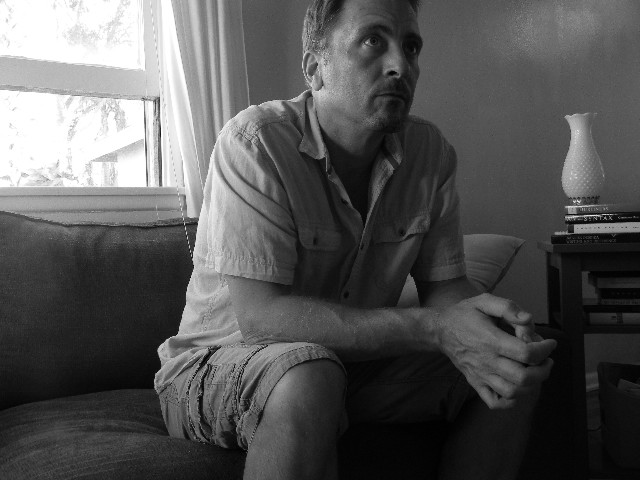
 Bruce Stone
“Remind me again of the advantages of living?” This I say to my girlfriend Svetlana, who pretends not to hear me at all. She’s far too preoccupied with the task, quite literally, at hand: namely, to bring to some sort of acceptable conclusion the handjob that began under the usual hurried circumstances, in the hall, outside my apartment door. I waited silently, burdened, for Svetlana to work the deadbolt, bracing the trusses of my arms against the groceries, their novel heft, their alien aura, bulging implausibly in polyethylene bags. They swayed and listed above the hardwood like twin worlds, grotesque, misshapen, stalled in a zone of veering space into which, shortly, Svetlana would deposit the keys, my keys, with a noise like breaking glass. As she bent to retrieve them, her shirt ascended and exposed to the air that little sacred band of flesh above her transparent linen pants (she goes around with her ass more or less wrapped in cheesecloth), and then the bags crashed to the floor, ejecting each one of their itemized contents, and I was clawing freely at her shirt.
We negotiated, somehow, the debris field-a shuffling, sloughing dance over tuna cans, yellow onion, solitary units of Jolly Good cream soda, a razor-sharp pineapple with negligible rind-rot-and maneuvered inside where those preliminaries graded into an hour of ineffective coitus on the living room floor (Svetlana’s face gradually taking on that cast of expressive accusation), which then lasted through dinner (I thought she almost had me when she brought out the colander), one and a half games of postprandial chess (I am a sore loser), and the phone call from the unemployment adjudicator who dispassionately informed me that my benefits are running out.
Now it seems we have come full circle.
Anyway, to my knowledge, she doesn’t speak a word of English.
She’s in a crouch, Svetlana, by the lower kitchen cabinets, directing the business end of my flexed equipment toward a saucepan. She does not perform fellatio, and I can’t blame her. From time to time she looks up at me, her face miming what she’s unable to say: “When it finally goes, look out!”
According to Dorland’s Medical Dictionary, I have a condition known as priapism, which, I must admit, has a certain old-Greek venerability to it, a bracing air of Trojan grandeur. But sadly, these heroic connotations bear little relation to the sordid facts of the case, the light of which compels me to refer to this predicament for what it really is: i.e., functional impotence. To all outward appearances, the equipment mostly works. I am erect almost constantly. And I go around dragging this piece of lumber, torquing it out of the way (I’m not a maniac) with the waistband of my boxer briefs-the type of undergarment I prefer because, I don’t know, despite everything they still make me feel athletic and capable. As I say, the equipment mostly works, excepting the gonads, of course, which Svetlana now hefts on her outstretched fingers, eyeing them sadly. No, those gonads are without question on the fritz: swollen, unresponsive, definitely not trucking their weight at all.
Svetlana is a good kid. When I met her, that’s the first thing I thought, and how could I not? Look at that face, pale, long-suffering, chinless, with here and there the inflamed corona of a pimple. What I see in her is complicated: she reminds me daily of that capacity exclusive to Slavic peoples for, shall we say, aesthetic forthrightness, a point impressed upon me a long time ago when I visited a rundown cathedral in an obscure corner of Prague. High on the wall, grainy, light-starved, above a bank of pews gnawed into ruin by devout parish rodents, a muscle-bound Christ was pinned isometrically to the Cross, His face grim, sightless and furrowed as an Easter-Island monolith, a sturdy bolt bisecting each gnarled wrist. Those muscles might have been a put-on, but that wrist business, from a procedural point of view, was pure honesty. Svetlana, perhaps through her very speechlessness, helps me to see things more clearly, perhaps to see things as they really are. With Svetlana, I think, I have become a tourist in my own home.
I do not say this to her, though I might. Her eyes prevent me. She has absolutely nothing going on in the eyes. It occurs to me that those eyes of hers, under the high forehead and the wounded line of bangs (she sheared them herself, in my bathroom, with shaking hand), beneath such tender agonies, the eyes and their wreaths of lashes have the look of blighted forget-me-nots, blackened, irretrievable. I gesture for her to stop, which she does, and when she rises, there’s a pop from her overstressed knees that says pretty much all there is to say. We look over the kitchen-a wreck of Etruscan implements and tomato-paste carnage-she adjusts the binding of her cornsilk ponytail and then saunters, nude, to the sofa where she raises one giraffe-leg and eases over the back, piling into the cushions. She waits, oblivious now to my presence, for the disk to load: I have a PlayStation. Svetlana has discovered a passion for the kart-game Crash Bandicoot. That’s imprecise. Svetlana has transferred a peculiarly Slavic hopeless fixation onto the kart-game Crash Bandicoot. Gravely, without irony, she adopts the guise of her favored avatar, the title character: a psychotic marsupial at the wheel of a souped-up go-kart, bound to race to the death a band of likewise mutant critters across a baroque steampunk landscape. Silently, unblinking, she imbibes the scene, a wash of tailpipe exhaust, the lurid geography (pixelated sand, mud, beached galleons) of the track. I hear her engine throttle, followed almost immediately by a cataclysmic crash. Her ponytail doesn’t flinch.
Sometimes I think this technology is the sole basis for our relationship. There are probably worse arrangements.
*
Living is a habit I have lost, I think, as I cross from the alley shadows into the streetlight glare of Third Avenue. Lampposts, really. Black fluted steel with dual bulbs hanging, a concession to nostalgia, harkening to quainter times as you might expect from a tourist hub. They throw a hell of a lot of light.
The street is active, even at this hour, when most of the shops have closed. But the lights are there, as is the canned music from the place that sells Irish things at a nice margin, and I think, not for the first time, that none of this has anything to do with me. The stragglers come on, with a fluorescent shimmer to their gear, immoderately peeping into storefronts for hypothetical souvenirs: the chance to see themselves reflected among the wares and experience, momentarily, grace. Tonight, it seems all the leggy daughters in their high-cut tennis shorts have been secreted away (I imagine cloistered wings of inaccessible resort facilities where machines shit ice incessantly), so around the sated passers there is an absence of gamboling and only the laundered air is on hand to frisk the shirttails and purse straps, the T-Mobile pouches and rigged-out cargo shorts, the sundry frayed edges of the blessed. At the fire station, the garage door stands open and the guys in their blue jumpsuits are fussing over one of the vehicles, an open-faced rig that could pass for a UPS truck except for the blaze-red paint and the gold-embossed letters that read, in honor of our fair city, SBFD. Above the left front tire there is a conspicuous ding, a hull fracture, really, which I take to be a succinct and pithy reminder of the inattentive driving habits of civil servants.
I thought a walk might help to calm me, but I don’t have the heart for it, not now, so I get no farther than the corner where the town’s only hansom cab (itself a remarkable fact) is stalled in a halogen pool near the stop sign: Eddie at altitude in the cabman’s box, portly and immovable under a black Stetson, presently neglecting the knotted reins to keep company with his folded newspaper.
I worry about Eddie. His ostensible purpose is to capitalize on the season, yet here he sits, on an eligible night, idle. For some reason he is giving me the finger; otherwise, he does not condescend to notice me.
This is the problem, I think, stepping into the gutter across from the BP and the medieval spikes of its lurid green sun, where a lone sedan quietly gorges. The oasis around the pumps is lit up like a reasonable affront to heaven, and still, out over the canal, above the bent girders of the old bridge, all the stars are burning, furious, ridiculously near. I have never gone in for stargazing, which, judging from the blunted glances of the pedestrians, isn’t so much gazing as it is a kind of celestial rubbernecking, an obligatory inspection of local ruins. I took my degree in finance, and am after all a man of commerce, a bottom-liner, and, when it comes right down to it, in my own way, a cheat. But I have what is known as a literary mind, and so it is to be expected that I would resent the inflated reverence commonly afforded to those moronic constellations, their sentimental mythologies and two-dimensional imprecision: their legacy, as I see it, is played out. I want to know that there’s a broader view. If there are apprehensible shapes in the cosmos, I want to feel that their complexity is somehow adequate to this tortured existence, this interminable straining at the yoke, this endless peering through blinders. In short, I want a more expansive consciousness so that I might better understand what I am, I think, already closing in on Eddie’s horse, whose name I never bothered to learn, who any minute now will blast the street with a searing bolt of piss-I have a sense for these things. Eddie thumps his paper irritably, but doesn’t say a word, not even when I lean forward, really feeling like weeping, and take the bit in my hands where it protrudes on either side from Moe’s gums (I call him Moe). The bit is understandably moist. Moe smells of baked mud and scabs. I lower myself in, enfolding and even cradling with my abdomen that length of aggravated cartilage, that blunt piton of thwarted virility, until at last we are brow to muzzle. I feel his coarse hairs on my skin, his wheezing through dilated nostrils, the disconcerted gaze of his runny brown eyes. There is no reassurance whatsoever. It occurs to me that, in human terms, what I am looking for is a plot.
The pain, when Moe nips, is stunning, such that I totter backward and drop onto the sidewalk to get my bearings on the impressive magnitude of this sensation. It is a pain not of the skin, but something deeper, an aching in the bone, which feels bludgeoned, throbbing from the core outward. This has my attention. I would like to tell someone.
Eddie is laughing his ass off, but he never puts down his newspaper.
The firemen have lighted cigarettes on the far side of their machine. I see the smoke rising.
When I get back to the apartment, Svetlana and the PlayStation are gone.
But she’s done this before.
*
“The advantages? Of living?” I say aloud simply because I can. I have retreated to this burrow, beneath the bench, on the third floor of the Fairfield Gallery, and per usual there’s no one else around. Up here they have some of the higher-end merchandise-a few of Giacometti’s striding stickmen, a stilted Modigliani, a Fauvist something or other. Across from me on the wall, there’s an uncharacteristic Magritte, having nothing to do with the bowler-hatted stuffiness of say The Menaced Assassin: something busier, nearly Cubist, a fevered collage reeking of consumerism, with one of those nifty Belgique titles like What the fuck are you looking at?
I grimace now in earnest.
Speaking objectively, every moment is for me a more or less harrowing experience.
I have decided to find employment, and arriving at this momentous decision was itself enough to get me through yesterday-I felt quiescent and resolute-so much so that today, just after lunch and a series of convoluted reflections-I was loitering by the canal, killing time before my rendezvous with the kid at the library-I double-checked the stays on that material nuisance below-decks and ventured into Castle Cove, a recently erected eyesore of sand-colored stone that towers over the timid and, in certain lights, maidenly waters of the harbor. I made a note to admire the facility’s stone battlements, suavely crossed its redundant moat. Inside, among the steamy fumes emanating from its banquet halls, I could distinguish the smells of cabbage and upholstery, or Svetlana emerging from a hard-water shower, toweling her tangled hair. A bartender directed me to the administrative offices on the second floor, where I introduced myself to the appropriate party (whom, I can honestly say, I’d never met before), allowed him to ravage my wounded hand in his grip. My good humor, my chummy grin, never creased. I had on my clean shirt and best sandals. But the whole time I had the feeling that all of this was inconsequential, as if I were on an errand in the subtext of a novel, one of those throwaway characters who has nothing whatsoever to contribute but who nevertheless goes on existing in a peripheral and stunted capacity. For some reason, I had particularly in mind the guy who rents the bicycles in Robbes-Grillet’s The Voyeur (a singularly disappointing work), his role of meaningless facilitation, after which he lapses once more into that unfinished layer of creation where everyone is a tourist against his will and the only common currency is loss. This is what I was thinking in the margins of our chitchat, and I recall nodding sagely as the appropriate party regretted to inform me…. Or words to that effect.
We were on the tail end of a more or less amicable farewell in the hallway when a woman in a beige housekeeping get-up swept past us, pushing a facilities cart in the direction of the elevator. She beamed, as she passed, with the languid self-assurance of her sub-tropical ancestors, turned her head and beamed, offering those sizeable teeth like a sunflower in the manner of all phony and perverted companionable displays. Her cleaning cart smelled of pineapples. At the elevator, she regally popped the call button. I really meant no harm, but in a moment of unchecked ire, I muttered something ambiguous about the openings of certain resort facilities and those of ingratiating, big-titted Tahitians. The usual harmless stuff. When I came to and there was sufficient pain to remind me that I was still in fact alive, a few blazered security attendants were hauling me to the street.
It seems everyone has a hair-trigger these days.
Scruggs, that was his name, Scruggs, bent over as if inspecting his handiwork, said he’d never liked me.
Speaking objectively, I have no reasonable explanation for how I have come to be this way. As I dragged myself through the parking lot, I could see the huge freighters where they mass in the shipyards, congregating like a bunch of fat guys in a bar, and though they did nothing, not so much as listing on their stays, I thought they might as well rear up on their prows, water spouting from their smashed-iron sides, just heave up, trailing tentacles of rigging and chains, and glide on the air for an instant before crashing arbitrarily earthward. I have lost my basic trust in things, I think.
Now that I consider it, yesterday was no different either.
I have missed my rendezvous.
“I know exactly what you mean,” I say to the taller of the Giacomettis, who lumbers woozily in the direction of I don’t know where.
When my father was in Chicago for his criminal prosecution, I took the train down to be present in the event that I should be called upon to corroborate the depositions. I was never called, so while the tax lawyers were zealously divesting my father of his net worth, I was stomping with my hands in my pockets along Michigan Avenue, getting similarly bullied by a pugnacious wind that caused the very street to ripple uncertainly. A guy holding his ground by a coffee cart was zipped up to his ears. I doubted that he would murder me. This was April. At Jackson Park, I watched an SUV crest a portion of hill between two enormous cement monuments where it sleekly descended into an apocalyptic collision-the swift, calamitous bang of metal and burst glass-with an onrushing Beetle. The vehicles, I thought, would have to be torn apart. Of course none of this was helping my agitated condition, and by the time I reached the river bridge, with the tinted-glass skyscrapers veering toward me, and the relentless menace of the traffic, CTA buses grinding their brutish hubs against the curbs, and that Munchian wind too fierce to carry a single smell, just gripping me by the testicles, shaking me furiously, I thought, well this is it then, and I clutched the stone guardrail, peering into the green contortions of the river, waiting for the universal annihilation. But there was no universal annihilation, and I could only shamble back in the direction of my hotel room, wind-tears streaming down my face, searching out my lost equilibrium.
This is how it is more or less all the time.
If Giacometti had walked in my shoes along the river bridge, I doubt he would have sculpted a thing.
He does not corroborate my deposition.
*
How, exactly, is this helping, I want to know. I am at the library. On the sofa. Across from the circulation desk where the librarian is wearing her flowered vest and a big clock on the wall tells me that I have been stood up. This library pacifies me. There is something in its architecture that conveys both aesthetic refinement and maximum functionality, like the high contrast between the dark floorboards and incandescent walls on the third floor of the museum. Here, I feel touches of the subdued poetry of Monticello, a kind of Jeffersonian exposition in the colonnaded entrance and shaved-steel book-drop. The newspapers are free for perusal, if you don’t mind another pair of mitts roughing up your creases, and I am taking full advantage, skimming the classified section with the practiced, clinical eye of a man of commerce, someone who knows what he’s about. On the cushion next to me, I have stowed a slip of paper (a halved portion of an old card-catalog entry-the remaindered book was titled Lime: The Corrosive Agent) and a short pencil, one of those clean amputees, to take down relevant information.
Across the room a bank of computer terminals blinks and simmers, a creepy phalanx of low-flicker-rate monitors and distressed motherboards. The machines siphon off most of the afternoon foot traffic, absorbing the very worst of user misbehavior and making of my abstinence a virtue (I duly honor the lifetime ban meted out to me, however unjustly: the Wikipedia vandalism was a misunderstanding, I maintain, the desultory porn surfing purely medicinal). Amid the sprawling tweens who occupy chairs even in front of the dud terminals, at a spot in the corner, seated in profile, a guy who looks exactly like Richard Gere squints into his browser, as if carefully considering his next move. This is the same man who, very recently, as he swept imperiously through the reference section, had paused, leaned in over my shoulder, and, pointing a hoary finger at my newspaper, suggested I avail myself of the Web classifieds with a simple, neighborly, obnoxiously affable “You know, most of those are online now” (flexing his eyebrows in postscript). He had feathery white hair, streaked with grey, a stubby hooked nose like a can-opener, and twin rows of small even dentures that he bared above a droopy lower lip. His face, I noticed, bore lurid red patches on the nose, cheeks and brow-fractal patterns of burst capillaries on his nostrils-and the skin appeared slick, richly lubricated, intermittently poreless: as if his face had been buffed with sandpaper, some radical therapy for psoriasis.
Now that I think of it, the resemblance is slight, at best.
For a while I breathe shallowly and sit perfectly still in an effort to compose myself, to keep in check a sensation of acute paranoia, but even so, from her post beneath the wall clock the librarian forwards disapproving glances in the general vicinity of my sofa-as if she does not remember at all my gratitude when she helped me to locate the Dorland’s Medical Dictionary, or when she procured for me the Russian/English dictionary with its impossible pronunciations, or when she directed me, that time before all hope was lost, to the men’s room with the bad light on the upper floor.
Anyway, none of this did me any good.
I try to tell myself that I am a miracle of nature occurring for a short period of time, but I’m not buying what I’m selling.
Help wanted, I think.
Time is a corrosive agent.
Svetlana, her disappearances notwithstanding, was never like this, this waiting, this agonistic uncertainty. When I first met her, at the public beach by the pier stanchions where she was sobbing into her hands, she was all present, all access from the start. I had rolled up, coaxing my arthritic Buick over the moguls in the parking lot, really feeling like a wreck: an implacable bone-deep aching, desperate to be rid of this ludicrous erection, which even then was less a figure of unassuageable longing than a serious breach of anatomical contract. By this point, I was, strictly speaking, no longer employed, it grieves me to admit; my father’s winery had already been shut down, owing to fiscal mismanagement, misreported revenues and an ongoing failure to respond to the worried messages from his accountant (Dad’s absenteeism was hopelessly thorough). Before me, I had the beach mix of sand and white stone, the late-season sun, the waveless water-its surface a veneer of chrome and blueberry fanning out toward the far islands like the purposeless expanse afforded by my severance package-and I was thinking that I would swim until I could distinguish, among the sand bars, the contours of my destiny, until things made sense or ceased forever to matter.
I didn’t care which.
I had already stripped down to my boxer briefs and was marching toward the water when I noticed Svetlana, sobbing in Cyrillic, amid the boulders by the pier, her ponytail limp over her shoulder, her lankiness knotted in a heap. She did not look up at me, but I could feel her wanting to look up at me as soon as I took a step in her direction and she shifted over onto one side, defensively, disrupting the spasms of her sobs and revealing in those see-through pants an elliptical stretch of buttock and the ghost of her thong chemise (her wardrobe is pitifully limited): then I knew everything about her all at once. That she was part of the influx of foreign nationals, a source of ready labor imported to ease the convulsions of an overstrained tourist economy. That the language barrier led her to suffer mistreatment at the hands of her Dickensian employers (I imagined her working as a housekeeper for one of these big resorts-a point later confirmed by the rhythms of her absences). And that her spirit was withering in the loveless dormitory erected by the chamber of commerce to house tragic migrants.
I could see that she needed looking after. And immediately we began to trade kindnesses, a slow-motion pantomime of consolation-she, sputtering in damaged Cyrillic, me, with a hand stuffed deep into the gauze recesses of her linen pants, as if to say, “Shhh, Svetlana, Shhh.” And when we rolled apart, sometime after sundown, as it has ever been, anticlimactically, her sniveling ceased, and I felt-I can’t explain this-pocketed somewhere in the root opacity of our conjunction, that life was nearly tolerable.
You can go a surprisingly long way on that slight feeling.
I wonder offhandedly if I should be concerned about this habit I have of narrating myself to myself.
Then she’s here. I did not notice her come in, pass the aluminum drinking fountain, and the tourist brochures in that wall-mounted display, and the double doors to the reading room with its odor of anxiety. I did not notice her trot up the stairs, shoot a meaningful look in my direction, gauging the coordinates of my position and the logistical possibilities it afforded. But I see her now, up there in the balcony-the loft area where the nonfiction holdings are sequestered and a kind of recessed catwalk spans the length from here to there. For a moment I permit myself to confuse her with Svetlana before I concede that her good teeth, her bad perm, her resolute American comportment radiate a special and inimitable charm. She does her best to look nonchalant, she even has me fooled, and I can see the shadows from the spindled guardrail stripe her legs until she stops above my position. She is wearing a cheerleader outfit and sheer underthings. That’s not precise. I can’t tell if she’s wearing sheer underthings or no underthings.
She’s a good kid, but my interest in her is strictly therapeutic.
We have an arrangement.
When I first approached her, she told me she was eighteen and I pretended to believe her.
The outfit, presumably, is for my benefit, but the tinny colors and the coarse material make her look dumpy, even fat. I don’t have the heart to tell her this.
With her back to me, she grips the sturdy banister and makes as if to stretch, straining forward on raised toes. I can see fine. Then, still gripping the handrail, she drops into a crouch, thrusting her rear between two of the steel spindles such that her skirt splays out like a fan.
Cherry Bluff Orchards is looking for day-labor. I entertain a vision of myself shirtless, in ripe orchards, gorging on fruit. I raise the amputated pencil, grit my teeth (figuratively) against the pain of flared nerves, make an apposite notation.
Up there, the kid is fronting the guardrail. She scans left and right with a vague air of gravity, and then she shoots up one leg onto the banister, ballerina-style, and raises her arms over her head, straining sidewise to the knee.
She’s a flexible kid. I should tell her about the ballerina thing.
I make a notation with the amputated pencil.
As a literary conceit, pedophilia is of course ridiculously old hat. But in this world (hardly real) it remains a viable coping strategy.
I’m rattling my paper, and when she doesn’t get the signal, I start making forced, throat-clearing sounds until the librarian at the desk trains her eyes on me. My erection is fine, but I cross my legs anyway.
This is all I have.
*
This is how it happened for me, I think, because I would prefer not to think about what happened yesterday, which is why today the only thing I am good for is standing like this, leaning out the open window, overlooking the midday thoroughfare and its faltering, cinerary traffic as if it had some necessary relation to me. I am naked from the waist down and giving no one in particular the finger.
Without the PlayStation, my store of household technologies is significantly depleted, consisting solely of the portable television (which gets no reception), a universal remote (which communicates with nothing), and the empty case of the lone DVD in my vestigial collection. Said videodisc Svetlana smashed in a fit of pique not long after we got together, the same fit of pique in which she absconded with, and subsequently sold (in her blatnoy black market, I presume), the DVD player that I bought, in another lifetime, on clearance at Wal-Mart.
The film was an old Richard Gere, Laura Linney title, one-hundred-nineteen minutes of oracular nonsense called The Mothman Prophecies. The plot and particulars escape me now, but I remember the thing came into my possession during a routine test of the public library’s security system (the old-fashioned book drop, it turns out, provides a functional point of egress). Hardly a loss.
I don’t know if my condition has worsened-there are blotches now, I think, or maybe there have always been blotches, or maybe the black bruise on my finger, which gives every indication of indelibility, has somehow migrated and metastasized, or maybe it’s just the light. In any case, pants today are out of the question.
Perhaps if I had turned up like this yesterday, things might have gone differently. The orchard keeper might have done something other than what he did, which was to take one look at me and say (he insisted) that the ad had been a misprint. And then I might not have gone for that sentimental traipse through the cherry trees and their cultivated nostalgia, where I encountered the harvest crew performing tense deliberations around the recent hire, critiquing her form up on the ladder. She was a nice-enough-looking gal with the predilection for short skirts, the aversion to underthings and the cracked teeth of a Croatian. Probably she bunked with Svetlana at the dormitory for imported foreign nationals. Probably she knew her. That was really all I wanted to know, but still the ensuing scuffle ended with me on the turf, and the stout veteran Mexican grinding my clenched hand and an anomalous swatch of skirt hem under his boot, asking had I had enough.
I had.
My appetite is gone.
This is how it happened for me, I say to the fire truck, that UPS imposter, which shifts into neutral and luxuriantly throttles its engine at the stop sign where the people are making a big deal over the crosswalk. As if they had never seen vomit before.
This whole landscape is tilted, unreliable, I think.
This is how it happened for me. Because you hear all the time that god is dead, life meaningless, all the usual encouraging clichés, and then one day the truth hits you with an almost biological urgency. I was on the train, southbound, heading to Chicago for the denouement to my father’s criminal proceedings, when I still had no idea that he was going to shoot himself, and I had managed to secure a seat beside a guy in camouflage pants who was penciling cartoon images of a femme fatale and whom the conductor referred to chummily as “Colonel.” Somehow, between his arms, the notepad and his compressed belly, he cradled a sandwich, soggy with tomato, lettuce and cold cuts, which leaked helplessly onto a sheet of waxed paper.
Having secured this seat, I made as if to read King Lear in my Oxford Shakespeare-the Bullen edition from 1938 and it looks it-because by then this was all I could do to discourage people from noticing me (of course, for a long time now I have been off actual reading altogether). And besides, the Bullen promised to create a suitable diversion, dispelling the images that I had (and toward which I was rushing anyway) of my father at a table of grimly polished wood, hounded by attorneys, a haunted, vanquished expression clouding the movie-star good looks on which he had founded his modest empire (the spaniel nose, the boyish grin, a tasteful hint of mullet in his wavy, gray hair-the staff used to say he resembled some Hollywood celebrity whose name escapes me). In my mind, I didn’t see the face of a man on the verge of incarceration, his nest egg vaporized: it was the face of a man who had lost a child.
Perusing those mildewed pages, their gargoyle fonts, gripping that fantastically dry-rotted spine, I found then a kind of respite, a loose psychosocial insularity, within which I entertained the odd minimalist sexual fantasy involving both Regan and Goneril (those vastly underrated sisters) and all of their voluminous skirts. But at some point in the course of these literary peregrinations, my lazy eye happened to fall upon that line in which Gloucester whimpers his pretty analogy to the effect that flies: wanton boys = men: gods. And it occurred to me, not for the first time, that the image was unsatisfactory. As the leading term in the rhetorical figure, the earwig, I thought, would make for a much better choice all around as the earwig is more repulsive, sluggish and malicious, and more stubbornly ineradicable.
But the longer I dwelt upon this unfortunate convergence of sadism and entomology-and what choice did I have really, with the great expanses of marsh ripping by, and the exhausted willows, and the Colonel’s sturdy leg knocking me in time with the swinging car-slowly, with greater force and gravity, the analogy began to reveal deeper and deeper layers of ineptitude until I was experiencing what can only be called epiphanic hyperventilation. Because of course, my earwig substitution was sheer snottiness, but the real crux of the matter was that the insect failed to convey the incomprehensible vastness of the gulf between mortality and immortality. The fly, as it staggers, wingless, has a language to communicate its suffering. The boy knows it suffers. To the hypothetical gods and any putative celestial persecution, we cannot ascribe anything like intentionality or malice. To such gods, I reckoned, we must possess as much personality and agency as, say, a tomato, or some other vegetable byproduct of four billion years of terrestrial confinement-Yes, I thought, this formulation, what it loses in poetry, it gains in precision. Between the here-and-now and the hereafter, we must assume a more radical separation, an evolutionary leap, as it were, which precludes any intelligible communication between states of being. We are destroyed, sure, but there is no way for the gods to know that we know it. In short, I thought, there is no way for the gods to hear us. And although I had absolutely no reason to mope about it, I must admit I felt the full weight of my solitude bearing down on me as if for the first time, as if all of this had just happened to me personally, and I looked mildly in the Colonel’s direction with my face wrenched into a brokenhearted smile, a smile of tolerance and shared purpose, but he had dozed off, mouth open, head collapsed on the seat back, and his pencil, I saw, had slipped into the dregs on the waxed paper.
I wanted to retrieve it for him, but you know how it is.
The water is going in the saucepan. I feel the steam saturating my sinuses, but I dump in the bag of Ramen noodles anyway.
Svetlana’s favorite race track was Hot Air Skyway.
It’s nice to know that I still have food in the house.
The noodles are going in the pan, churning and paling in the roil. I think, but I do not do this, of submerging my hand in the froth. I imagine the skin peeling away, flapping in the current, entwining with the noodles. I think, but I do not do this, of lowering my hand to the bottom, palming the flat blaze of steel. I wonder how long I could stand it.
I wonder if I might profit somehow from this pain.
*
Has it really come to this then? I reflect offhandedly through the filtered light of exertion and the dingy, shadow-burdened light of the bathroom and the abrasive, played-out feel of this advantageless arrangement.
Everything is this crummy, filtered bathroom light.
It’s all I have.
The kid had turned up in a yellow shirt screaming Cheerios, which bore, between the breasts, the imprint of a seat belt, as if implying the existence of a conscientious parent, and when I suggested that we modify our arrangement, stuffing the roll of my last remaining bills into her pocket, she didn’t bother to count the money (which was exactly twenty-four dollars). She just took me by the wrist and led me up here where everything smells of nonfiction, except the urinal cakes, which smell of despair, and when I asked her why the men’s, she merely shrugged as if to say she’d always wanted to see the inside.
If you ask me, it isn’t much to look at.
The shirt is now torqued in a mess under her chin. When she tightens, innocently I think, the grip with her ankles, the balled jeans make a push for total asphyxiation, but I don’t back off because at this point I’ll try anything and I don’t have the heart to let her know that I’m not even close.
She’s a good kid.
She doesn’t seem to be in any hurry, though periodically she steals glances at the door, not as if she expects any sudden intrusion, but solely I think to break up the monotony of the view. So I have plenty of time not to remember what happened to me yesterday when I visited the offices of the tourist bureau, which claimed to be soliciting legitimate applications for employment. I had presented myself, thinking optimistically about what it would be like to thrust my hands into soil, to water copiously, to till. That sort of thing. I had, what’s more, taken considerable preparatory pains, acquiring some of the lingo with the gracious assistance of my librarian friend in the flowered vest that she kept rearranging to conceal her incensed nipples (I figured she was breaking in a new undergarment, and tactfully did not draw attention to her discomposure). She led me through the nonfiction holdings to a tome on husbandry that helped me to distinguish my bulbs from my seeds, explained how to finesse a hydrangea, etc., and I was nearly feeling pretty good about myself until I arrived at the office where I learned 1) that the position had called for a brochure copywriter and not, as I insisted, an experienced groundstender; 2) that they had already hired a leggy Bratislavan who has her own tools and consents to work in a homemade bikini of spaghetti-string straps and Eastern-Bloc Post-Its; and 3) that they had never heard of anyone named Svetlana. Point taken, I thought, conceding, then, the evident redundancy of my placement in this universe, but I didn’t say a word, just lay down on the carpet and waited for the inevitable formality of the coup de grace. Underneath the desk, an invoice or some such had fallen, its letterhead sporting an urgent-looking QUAST, which was supposed to remind me of quest but instead made me think only of an obscure radioactive element mined in the African jungles of an old English novel. Somewhere someone was running a vacuum cleaner. They let me lie like that for a while. Eventually I bedded and seeded and sodded my quap heap and went home.
When I pick up the pace, the tile hardly bothers her at all.
The last time I had contact with something beautiful goes like this: I was on the train, returning from Chicago, where I had made a nuisance of myself in the courthouse, but was otherwise incapable of effecting any alteration in the proceedings against my indicted father. The night before, I had stumbled in the direction of my hotel room, bent at the waist, fighting the whole way a sheering wind and chafing briefs-a classic existential fug which I tried to drown in curaçao at the tavern across the street from my hotel, where I left the bartender a tip to the tune of twenty-four drenched dollars in a heap on the bar (she had a butterfly tattoo on the small of her back and a commiserating air of self-destruction). So I was feeling a little iffy when I arrived at the station the next morning, a condition that persuaded me, on medical grounds, to procure a bottle of pineapple juice from the cooler at the busy and inattentively manned newsstand. This I later had occasion to regret.
But I boarded, and bribed the conductor to leave me alone, which he did after riffling through a ticket with his hole-punch. For some time I sat sipping cautiously from the rank platform air that seeped into the compartment, endured the silent inquisition of an overdressed policeman who braced his fists against the luggage racks and completed a thorough inspection of the vacant balcony seats before heavily disembarking. An oily, evasive period followed, then, with a bang and a lurch, the train creaked out into the sunlight and swung between the high rises and the low brick slaughterhouse tenements, and the city, I must say, looked itself a little green around the gills through the tinted windows. I had the car mostly to myself. When I closed my eyes, I could feel the unsteady jiggering of the wheels bumping over the junctions, and the gentler, steadier subliminal jiggering from side to side, and through the murderous headache and the pineapple-tainted cottonmouth it became clear that I would be sick.
In a state of surprising composure, I ventured on faith, a shambling, weightless gallows walk, to the next car to locate the facilities, into which I shut myself, sliding the battered door on its tracks and throwing the bolt behind me. Simultaneously, a jaundiced interior light came on above the mirror to offer visual corroboration of the pervasive aura of fecal smatterings and urinary drippings and other Dantesquan unpleasantnesses.
In all of this there was a minimum of ceremony.
Almost casually, I bent a little at the knee, folded an arm across my chest and, in a state of truly remarkable composure, retched voluminously and accurately in the direction of the long-suffering toilet, with its cheap flap lid and shallow cavity and the flimsy trapdoor at the bottom. I retched in successive waves, primly and energetically, shouting at the onset of each spasm, discharging tubes of vomit with a surprising geometrical integrity, in the color, for some reason, of crushed plums. The effort forced tears at an impressive rate from my eyeducts, but even weeping as I was, I offered none of those intermediary whimpers that indicate a self-pitying temperament. Time, in a metaphysical sense, became irrelevant. At some point I distinctly heard the door to the vestibule slide open, and the conductor as he passed with measured steps of his black shoes, idly clicking his ticket-punch. After one last roar in the direction of that obedient drain mechanism and the messy business of puffing air through my lips, submitting to full-body tremors, I flooded the bowl with its toxic rinse of blue slime, putting paid, I thought, to the proceedings. But as I continued to feel a shimmering violence around the middle, baroque sequences of expulsive ripples, I negotiated the cramped space, hobbling in a tight circle, and with a foreigner’s hypersensitivity proceeded to unbuckle and lower and rest my haunches on the bowl, training my erection with both hands (which nevertheless spurted wayward spikes of urine as the train swung me back and forth), noisily and helplessly unburdening myself of this secondary colorectal duress.
I felt humbled, purged on a mitochondrial level, thrown clear, as it were, of the blast radius of myself. As if I had finally settled the accounts on a lifetime of error.
I made myself presentable once more, straightening my collar and smoothing my hair, savoring the preternatural stillness that had descended over our steady acceleration. Then I swept open the door, naked as it were before the horror and derision of my fellow passengers, who merely gazed placidly at the retreating city, rocked sedately over columns of unwavering newsprint, continued gravely and serenely to tap keypads, communing sweetly with obsolescing technologies, stenciling the windows of Palm-Pilots and cellphones with earnest, euphonic prayers. I believed that I had gained access to the benevolent region of pure poetry.
The kid makes out as if she understands all of this.
For a split second it occurs to me that I am in love with Svetlana.
And then the kid starts quivering strangely, copacetically, beneath me, and I feel something quickening in the machinery of my loins, a delicate rising sensation, like the immaculate reoccurrence of an extinct organism. It is a sensation that I can only compare to hope as I am inclined to believe that all of this now is headed somewhere. For a few moments, I catch a glimmer, in the radiating swarms of banded light, of my destiny, a benign assurance that it exists somewhere. I think of Svetlana and myself cruising unhurried, contentedly, in a sleek two-seater, along the levitating expanses of Hot Air Skyway-where the smoking wreckages of the past have been cleared away, and there is only the pristine patchwork of the track as it rises and falls between the watercolor dirigibles, the gush of pixels drummed up by their bow-blades, leading us on toward the pastel smoke of high cirrus that reaches far into the measureless horizons-and I believe that life is trembling on the verge of a nearly tangible possibility-until I see the kid moving under me, squirming without inflection, that patient look in her eyes discharging gun-batteries of boredom, and then I understand that I am experiencing what is known as a false positive.
I try for her benefit to simulate orgasm, and when I roll off her, I can see that she’s scarcely disheveled.
A good kid.
Before she goes, she smiles with her eyes closed as if to acknowledge a completed transaction but she does not ask about my hand.
*
I am reasonably sure that this is how it ends. I am sitting on the tarmac under the oasis of the BP in a puddle of lake water and the solitary dribble of gasoline that I was able to squeeze out of the pump before the clerk’s invisible intercession.
The police, he has leaned out the door to inform me, are on their way.
He seems a nice enough sort, this despite having refused me a job application, a book of matches, and a show of human compassion, in that order. He watches from the window through which you can just distinguish the top of his no-doubt impeccably balanced cash register, and he conveys an aura of concern, of nearly paternal solicitude that reminds me of what had always been lacking between me and my father. Perhaps, had I felt this abiding tenderness, things might have gone differently; I might have abetted his criminal prosecution less aggressively, might even have copped to my own modest profiteering-which was negligible, certainly, but I might have saved him some jail time.
In any event, the shot to the chest wasn’t fatal.
I am not suicidal-the matches were really a kind of pick-me-up as I am generally cheered by the smell of sulfur. The gas, I think, is a poor substitute.
Still I am reasonably sure that this is how it ends.
When I returned to my apartment this afternoon, there was a notice of eviction affixed to the door, official-looking in every way excepting the marginalia scrawled in an illegible Cyrillic.
All in all, this has been a disappointing day.
When I reached the site of our putative rendezvous, the kid was not there, nor were her three promised friends.
I had been stood up.
The place I had selected for our assignation was, and still is, called Cave Point, a stretch of shoreline where the water has been occupied for centuries fine-tuning the deep scallops that it is carving into the limestone. After that unfortunate business in the men’s room-the librarian pushing through the door, prematurely outraged, where she discovered me at the sink, splashing tap-water over my tormented equipment, her face then paling and burning by turns, the paisley of genuine outrage-this seemed like a sensible alternative.
But the kid wasn’t there.
Perhaps she had seen through to my basic insolvency or the four of them had found a more lucrative arrangement.
Anyway, it wouldn’t have mattered.
I waited by the water, my toes grasping the limestone, which, on the cusp of dusk, appeared to be the last remaining source of light, as if the rock had stored up remnants of the sun’s irradiation, igniting the sheltered depths, turning them a limpid lozenge-blue color that was liquid in addition to the water being liquid.
It was twice liquid, and very pretty.
I have heard stories to the effect that the water has carved clean through the peninsula, bored underground, creating cavernous transepts that are too dangerous for divers, but which contribute to all sorts of mythologizing possibilities: as if secreted below the surface of this life, there might be a comprehensible and benevolent rationale, a basic cohesion and purpose, a root stratum of ultimate meaning.
The same old dream, but clearer then, more plausible, I think, than ever. I foresaw myself backstroking beneath architraves of glazed stone, drinking in their salaried air and tart snorts of lake water. Hypothetically, as it were, I was already knifing through the tremulous wavelets, the mantle-stink of sulfur, flexing the oarlocks of my shoulders, making good time with a compact and serviceable Australian crawl, but it was no use. If I were to discern, say, by the inconsistent torchlight of my imagination, the arterial patterns of mineral stains or the guano from a race of prehistoric bats, if I were somehow to negotiate the interchanges of those catacombs and emerge, where none had ever emerged, to glimpse the lights of a foreign city across the water, faltering, intermittent, obliterated by steadier vapors, that city, I understood, that other more profitable landscape would itself be forever unattainable: charging away endlessly into the silent collision of earth and sky in the molten dregs of the horizon. No, what we had here was no geological covenant, just the ravages of the timeless and purposeless intercourse of the elements.
I adjusted the disposition of my boxer briefs, measuring the distances before me, concealing my erection as a courtesy to the people who would never arrive.
Where the water slopped into the recesses, the sound was rich with empty promises.
Everywhere the stars were quickening, and I consulted them, stared into the press of their teary declinations before I heaved over the edge and crashed into the water, which, unearthly light notwithstanding, immediately went to work on my bandages.
To be precise, I had cozied my crippled hand into a tube sock smeared with lard.
The water was remarkably fierce on the wounds.
After a while-of scissoring luminous water, enduring the fore and aft shove of the tide surge, diving and groping and straining at the indisplaceable façade of slick, pitted stone-after a while, I gave in to the simple unpoetic truth of the matter.
Shivering-that is, in a state of neurological agitation brought on by the pain, the exertion and the cold, I clambered out of the water, rattling my bones against those blunt escarpments. As I stood, damaged and quaking, on the shelf, no longer contemplating the industry of the waves, the passive fury of the business, it was as if I could see myself reflected there on the air, where the light was disappearing on a molecular level.
Not a pretty sight.
I made an effort to induce vomiting but there was only the existential run-off pooling between my feet.
For a moment I considered the possibility that there had never been any kid, nor for that matter any Svetlana.
Then I could hear them, coming toward me from the path where it breaches the tree-line. The four of them, snorting, yelping from time to time as they struggled with the terrain. Between them, they had three pairs of high-cut tennis shorts, two flashlights and one conspicuous whistle on a long neck-leash, which I imagine was a hedge against their encountering other, unwanted erect personages by the waterside.
The kid herself was nearly unrecognizable in this entrepreneurial context.
I adopted an attitude of conscious disregard for the dripping bas relief of my boxer briefs.
One of the girls asked to see it.
Gingerly, I removed the tube sock.
Concerted and quite unnecessary movements of the flashlights.
“Does it hurt?” the kid asked.
“Yes,” I said. “Everywhere.”
And that was how I left them.
I am prepared to wait now for the inevitable.
It no longer bothers me that there might have been a time before this, when things were different.
There is only this.
From behind the window, the clerk watches me and a limited, though he cranes, portion of the universe.
Across the street, a deep sense of loss emanates from the empty garage at the firehouse. I see Moe, at the curb, standing amid a frothy pool of old urine, hanging his head in agony, and Eddie curling forward, leaning toward the pavement as if in the last throes of infarction. Then I glimpse the nearly recognizable legs through the cab wheels, the capri pants sliced into segments by the spindles, and I am already rising, crossing the tarmac, stepping down into the street where I see the familiar ponytail, the unsteady bangs, the aesthetic honesty in the features. For a moment I am under the impression that I have something to say to Svetlana, something uncertain but pithy and basically communicable, and I am crossing the street, making for them, until I see that she is cradling in her arms the portable television from my impounded apartment, and that Eddie is listening intently to whatever it is she is saying. Then I realize my mistake. This is not Svetlana at all, but some other foreigner with good pidgin English who happens to be holding my television. And I am standing like this in the middle of the street, which telescopes weirdly as if in the direction of someplace I remember. I am trying to commiserate with the ancient tar smell and the deep sense of loss that I feel emanating from the dark interior of the firehouse garage, when an overhead light goes on in the recesses, as if to portend some conclusive epiphany, an in-house singularity, a constellation of one, and it’s not until then that I hear the roar of the CTA engine, which strikes me as odd since we don’t have a transit system and, anyway, I never even see the bus.
–Bruce Stone


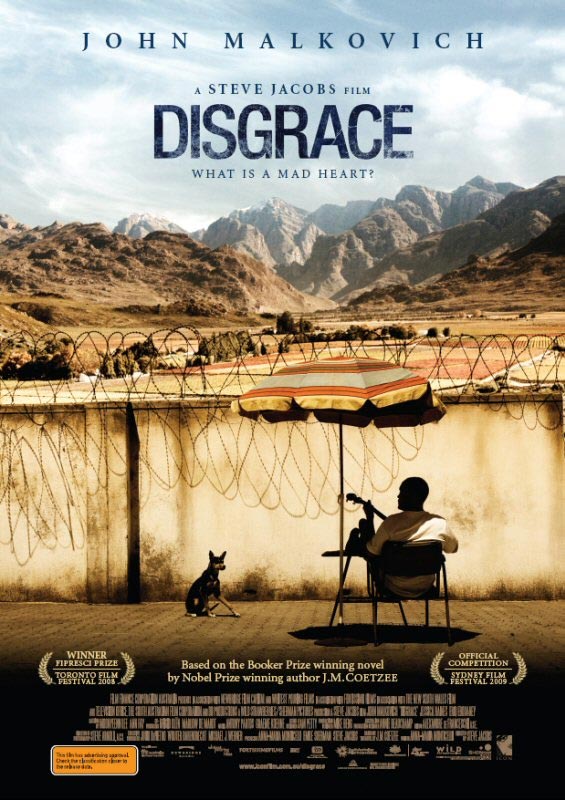 I recently saw the film adaptation of Disgrace, J.M. Coetzee’s 1999 Booker Prize winning novel. In the novel, David Lurie is a white college professor in post-apartheid South Africa who has an affair with one of his students, a girl named Melanie Issacs. Melanie files a complaint against Lurie and he is dismissed from his post. He travels to the country to live with his daughter, Lucy, a young woman trying make her way as a farmer. At the farm, Lurie and his daughter are attacked by three black South Africans, foregrounding the huge issues of race and land ownership and post-colonial Africa. Lucy steadfastly refuses to leave the farm, even though her attackers continue to roam nearby. David begins a healing process himself by helping to euthanize stray dogs in a make-shift animal clinic.

