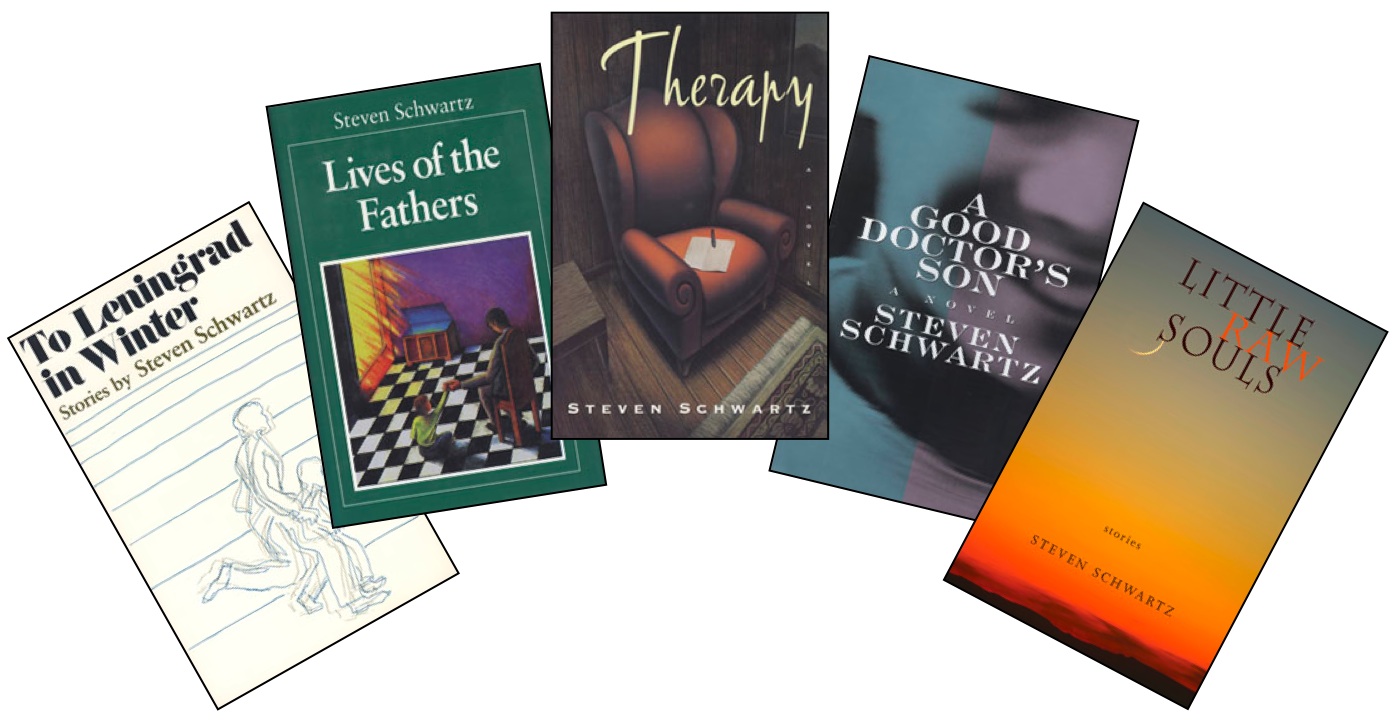
Steven Schwartz writes to his obsessions. Currently, he’s obsessed by success, failure, and redemption, fixations which contextualize the main conflicts of his short stories and novels. In the title story of his first collection, To Leningrad in Winter, Schwartz tells the story of manwho attempts to distance himself from his Jewish heritage even when faced with acts of anti-Semitism that compel him to join a cause. Lives of the Fathers, his second collection, follows relationships between family members as they attempt to grow up and distance themselves from their parentage. Schwartz’s title story of this collection is told from the perspective of a son who simply wants to help his father move after his mother’s death. But when his father ropes him into helping him pursue Victoria, his father’s ailing, long-lost love, the narrator realizes he may be unable to avoid repeating his father’s mistakes. Schwartz’s first novel Therapy is told from the perspectives of three interconnected characters, each working through family dilemmas, personal trauma, and therapy to find meaning and love in their lives. In his second novel, A Good Doctor’s Son, Schwartz tells the story of a teenager who grows up in a racially intolerant small town in Pennsylvania. After accidentally killing the child of a black family while drag racing, the main character refocuses his life by attempting to deal with the moral repercussions of his actions. Schwartz’s most recent collection, Little Raw Souls, features stories of characters faced with difficult situations that force them to question their complacency with their lives, such as a man who can’t seem to let go of the adolescent crush he’d had when his transgender cousin was a girl; a rancher easily fooled by a couple vagrants who camp on his property; a woman at an airport who contemplates spending the night with a stranger rather than telling her husband her wallet was stolen.
Following the release of Little Raw Souls and his recent reading at an independent bookstore in Denver, CO, I spoke with Schwartz on how he maintains flexibility in his writer’s voice, pursues his obsessions, and wrestles his material into character-driven narratives.
—Jacqueline Kharouf
§
 Jacqueline Kharouf: You wrote a very interesting essay about voice called “Finding a Voice in America,” which was published in the AWP Chronicle (Oct.-Nov. 1991) and later published in the craft anthology Bringing the Devil to His Knees. In the essay, you briefly discuss the discovery (or acceptance) of your “material” and that once you finally stopped avoiding it, you came into your voice: “[…] the writer’s voice emerges at the place where her unique experience meets the larger culture.” I think of the writer’s voice as an ever-evolving aspect of being a writer (or that as we have new experiences, we meet that “larger culture” in ever-different and unexpected ways) and I wonder how you’ve noted (or embraced) that evolution in your own career.
Steven Schwartz: I think it’s important to say that writers, especially younger writers, although this can happen at any stage, spend a lot of time running away from their material. And why do they do this? Well, for any number of reasons. They’re afraid of being boring, that is, what happened to them couldn’t possibly be of any interest to anyone else simply because it did happen to them. They’re worried about dredging up material that might hurt those close to them—even when it’s disguised as fiction or only inspired by real events. But you can’t run away from your material because you don’t choose it, it chooses you. Even writers who claim not to be autobiographical at all—as if this is something to be ashamed about, suggesting they have no imagination—you’re still unconsciously going to run into your own obsessions if you write long enough.

For me, I had this idea that plot alone would make me an interesting writer, until I came to understand that I was only using plot to avoid revealing anything about myself that might stray into dangerous emotional territory and risk being sentimental. But it quickly became obvious—and I remember the story in particular, “Monkey Business” in my first collection To Leningrad in Winter—that when I finally wrote about the pain of a lover having an affair, (and allowed the real life event to take imaginative flight) and saw the impact it had on readers, I understood voice came out of the depths of character.
That intersection you mention about voice emerging at the place where your unique experience meets the larger culture is always variable. Which is another way to say that your voice does change over time depending on everything from your new experiences to what you’re reading to what you choose to write about. The idea of “finding your voice”—that chestnut of writerly advice—makes you think once you have it, that’s it. Good. I’ve got mine, hope you get yours. But actually you have to lose your voice periodically to keep it alive. Otherwise it becomes stale because you’re clinging to what worked before.
One caveat here: I remember speaking with the writer Charles D’Ambrosio after he gave a reading of his wonderful story “Screenwriter” and asking him about its genesis. He told me something very interesting. He said, in fact, the story was all voice at one point, and he had to proceed in the opposite direction, find what undergirded the voice, a structure for that voice that had some sort of narrative arc. So you have to be aware that your work can actually depend too much on voice and neglect all the other fundamentals of craft.
JK: One of the most intriguing and moving components of your prose is your dialogue, which is always a showcase of the differences that put your characters at odds with each other and an opportunity for those differences—and degrees of separation—to reveal what the characters most want. I wonder if you could discuss how you work on dialogue and if you could explain a bit of your process for fusing motivation with desire in terms of the particular context you want to create for the story. Do you begin a story with a particular context already in mind? Or does the character (and his/her particular situation/conflict) shape the story context?
SS: As a child I was always listening, always the witness to a lot of other more flamboyant family members. I think many writers, who tend to be watchers or witnesses in their families, silently take on the voices around them for lack of having any voice themselves. They become mimics. They study their subjects. They teach themselves to imitate others in order to get attention. But with the polyglot of voices you’ve collected, you begin to populate an inner world, and you do that by a sort of talking to yourself. You then come to appreciate how sound can be associated with image and before long you’re creating stories that are more interesting than what’s going on around you. Soon you discover that lived life isn’t enough for you, that it needs to be heightened, in particular by language. That’s how you learn to speak.
Dialogue as everyone knows can’t just be about delivering information. It has to be about creating character. So while other people may be listening for information, all that watching and listening that you’ve done has primed you to hear resonance. You hear all the shadings of meaning, the tones and intentionality, the emotional landscape behind the words. Without realizing it, in the silence of your listening, you’ve been teaching yourself about subtext.
When I’m working on a story, I usually have some idea of when a scene has to occur and how vital it is to bring in the actual voices of the characters. In one of the more dialogue-heavy stories in Little Raw Souls, “Stranger,” I needed to allow these two strangers who meet in an airport and contemplate having an affair to speak for themselves, as if only direct testimony from them could explain their actions. So you might say that dialogue comes into play when it’s most urgent for characters to speak and no other words than theirs will do. Dialogue has to feel special in a story. What I mean by that is that when you come across it, you have to be a little thrilled to hear directly from a character, and if you’re not, then it’s either bad dialogue or it’s being overused. Dialogue has to have force behind it—a pressure to speak.
JK: I really enjoyed your reading and I especially admired how you handled the variety of questions that you received from the audience. The first question, in particular, was pretty interesting because someone asked about the risky subject matter of the story you read (the story includes a transgender character). The audience member didn’t say whether he liked the story or not, but if you had hesitations about sharing it. Do you think—in this current state of the culture, which tends toward shock value and grabbing the consumer’s attention with as little effort from the consumer as possible—an author should worry about what readers will think of their work?
SS: Well, the short answer is no, of course not. But let’s be honest. What writer doesn’t—especially in this age of populace commentary—peek at those sometimes nasty comments on Amazon or Goodreads. In the past, writers were more insulated from that opining. You published a book. Someone maybe sent a letter to you. Or to your publisher. But it was all relatively private. Not anymore. And those comments stay.
All that said, it still shouldn’t matter one bit. If you want to take risks as a writer, and you’d better, if they’re honest risks, then you have to find a way to block those outside voices that are more prevalent today than ever before and would like to tell you everything from how you should write (or not) to tips about your personal hygiene.
JK: What are your obsessions that you write towards in your work? Do you actively cultivate these obsessions in other aspects of your life (aside from writing) or, in writing about your obsessions, do you work through those obsessions as a way of learning and letting them go?
SS: You have to make friends with your obsessions. But the catch is you don’t know your obsessions until you write enough to discover them. What you think you’re obsessed with may in fact not turn out to be the matter at all. I know for a fact that I’m obsessed with success, failure, and redemption, but how those forces will play out I never know, and in fact, don’t want to know.
You can’t rid yourself of your obsessions but you don’t have to assume you’ll always be trapped into writing about them either. If you say, I’m not going to repeat myself in this book by writing about X or Y, you’ll undoubtedly do just that. On the other hand, if you don’t fear that you’ll repeat your obsessions, you’ll find that they evolve into fascinating elaborations on a theme. Thomas Wolf couldn’t seem to stop writing about going home, Fitzgerald about wealth, Flannery O’Connor about mother figures, Dostoyevsky about suffering, judgment, goodness, violence and a whole bunch of other obsessions bursting at the seams of his books. In short, you have to embrace your obsessions with a faith that they’re both inexhaustible and capable of transmutation.
JK:I’m curious about the hierarchy of characters in your first novel, Therapy. Each character has such depth and dimension that, as I was reading, I often thought that they could each carry on in their own separate narratives. The novel’s close third-person point of view mostly centers on Cap, but also dips into the perspectives of Wallis (Cap’s wife), Julian (one of Cap’s therapy clients), Celia (Julian’s classmate), and Anna (Julian’s reclusive mother). I wonder if you could talk about what you hoped these other points of view would reveal about the story. I think there’s a certain danger in having too many points of view—a need to collect more information than the reader needs to feel invested in the story—and a risk in creating red-herrings (events or people who turn up, seem important, and then don’t necessarily influence lasting change on the main characters or their situations). However, each of your characters, with their various issues and desires, propel the plot forward and you return to and revisit other characters (and simultaneously drop others) in a kind of juggling act that raises the stakes of the story the longer you keep this number of characters in play. Ultimately, the novel (and the point of view) culminates at the point in which Cap recognizes what I think is at the heart of all desires: “It was what he’d always wanted to know too. The riddle of The Thing: Am I loved?” (331).
SS: Among the different points of view in Therapy, I have, Julian, a young man in college who is epileptic, Cap, a psychologist, and Wallis, Cap’s wife. At one time I was trying to write three individual books about each of these characters, toiling away over a period of a decade. Then I realized they could all be united in one story by the device of therapy and benefit from working off of each other.
It’s always interesting trying to decide exactly who will be a primary character and who a secondary one. I just wrote a paper for a panel about this topic for the AWP conference, and one of the conclusions I came to is that secondary characters have to be distinct in their own right. They can resemble types but at the same time they have to freshen that type. Secondary doesn’t mean second rate. But they are basically there to illuminate the struggles of the major characters, as Celia does for Julian when she meets and falls in love with him. So secondary characters can often fulfill their role, contradict it, or exceed it, and you have to be alert to the possibility of discovering your secondary characters are outgrowing their intended potential.
This is far often more true for a novel than a short story, a short story being an exclusive operation that weeds out material and a novel being an enterprise that wants to suck in everything around it including the idle conversation you just had with your neighbor about cantaloupe at the market (“I know I can work that in!”). So one of the characters in Therapy, Maureen, with her highly charged sexual behavior, started out more as a minor character but blossomed into a major one as she got more involved with Julian and I had to understand her motivation. And once you start mucking around with a character’s actions, and those actions are perhaps damaging to others as in the case of Maureen, you almost have an obligation to investigate the complexity of why a character behaves as she does, and that in itself indicates you’re on to creating a primary character. You have to explore motivation in a way that even if an act appears random the possibilities of what caused that act are myriad and compelling, otherwise you’re light on character. In Melville’s “Bartleby the Scrivener,” Bartleby literally winds up doing nothing, fading away as a human being, but it’s the why of his nothingness that makes this story a fascinating study of motivation with its possible social, economic, psychological, spiritual, philosophical explanations for behavior that can’t be reduced to one cause.
And this is where point of view often comes in, regardless of whether we’re talking about a primary or secondary character. I knew for most of the principal characters I could go into their heads, but with Maureen, I had to stay out of it, despite her being a major character. I simply could not do justice to—and in fact would be subtracting from—the nature of her behavior if I tried to explain her from the inside out. It was an intuitive decision to stay out of her head, as many decisions about point of view are, knowing that she would have more raw power as a character seen from the outside than from the inside. My friend, Robert Boswell, talks about the half-known world of characters, that “you can measure how successfully you’ve revealed a character by the extent to which his acts, words, history, and thoughts fail to explain him,” and I think that’s true of all characters: you don’t want to over-solve. If you do, their mystery disappears. You have to take the measure of how fully you’re going to expose each character, or to use your phrase, complete or make incomplete their lives.
To be clear, this has nothing to do with not developing a character to the fullest—all characters need to have their trajectories followed through on—but with psychological constructs of a character, if you still believe in that sort of thing as a writer of mostly realistic stories, as I am. And since I’ve brought up the subject of realism versus other modes, I should say that I think it’s often an artificial or perhaps useless distinction. A Jonathan Franzen versus an Aimee Bender. Borges versus Roth (who’s taken a few fantasy turns in his fiction himself). In Therapy, I have an absolutely bizarre sequence of events that takes place in the basement of a psychiatrist’s office. People always ask me about that scene, and I really can’t give any more justification for it other than it fits and that’s where the story took me. Likewise in Little Raw Souls, in “Absolute Zero,” there’s no explaining the Seer. But nothing could persuade me to take these moments out just to make the stories “consistent.” Insisting on categorization can only inhibit the work and the possibility of a truly original moment happening. I published an essay in The Writer’s Chronicle called “In Defense of Contrivance,” and one of my arguments I make is that it’s not what happens but what happens afterward that makes an event believable or not. Create the right context and follow up and there are no limits on how a so-called magical moment might pop up and become integral and credible to an otherwise erstwhile realistic work.

JK: In your new story collection Little Raw Souls, you create situations for your characters and then introduce conflict that threatens to disrupt or end these situations. For example, in “Bless Everybody,” the narrator Charlie is retired, divorced, and living off the land he’d always wanted to own, but then two hippies arrive and want to stay for a time. In “Absolute Zero,” Connor’s dying mother won’t sign the papers allowing him to enlist for the Marines, but then he spends time with a classmate who is also dying. In “Seeing Miles,” David reconnects with his second cousin who—over the years—has changed her gender. Did you begin your stories with these situations in mind first? Or did you think of the conflict first before crafting a situation that contextualizes the resolution of that conflict?
SS: I really don’t think one knows the conflict in advance of writing stories. In “Bless Everybody,” Charlie has a run in with some young hippies who take a liking to his land but turn out to be different people than they appear at first. That story came out of an experience of a couple who did call us out of the blue and ask to stay on some land we owned. They turned out to be deceitful and though it’s not necessary to go into exactly how, I can say, what intrigued me about the situation for years before I could write about it was how easily I was hoodwinked. In other words, I couldn’t get over my own susceptibility. In writing the story I had to find a way to investigate that initial miscalculation of mine, given I consider myself a good reader of people, which broadened into a conflict about a man confronting the idea of what it means to be a good person and whether he’s failed at that over the years or been too rigid in his pursuit of that goal.
So the original conflict that might initially intrigue me and be based on my own experience has to evolve into something more universal in the course of writing a story, otherwise it just stays limited—a situation, not a story. Likewise for “Seeing Miles.” I was always fascinated by how I had my first crush on my lovely cousin at thirteen, who turned out in her thirties to have a sex change, and what that meant about me. The real conflict, however, involved wrestling with a story about the nature of desire. Did I at any point sit there and say to myself, I’m writing a story about the nature of desire? Absolutely not. I probably would have hit myself over the head with hammer first and said get back to work, Steven! Wake up and write a story, not an idea.
—Steven Schwartz & Jacqueline Kharouf
————————————–

Steven Schwartz grew up outside Chester, Pennsylvania, and has lived in Colorado for the past twenty-eight years. He is the author of two story collections, To Leningrad in Winter (University of Missouri) and Lives of the Fathers (University of Illinois), and two novels, Therapy (Houghton Mifflin Harcourt) and A Good Doctor’s Son (William Morrow). His fiction has received the Nelson Algren Award, the Sherwood Anderson Prize, the Cohen Award, the Colorado Book Award for the Novel, two O. Henry Prize Story Awards, and fellowships from the National Endowment for the Arts, MacDowell, and Bread Loaf. His essays have appeared in The Massachusetts Review, North American Review, Crazyhorse, Image, and have been awarded the Cleanth Brooks Prize in Nonfiction from The Southern Review. He teaches in the low-residency MFA Program at Warren Wilson College and the MFA program at Colorado State University, where he also serves as fiction editor for the Colorado Review. Married to the writer Emily Hammond, they have two grown children. His new collection of stories, Little Raw Souls, was published by Autumn House Press in January 2013.
 Jacqueline Kharouf is a graduate of the MFA in Writing program at the Vermont College of Fine Arts. A native of Rapid City, SD, Jacqueline currently lives in Denver. Her work has appeared in Numéro Cinq, Otis Nebula and H.O.W. Journal, where she won third place in a fiction contest judged by Mary Gaitskill. She had work forthcoming in NANO Fiction. Jacqueline blogs at: jacquelinekharouf.wordpress.com and tweets @writejacqueline.
